
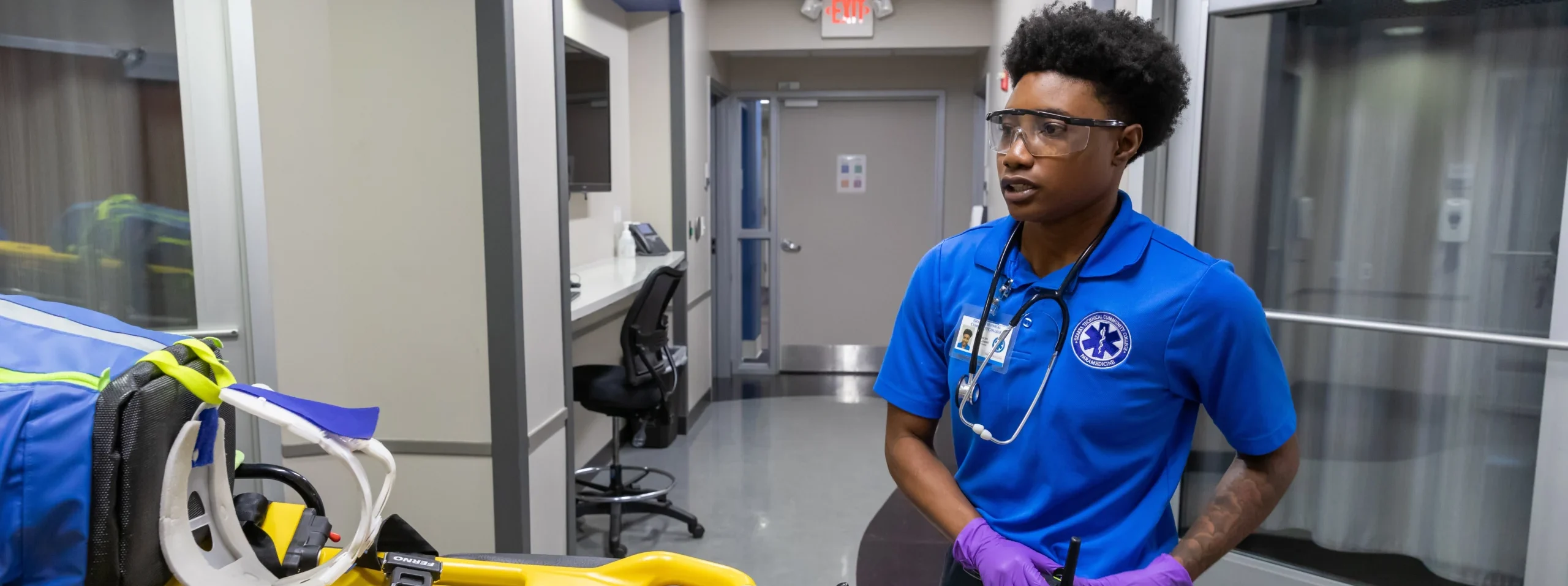
Hands-On Training in Life-Saving Skills
Start a career providing advanced life-saving care as a paramedic. Paramedics work as a part of a team to make quick decisions and provide first response care. At Ozarks Tech you gain the skills and confidence needed to save lives.
Grow your skill set through hands-on practice in clinics and field internships. You’ll practice:
-
Administering CPR or oxygen
-
Treating injuries
-
Performing advanced medical care
-
Collaborating with other emergency teams
After finishing the program, you’ll be ready to earn certification and apply for your license to practice in Missouri.
Program Information
Explore our accreditation information, find program contacts and learn more about how to apply for the program.
The Paramedicine program requires a separate application process in addition to the general Ozarks Tech admission process.
Paramedicine Candidate Selection Form
Application Requirements and Information
General Admissions to Ozarks Tech
Admission to Ozarks Technical Community College is open to all individuals who can benefit from its educational programs. A focus of the college mission is on the academic, career and personal goals of the student. OTC may admit you as a First-Time student just completing their high school, GED or HiSET requirements or as a Transfer student coming from another institution finishing up a certificate or degree. For more information, visit OTC Admissions.
Wondering how you’re going to pay for college? At OTC, we believe that cost shouldn’t be a barrier to earning a degree. Our staff will work with you to make a financial plan. To browse the resources available to you, see paying for college.
At Ozarks Tech, we want your transfer process to be easy. We accomplish this goal through articulation agreements. These agreements are an official partnership to match coursework between schools. This gives you a more seamless transition from Ozarks Tech to a four-year institution.
We have established an agreement for this program. This will simplify the transfer of your credits to partner schools. To understand how this degree will transfer, review the current articulation agreements. Be sure to consult with your transfer school to ensure you’re on the right path toward completing your four-year degree.
The Ozarks Technical Community College Paramedic Program is accredited by the Commission on Accreditation of Allied Health Education Programs (www.caahep.org) upon the recommendation of the Committee on Accreditation of Educational Programs for the Emergency Medical Services Professions (CoAEMSP).
Commission on Accreditation of Allied Health Education Programs
9355 113 St. N,
#7709
Seminole, FL 33775
www.caahep.org
Commission on Accreditation of Educational Programs for the EMS Professions (CoAEMSP)
8301 Lakeview Parkway, Suite 111-312
Rowlett, TX 75088
(214) 703-8445
coaemsp.org
OTC is accredited by the Higher Learning Commission (hlcommission.org), an accreditation agency recognized by the U.S. Department of Education. Our current accreditation status with the HLC is displayed on the page linked below. Our next comprehensive evaluation will be in 2030-2031. View more on OTC Accreditation.
Mission Statement
To prepare competent entry-level paramedics and support them with high-quality continuing education and career advancement opportunities.
Program Outcomes
NREMT Paramedic Pass Rate
- 2020: 100%
- 2021: 100%
- 2022: 100%
- 2023: 100%
- 2024: 96%
Paramedic Program Retention
- 2020: 71%
- 2021: 89.5%
- 2022: 47%
- 2023: 70%
- 2024: 92.6%
Paramedic Positive Job Placement
- 2020: 100%
- 2021: 100%
- 2022: 100%
- 2023: 100%
- 2024: 96%
Joe McTaggart
Paramedicine Program Director
417-447-7858
The paramedicine programs advisory committee brings prospective and insight to the Paramedicine and EMT programs, keeping courses content consistent with current practices in the field.
- Dr. Tom Lewis – Medical Director
Get Involved
Get connected with other students and find support throughout the program.
The Student Paramedicine Association (SPA) is a student group of aspiring EMTs and paramedics who participate in community service, educate the public about the profession and work to enhance the experience of Ozarks Tech Paramedicine students.
Looking for something a little different?
Check out similar programs that might be the right fit for you.
Emergency Medical Technician (EMT) Certificate
Course Information
Discover overview information, course sequences and specific course descriptions. Or, view the full catalog to see all the details.
Paramedicine (A.A.S.)
Program Length: 2 Years
Location: Springfield Campus, Table Rock Campus
A.A.S Degree: 64 Hours
The Paramedic is an allied health professional whose primary focus is to provide advanced emergency medical care for critical and emergent patients who access the emergency medical system. This individual possesses the complex knowledge and skills necessary to provide patient care and transportation. Paramedics function as part of a comprehensive EMS response, under medical oversight. Paramedics perform interventions with the basic and advanced equipment typically found on an ambulance. The Paramedic is a link from the scene into the health care system.
This is a selective admission program that requires a valid EMT license.
An application packet is available online or by contacting the EMS department at [email protected]. Please see faculty members for further advisement.
Missouri Department of Health and Senior Services, Bureau of Emergency Medical Services, PO Box 570, Jefferson City, MO 65102, (573) 751-6356 https://health.mo.gov/safety/ems/
This program is accredited by the Committee on Accreditation of Education Programs for the EMS Professions (CoAEMSP), 8301 Lakeview Parkway, Suite 111-312, Rowlett, TX 75088, (214) 703-8445 https://coaemsp.org/
This program is accredited by the Commission on Accreditation of Allied Health Education Program (CAAHEP), 9355 – 113th St. N, #7709, Seminole, FL 33775 727.210.2350 https://www.caahep.org/
Paramedicine Certificate
Program Length: 1 Year
Location: Springfield Campus, Table Rock Campus
Certificate: 52 Hours
The Paramedic is an allied health professional whose primary focus is to provide advanced emergency medical care for critical and emergent patients who access the emergency medical system. This individual possesses the complex knowledge and skills necessary to provide patient care and transportation. Paramedics function as part of a comprehensive EMS response, under medical oversight. Paramedics perform interventions with the basic and advanced equipment typically found on an ambulance. The Paramedic is a link from the scene into the health care system.
This is a selective admission program that requires a valid EMT license.
An application packet is available online or by contacting the EMS department at [email protected]. Please see faculty members for further advisement.
Missouri Department of Health and Senior Services, Bureau of Emergency Medical Services , PO Box 570, Jefferson City, MO 65102, (573) 751-6356 https://health.mo.gov/safety/ems/
This program is accredited by the Committee on Accreditation of Education Programs for the EMS Professions (CoAEMSP), 8301 Lakeview Parkway, Suite 111-312, Rowlett, TX 75088, (214) 703-8445 https://coaemsp.org/
This program is accredited by the Commission on Accreditation of Allied Health Education Program (CAAHEP), 9355 – 113th St. N, #7709, Seminole, FL 33775 727.210.2350 https://www.caahep.org/
Paramedicine – Community Paramedic Certificate of Specialization
Program Length: Less than one year
Location: Springfield Campus
Certificate of Specialization: 15 Hours
This program is designed to educate the student in aspects of community based care required to qualify the student to write the CP-C certification examination offered by the International Board of Specialty Certification. The certificate of specialization consists of two components: classroom and clinical experiences. Incorporated in these areas are the pre-hospital environment, community and personal needs assessment, chronic disease monitoring and interventions, utilization and coordination of community health and social services.
Applicants to this program must be a currently licensed paramedic.
Paramedicine – Critical Care Transport Certificate of Specialization
Program Length: Less than one year
Location: Springfield Campus, Table Rock Campus
Certificate of Specialization – 15 Hours
The Critical Care Transport program is designed to prepare students to provide (ICU)-level care during transport of various types of critically ill patients. A broad base of emergency and critical care physiology, pathophysiology, pharmacology, and treatments will be covered as well as advanced skills that would be above and beyond the normal scope of a paramedic. Fundamentals of flight transport, CAMTS requirements, and flight physiology will also be covered. It is expected that students who successfully complete this course will test for and obtain certification as a critical care paramedic or flight paramedic. The certification will come from a national or international certifying body.
More Tools for Finding Your Path
Notices & Disclaimers
*Costs displayed are based on current tuition and fee rates for the program’s required credit hours, as approved by the OTC Board of Trustees, and are subject to change without notice. Estimates reflect both in-district and out-of-district residency rates. Actual costs, degree completion time, and credit requirements may vary based on residency, prior credits, elective courses, program updates, and enrollment factors. For additional information on attendance costs, visit Cost of Attendance, tuition and fees or contact us at 417-447-6900.
**Graduation rates vary by individual. For details on program enrollment, retention, exam/certification, and employment rates, visit Student Outcomes / Student Right-to-Know. Some careers on this list may require additional education and training. For program-specific accreditation visit OTC Accreditation.