
Chart Your Course to a Future in Nursing
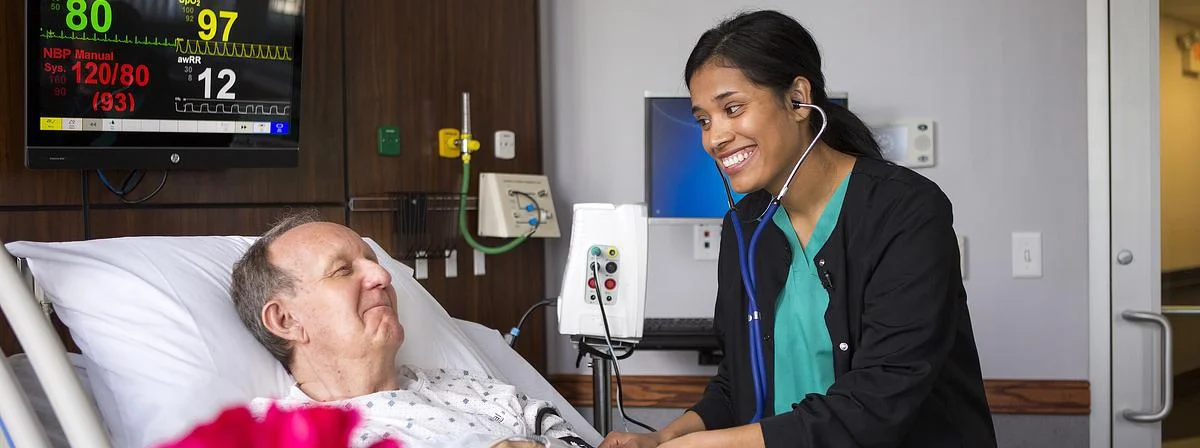
Kickstart your nursing career at Ozarks Tech! You’ll build skills to work as a licensed practical nurse (LPN) in a variety of health care settings. LPNs provide direct patient care under the guidance of a registered nurses (RN), advanced practice nurse (APRN), or physician. Your courses focus on hands-on care. You’ll practice essential career skills like:
-
Administering medication
-
Checking patients’ vital signs
-
Helping patients get dressed
-
Maintaining documentation and reports
-
Collaborating with the healthcare team
Realistic labs and hands-on clinical experiences help you build and practice your skills. Find roles working in a variety of health care settings including hospitals, nursing homes, home health, schools and more!
All three Practical Nursing programs are fully approved by the Missouri State Board of Nursing.
Program Information
Explore our accreditation information, find program contacts and learn more about how to apply for the program.
The Practical Nursing Program is a selective admission program determined by a points-based system.
Application Requirements and Information
General Admissions to Ozarks Tech
Admission to Ozarks Technical Community College is open to all individuals who can benefit from its educational programs. A focus of the college mission is on the academic, career and personal goals of the student. OTC may admit you as a First-Time student just completing their high school, GED or HiSET requirements or as a Transfer student coming from another institution finishing up a certificate or degree. For more information, visit OTC Admissions.
Wondering how you’re going to pay for college? At OTC, we believe that cost shouldn’t be a barrier to earning a degree. Our staff will work with you to make a financial plan. To browse the resources available to you, see paying for college.
At Ozarks Tech, we want your transfer process to be easy. We accomplish this goal through articulation agreements. These agreements are an official partnership to match coursework between schools. This gives you a more seamless transition from Ozarks Tech to a four-year institution.
We have established an agreement for this program. This will simplify the transfer of your credits to partner schools. To understand how this degree will transfer, review the current articulation agreements. Be sure to consult with your transfer school to ensure you’re on the right path toward completing your four-year degree.
Dr. Kristy Conner
Practical Nursing Program Director – Springfield Campus
417-447-8847
Dr. Kristall Fears
Practical Nursing Program Director – Table Rock Campus
417-447-2643
Tracie Liska
Practical Nursing Program Director – Lebanon Center
417-447-6609
Accreditation
All three Practical Nursing programs are fully approved by the Missouri State Board of Nursing.
Mission Statement
The mission of the Practical Nursing Program is to provide educational opportunities to individuals that benefit the society and community in which they practice by promoting the health and well-being of all individuals.
Philosophy
The faculty is dedicated to educating students in entry-level skills to succeed in the field of practical nursing. Belief in the integrity and worth of all human beings is the basic philosophy of the Practical Nursing program. Each person is viewed as an individual with unique characteristics and behavior. All persons have common basic needs and roles within the context of society which includes family and community. Nursing is a health profession concerned with promoting the quality of life of individuals and families. Practical Nursing is accountable to society and is characterized by a commitment to practice within ethical, legal, and professional standards.
Learning is a complex, mutual progression of growth and development, identified by changes in the behavior of the learner. Critical thinking is a necessary component of nursing and must be fostered in students and integrated throughout the curriculum. Learning is facilitated in a supportive environment. Students must assume responsibility for their own professional development and personal growth.
OTC is accredited by the Higher Learning Commission (hlcommission.org), an accreditation agency recognized by the U.S. Department of Education. Our current accreditation status with the HLC is displayed on the page linked below. Our next comprehensive evaluation will be in 2030-2031. View more on OTC Accreditation.
Program Outcomes
Upon completion of the curriculum and practicum provided in the Practical Nursing program, the student will demonstrate the achievement of the program’s graduate competencies:
- Provide safe nursing care for all clients in a variety of healthcare settings.
- Utilize the nursing clinical judgment model to implement and prioritize client needs.
- Communicate in a purposeful and facilitative manner with the client, family, and members of the healthcare team.
- Demonstrate professional behavior by practicing within the ethical and legal framework of nursing. (Revised 2024)
Find Your Community
Getting involved is a great way to build connections and find your community on campus. With a variety of clubs and organizations and campus events it’s easy to find your people.
Interested in learning more?
Watch an informational session! Applicants are encouraged to watch a nursing advising session to learn more about the program and the application process.
Course Information
Discover overview information, course sequences and specific course descriptions. Or, view the full catalog to see all the details.
Nursing—Practical Nursing Certificate
Certificate: 49 Hours
All three Practical Nursing programs are fully approved by the Missouri State Board of Nursing and offered in a hybrid course delivery option. A grade of “C” or better is required for all Practical Nursing Program required courses. Graduates receive a certificate and are eligible to apply to the Missouri State Board of Nursing for permission to write the NCLEX-PN exam and become licensed as a Practical Nurse. Employment options for graduates include long-term skilled care, hospital acute care, home health care, doctors’ offices and clinics, hospice, or industrial nursing. Graduates may also use a Practical Nursing Certificate as a stepping stone to further their education and progress to an Associate of Science in Nursing degree.
Students may take the “Program Specific Courses” only after they have been admitted into the program. A separate application process is required for acceptance into this program. Refer to the “Application Information” tab on the program website, at https://academics.otc.edu/lpn/ for admissions requirements. Complete application information can be obtained on the OTC web site or from the Health Sciences office. A new class begins each fall and spring semester at the Springfield campus, each fall semester at the Table Rock campus, and each spring at the Lebanon center.
MO State Board of Nursing, PO Box 656, Jefferson City, MO 65102, (573) 751-0681 https://www.pr.mo.gov/nursing.asp
Pre-Admission Requirements – 17 Credit Hours
Note: Contact the Health Sciences Office if BCS 165 and BCS 205 have been completed more than five years ago.
- BCS 132: Health Sciences Nutrition
Health Sciences Nutrition
This course is a survey of human nutrition for Pre-Health Sciences students. Students will study the different nutrients found in food, food grouping systems, the human digestive system, body weight maintenances, immunity and disease prevention, nutrition through lifespan, and food processing technology. Students will also study the different dietary requirements for disease treatment.
- BCS 165: Human Anatomy *
Human Anatomy
Microscopic and macroscopic examination of the human body structures and systems are the focus of this course. Students evaluate the integration of the various systems within the entire body. The laboratory provides an opportunity for identification and evaluation of representative human models and slides and dissection of comparable mammalian organ systems.
- BCS 205: Human Physiology *
Human Physiology
This course examines the organization and function of the human body as a whole and the interrelationships of the various systems. The laboratory teaches the fundamental techniques necessary for the study of life processes. Laboratory activities give the students an opportunity to illustrate principles presented in lecture.
Prerequisite(s): Grade of "C" or better in BCS 165. - ENG 101: Composition I
Composition I
This course introduces students to college-level reading, thinking, and writing through a series of composition-rhetoric assignments and activities that culminate in a research-supported project. Specifically, students apply critical and creative thinking to evaluate problems, interpret evidence/data, and draw conclusions. As part of this process, students learn to evaluate sources and emerging digital tools for currency, feasibility, truthfulness, credibility, and accuracy. Ultimately, students learn to synthesize knowledge to solve problems. This writing process (thinking, researching, evaluating, and persuading) helps students to develop an essential skill set they can use in their future academic, civic, and professional lives.
or - ENG 100: Composition I With Support
Composition I With Support
This course introduces students to college-level reading, thinking, and writing through a series of composition-rhetoric assignments and activities that culminate in a research-supported project. Specifically, students apply critical and creative thinking to evaluate problems, interpret evidence/data, and draw conclusions. As part of this process, students learn to evaluate sources and emerging digital tools for currency, feasibility, truthfulness, credibility, and accuracy. Ultimately, students learn to synthesize knowledge to solve problems. This writing process (thinking, researching, evaluating, and persuading) helps students to develop an essential skill set they can use in their future academic, civic, and professional lives. English 100 will be driven by the same course objectives as English 101 and satisfy the same requirement.
- ENG 101: Composition I
- PSY 110: Introduction to Psychology
Introduction to Psychology
This course provides an introduction to psychology including history and systems, physiology, human growth and development, sensation and perception, learning, memory, emotion, motivation, personality, adjustment, psychopathology, industrial and social psychology.
Nursing – Practical Nursing Program Requirements – 32 Credit Hours
- NUR 105: Personal Voc Concepts I
Personal Voc Concepts I
This course serves as part one of an introduction to nursing by covering the history of nursing, nursing roles, and the health care delivery system. Emphasis is placed on how to be a self-directed learner by assisting the student with comprehension of nursing concepts as well as methods for successful testing in nursing school. Content areas include nursing history, therapeutic communication, the NCSBN clinical judgment model, and the role fo the practical nurse in developing patient care plans.
Prerequisite(s): Admission to the Practical Nursing program. - NUR 115: Personal Voc Concepts II
Personal Voc Concepts II
This course continues the introduction to nursing by covering additional topic areas relevant to the role of the nurse. These topics include ethics and legalities in nursing, professional accountability, appreciation of cultural and religious diversity and health education of the client. It also emphasizes the clinical judgment and nursing process material learned in part I of the course.
Prerequisite(s): Grade of "C" or better in NUR 105 and NUR 110. - NUR 110: Fundamentals of Nursing I
Fundamentals of Nursing I
This course introduces the fundamental principles, basic skills and attitudes necessary to care for clients who are experiencing alterations of health throughout the lifespan. This course prepares the student to perform skills in the nursing laboratory and at the beginning levels of nursing in the clinical area. It is the foundation of nursing education.
Prerequisite(s): Admission to the Practical Nursing program. - NUR 120: Fundamentals of Nursing II
Fundamentals of Nursing II
This course introduces involved principles, skills, and attitudes necessary for clients who are experiencing alterations of health throughout the lifespan. This course prepares the student to perform more intensive skills in the nursing laboratory and at the beginning levels of nursing in the clinical area.
Prerequisite(s): Grade of "C" or better in NUR 105 and NUR 110. - NUR 205: Adult Medical-Surgical I
Adult Medical-Surgical I
This course presents information regarding disorders of the cardiac, respiratory, hematological, musculoskeletal, integument, renal systems and the surgical client. This course provides the student with the opportunity to apply nursing knowledge in the clinical setting. Geriatrics, nutrition, diet therapy, pharmacologic and psychosocial aspects are integrated.
Prerequisite(s): Grade of "C" or better in NUR 115 and NUR 120. - NUR 215: Adult Med Sur II-I.V. Therapy
Adult Med Sur II-I.V. Therapy
This course presents information regarding disorders of the gastrointestinal, endocrine, neurological, sensory, immune, reproductive systems and the client with an IV infusion. This course provides the student with the opportunity to apply nursing knowledge in the clinical setting. Geriatrics, nutrition, diet therapy, pharmacologic and psychosocial aspects are integrated.
Prerequisite(s): Grade of "C" or better in NUR 205. - NUR 225: Maternal and Pediatric Nursing
Maternal and Pediatric Nursing
This course involves the study of nursing care of mother and infant during antepartal, intrapartal and postpartal periods. The pathophysiology of common diseases of children is included. Nutrition, pharmacology and the nursing process are integrated throughout the course. The clinical component gives the student opportunity to incorporate the theory into practice.
Prerequisite(s): Grade of "C" or better in NUR 215 and NUR 240. - NUR 230: Community/Mental Health Nur
Community/Mental Health Nur
This course covers community nursing and emphasizes wellness, prevention and teaching of good health. It will also lead to a development of knowledge and skills necessary to provide basic mental health nursing care to patients who demonstrate common mental problems. Maintenance and restoration of health is included. Pharmacological aspects are integrated.
Prerequisite(s): Grade of "C" or better in NUR 215 and NUR 240. - NUR 240: Management
Management
This course involves the discussion of various leadership styles and techniques, not only as an individual, but as a team leader. It emphasizes the student’s need for a variety of management skills, as the graduate prepares to work with the interdisciplinary needs of patient, family and staff. Guidelines for effective resumes, job interviews and the preparation for the NCLEX comprise the other areas of concern of this course.
Prerequisite(s): Grade of "C" or better in NUR 205.
Locations Offered:
More Tools for Finding Your Path
Notices & Disclaimers
*Costs displayed are based on current tuition and fee rates for the program’s required credit hours, as approved by the OTC Board of Trustees, and are subject to change without notice. Estimates reflect both in-district and out-of-district residency rates. Actual costs, degree completion time, and credit requirements may vary based on residency, prior credits, elective courses, program updates, and enrollment factors. For additional information on attendance costs, visit Cost of Attendance, tuition and fees or contact us at 417-447-6900.
**Graduation rates vary by individual. For details on program enrollment, retention, exam/certification, and employment rates, visit Student Outcomes / Student Right-to-Know. Some careers on this list may require additional education and training. For program-specific accreditation visit OTC Accreditation.
