Start Your Career: By the Numbers
Apply To This ProgramSmall class sizes allow you to build strong relationships with your instructors.
Learn from instructors with experience navigating the challenges of the field.
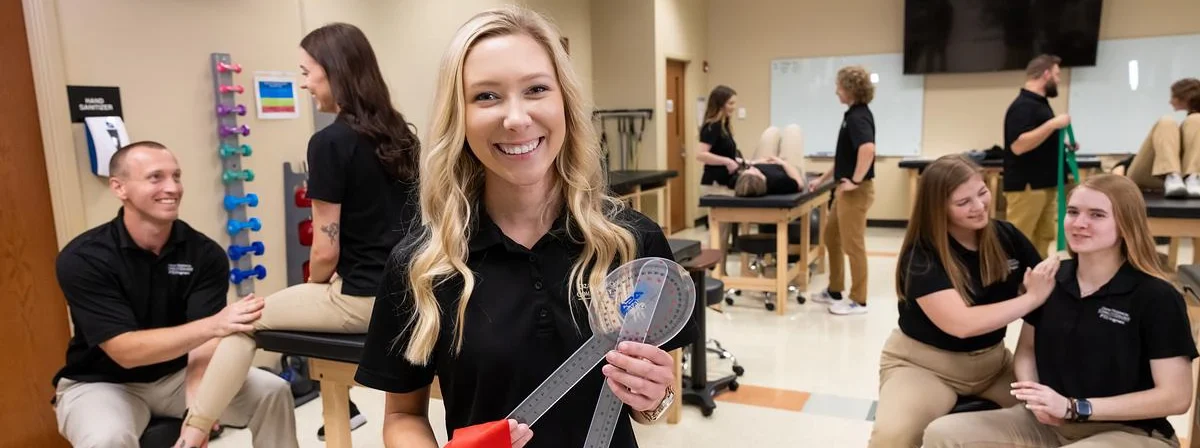
Hands-On Training for Healing
Help clients regain strength and mobility as a physical therapist assistant (PTA). As a PTA you can support patients as restore movement, manage pain and improve physical function.
PTAs work under the direction of a physical therapist to guide patients through treatment. You may assist by:
-
Helping patients follow the treatment plan designed by the physical therapist
-
Guiding patients and families through safe and effective treatment plans
-
Measuring and tracking progress to show improvement
-
Documenting each session to record treatment and results
At Ozarks Tech, you build practical skills through your classes, lab work and clinical experiences. These experiences help you prepare for the National Physical Therapy Exam (NPTE-PTA), which you must pass to earn your license.
Ozarks Tech graduates have earned a 100% pass rate on the exam for the past two years. This strong record shows you can feel confident as you prepare for the exam and begin your career.
The Physical Therapist Assistant Program at Ozarks Technical Community College is accredited by the Commission on Accreditation in Physical Therapy Education (CAPTE).
Program Information
Explore our accreditation information, find program contacts and learn more about how to apply for the program.
The Physical Therapist Assistant program is a selective admission program.
Application Requirements and Information
General Admissions to Ozarks Tech
Admission to Ozarks Technical Community College is open to all individuals who can benefit from its educational programs. A focus of the college mission is on the academic, career and personal goals of the student. OTC may admit you as a First-Time student just completing their high school, GED or HiSET requirements or as a Transfer student coming from another institution finishing up a certificate or degree. For more information, visit OTC Admissions.
Wondering how you’re going to pay for college? At OTC, we believe that cost shouldn’t be a barrier to earning a degree. Our staff will work with you to make a financial plan. To browse the resources available to you, see paying for college.
At Ozarks Tech, we want your transfer process to be easy. We accomplish this goal through articulation agreements. These agreements are an official partnership to match coursework between schools. This gives you a more seamless transition from Ozarks Tech to a four-year institution.
We have established an agreement for this program. This will simplify the transfer of your credits to partner schools. To understand how this degree will transfer, review the current articulation agreements. Be sure to consult with your transfer school to ensure you’re on the right path toward completing your four-year degree.
Niki Wallen
PTA Program Director
417-447-7973
Accreditation
The Physical Therapist Assistant Program at Ozarks Technical Community College is accredited by the Commission on Accreditation in Physical Therapy Education (CAPTE), 3030 Potomac Ave., Suite 100, Alexandria, Virginia 22305-3085; telephone: 703-706-3245; email: [email protected]; website: http://www.capteonline.org. If needing to contact the program/institution directly, please call 417-447-7873 or email [email protected].
Ozarks Technical Community College PTA Program — Academic Year Ending 2025
| Year | 1st time Pass Rate | Ultimate Pass Rate | Graduation Rate | Employment Rate |
|---|---|---|---|---|
| 2025 | 94.7% | 100% | 82.61% | 100% |
| 2024 | 90% | 100% | 89.47% | 100% |
| 2 Year Avg. | 92.35% | 100% | 86.04% | 100% |
Ozarks Technical Community College PTA Program — Academic Year Ending 2024
| Year | 1st time Pass Rate | Ultimate Pass Rate | Graduation Rate | Employment Rate |
|---|---|---|---|---|
| 2024 | 90% | 100% | 89.47% | 100% |
| 2023 | 100% | 100% | 77.3% | 100% |
| 2 Year Avg. | 95% | 100% | 83.38% | 100% |
Ozarks Technical Community College PTA Program — Academic Year Ending 2023
| Year | 1st time Pass Rate | Ultimate Pass Rate | Graduation Rate | Employment Rate |
|---|---|---|---|---|
| 2023 | 100% | 100% | 77.3% | 100% |
| 2022 | 100% | 100% | 77.27% | 100% |
| 2 Year Avg. | 100% | 100% | 80.73% | 100% |
Licensure Exam Pass Rate:
1st Attempt Rate: This is the 1st attempt pass rate as published by the Federation of State Boards of Physical Therapy.
Ultimate Pass Rate: This rate is the ultimate pass rate as published by the Federation of State Boards of Physical Therapy.
Graduation Rate: This rate is calculated according to the CAPTE formula required in the AAR.
Employment Rate: This rate is the % of graduates who were employed as PTAs within twelve months of passing the licensure examination and is current as of 9/30/2025.
Interested in learning more?
Join us for an informational session! Ask questions and learn more about the program. Sessions are offered in an online format.
Looking for something a little different?
Check out similar programs that might be the right fit for you.
Occupational Therapy Assistant
Course Information
Discover overview information, course sequences and specific course descriptions. Or, view the full catalog to see all the details.
Physical Therapist Assistant (A.A.S.)
A.A.S. Degree: 72 Hours
The Physical Therapist Assistant program is designed to prepare graduates to serve as an essential member of a PT/PTA team in a variety of health care settings. A new class of 24 students begins each spring semester and graduates in May (17 months later). A separate application process is required for acceptance into this program.
The limited and selective admission phase of the program begins in Semester III after successful completion of the required general education courses. Through didactic, laboratory, and clinical education components, students will have the opportunity to develop the knowledge and skills necessary to function in the health care delivery system under the direction and supervision of a physical therapist. Students may enroll in the “Program Specific Courses” (those labeled as PTA) only if they have been admitted into the program. Students admitted into the PTA program are required to adhere to strict program attendance and professional behavior standards in order to participate, progress, and graduate from the PTA program.
Graduates of this accredited PTA program are eligible to apply to sit for the national licensing examination. After successful completion of this examination, the individual will be a licensed physical therapist assistant (PTA).
A grade of “C” or better is required for all PTA Program required courses.
The Physical Therapist Assistant Program at Ozarks Technical Community College is accredited by the Commission on Accreditation in Physical Therapy Education (CAPTE), 3030 Potomac Ave., Suite 100, Alexandria, Virginia 22305-3085; telephone: 800-999-2782; email: [email protected]; website: http://www.capteonline.org. If needing to contact the program/institution directly, please call 417-447-7873 or email [email protected]
Pre-Admission Requirements – 23 Credit Hours
- BCS 165: Human Anatomy *
Human Anatomy
Microscopic and macroscopic examination of the human body structures and systems are the focus of this course. Students evaluate the integration of the various systems within the entire body. The laboratory provides an opportunity for identification and evaluation of representative human models and slides and dissection of comparable mammalian organ systems.
- BCS 205: Human Physiology *
Human Physiology
This course examines the organization and function of the human body as a whole and the interrelationships of the various systems. The laboratory teaches the fundamental techniques necessary for the study of life processes. Laboratory activities give the students an opportunity to illustrate principles presented in lecture.
Prerequisite(s): Grade of "C" or better in BCS 165. - COM 100: Introduction to Communication
Introduction to Communication
This course provides an introduction to the study of communication, including interpersonal communication, small group dynamics, and public speaking.
or - COM 105: Public Speaking
Public Speaking
This is an introductory course in research, composition, delivery, and evaluation of speeches for a variety of purposes and occasions. Students develop skills in critical listening and analysis through small group and individual activities.
- COM 100: Introduction to Communication
- ENG 101: Composition I
Composition I
This course introduces students to college-level reading, thinking, and writing through a series of composition-rhetoric assignments and activities that culminate in a research-supported project. Specifically, students apply critical and creative thinking to evaluate problems, interpret evidence/data, and draw conclusions. As part of this process, students learn to evaluate sources and emerging digital tools for currency, feasibility, truthfulness, credibility, and accuracy. Ultimately, students learn to synthesize knowledge to solve problems. This writing process (thinking, researching, evaluating, and persuading) helps students to develop an essential skill set they can use in their future academic, civic, and professional lives.
or - ENG 100: Composition I With Support
Composition I With Support
This course introduces students to college-level reading, thinking, and writing through a series of composition-rhetoric assignments and activities that culminate in a research-supported project. Specifically, students apply critical and creative thinking to evaluate problems, interpret evidence/data, and draw conclusions. As part of this process, students learn to evaluate sources and emerging digital tools for currency, feasibility, truthfulness, credibility, and accuracy. Ultimately, students learn to synthesize knowledge to solve problems. This writing process (thinking, researching, evaluating, and persuading) helps students to develop an essential skill set they can use in their future academic, civic, and professional lives. English 100 will be driven by the same course objectives as English 101 and satisfy the same requirement.
or - ENG 102: Composition II
Composition II
This course continues developing students’ abilities to use research and writing to make informed and ethical arguments; effectively communicating these arguments to professional and expert audiences in a research-supported project. Moreover, the course further develops students’ skills in critical and creative thinking to evaluate problems, interpret evidence/data, and draw conclusions.
Emphasis is placed on honing skills of audience analysis, analytical reading, problem solving, research methods—including both primary and secondary research—and persuasive writing. Also, this course will acquaint students with patterns and conventions of multiple disciplinary communities. This writing process (thinking, researching, evaluating, and applying rhetorical strategy) prepares students for their academic and professional futures.
Prerequisite(s): ENG 100 or ENG 101.
- ENG 101: Composition I
- MTH 128: Contemporary Mathematics *
Contemporary Mathematics
This course provides students with a basic survey of mathematics. Topics include problem solving, modeling, counting methods, probability, statistics and geometry.
(or higher)
- PLS 101: American Government and Politics
American Government and Politics
This introductory course familiarizes students with American and Missouri government constitutions, institutions, policies and processes. Students develop an understanding of the foundations, environment, and principles of democracy with key concepts about voting, political parties, campaigns, and interactions between the branches of government. The course emphasis is on the values, rights, and responsiblities that shape public decision making of active and informed citizens in the American political system. This course meets instruction requirements (Missouri Revised Statute 170.011.1) in the Constitution of the United States and the state of Missouri.
or - HST 120: U.S. History I: to 1865
U.S. History I: to 1865
This course is a survey of the history of the United States from pre-Columbian societies through the Civil War, including formative political, social, economic and cultural developments. It also introduces students to history as an academic discipline and requires analysis, synthesis and evaluation of primary and secondary materials in reading, discussion and writing. HST 120 will satisfy the Missouri state law requiring instruction in the United States and Missouri Constitutions.
or - HST 130: U.S. History II: 1865-Present
U.S. History II: 1865-Present
This course is a survey of the history of the United States from Reconstruction to the present, covering the political, economic, social and cultural developments that have shaped modern America. It introduces students to history as an academic discipline and requires analysis, synthesis and evaluation of primary and secondary materials in reading, discussion and writing. HST 130 will satisfy the Missouri state law requiring instruction in the United States and Missouri Constitutions.
- PLS 101: American Government and Politics
- PSY 110: Introduction to Psychology
Introduction to Psychology
This course provides an introduction to psychology including history and systems, physiology, human growth and development, sensation and perception, learning, memory, emotion, motivation, personality, adjustment, psychopathology, industrial and social psychology.
Physical Therapist Assistant Program Requirements – 49 Credit Hours
- BCS 210: Pathophysiology
Pathophysiology
This survey course studies the changes in normal anatomy and physiology of the human body. Disease processes are studied and the disruption of homeostasis is emphasized. Also included is the correlation between the pathology of the disease process and clinical signs and symptoms of the disease.
Prerequisite(s): Grade of "C" or better in BCS 165 and BCS 200 and BCS 205.(must be completed prior to semester IV of program) * - PTA 100: Introduction to Physical Therapist Assistant
Introduction to Physical Therapist Assistant
This course is offered to Physical Therapist Assistant students in the A Block of the 1st Spring Semester of the Technical Education component of the PTA program. PTA 100, Introduction to PTA, provides an introduction to the role and scope of practice of the Physical Therapist Assistant. Emphasis will be on educational preparation, historical overview of physical therapy in the healthcare system, professional affiliations, structure and function of physical therapy services, ethical and legal issues in healthcare, the demographics of function and visibility, and an introduction to a self-study program in medical terminology. Additionally, the course will provide an introduction to the concept of individual differences, communication skills, psychology of disability, and professional behavior within the healthcare delivery system.
Prerequisite(s): Admission to the PTA program. - PTA 155: Anatomy for the PTA
Anatomy for the PTA
This course will be offered to Physical Therapist Assistant students in the A Block of the 1st Spring Semester of the Technical Education component of the PTA program. This course will focus on the systems that are required for human movement: skeletal system, articulations, muscular system, surface anatomy, nervous system, to include the central nervous system, peripheral nervous system, and autonomic nervous system.
Prerequisite(s): Admission to the PTA program. - PTA 225: Clinical Kinesiology
Clinical Kinesiology
The focus of this course includes principles of motion, body movements, muscle actions, and joint mechanics in relation to human movement. Principles of anatomical and biomechanical analysis as related to normal movement and modified by pathological conditions.
Prerequisite(s): Grade of "C" or better in PTA 100 and PTA 155. - PTA 200: Therapeutic Procedures
Therapeutic Procedures
This course provides an introduction to patient care activities, fundamentals of patient handling, data collection, infection control procedures, wound management and environmental safety as related to physical therapy.
Prerequisite(s): Grade of "C" or better in PTA 100, PTA 155, PTA 225, BCS 210. - PTA 220: Biophysical Agents/Thera Massage
Biophysical Agents/Thera Massage
This course is a study of the use of physical agents and therapeutic massage in the practice of physical therapy for the relief of pain and inflammation and the facilitation of motor function. The course includes techniques of application, indications, contraindications, precautions, and conditions for which treatment is provided.
Prerequisite(s): Grade of "C" or better in PTA 200. - PTA 230: Therapeutic Exercise
Therapeutic Exercise
This course provides an introduction of basic exercise principles and the application to musculoskeletal and cardiopulmonary conditions commonly encountered in physical therapy practice with discussion, demonstration and practice of therapeutic exercise interventions designed to improve musculoskeletal or cardiopulmonary function.
Prerequisite(s): Grade of "C" or better in PTA 200. - PTA 240: Neuro Conditions
Neuro Conditions
This course provides an introduction of therapeutic intervention strategies for patients with neurologic conditions commonly encountered in physical therapy practice. Discussion, demonstration and practice of therapeutic interventions and compensatory strategies for impaired function are included.
Prerequisite(s): Grade of "C" or better in PTA 200. - PTA 250: Clinical Education I
Clinical Education I
A four-week full-time supervised clinical experience at one health care facility, of which, there will be active student participation in patient care, consistent with the completed academic coursework.
Prerequisite(s): Grade of "C" or better in PTA 200. - PTA 270: Selected Topics
Selected Topics
This course is comprised of selected topics in physical therapy to complement prior course work and to respond to student and faculty (academic and clinical) identified requests for additional information. Clinical topics may include: advanced wound topics, chronic pain, orthotics, prosthetics and other contemporary issues encountered in physical therapy delivery systems.
- PTA 280: Clinical Education II
Clinical Education II
Full-time, supervised clinical experience at two separate health care facilities. The student will complete a variety of experiences to provide sufficient depth and breadth to meet the objectives of the course. Prior completion of academic coursework will allow integration of classroom and clinical experiences with the refinement of professional behaviors, assessment, communication, and treatment skills.
Frequently Asked Questions
No, we do not maintain a waiting list for qualified applicants.
The PTA program is very rigorous. Students should plan to study a minimum of 2 to 3 hours per week for every credit hour taken.
It is difficult to work while in the PTA program. The program is a full-time, daytime program with both morning and afternoon courses held Monday through Friday. The program conducts the courses in a seated format.
Locations Offered
More Tools for Finding Your Path
Notices & Disclaimers
*Costs displayed are based on current tuition and fee rates for the program’s required credit hours, as approved by the OTC Board of Trustees, and are subject to change without notice. Estimates reflect both in-district and out-of-district residency rates. Actual costs, degree completion time, and credit requirements may vary based on residency, prior credits, elective courses, program updates, and enrollment factors. For additional information on attendance costs, visit Cost of Attendance, tuition and fees or contact us at 417-447-6900.
**Graduation rates vary by individual. For details on program enrollment, retention, exam/certification, and employment rates, visit Student Outcomes / Student Right-to-Know. Some careers on this list may require additional education and training. For program-specific accreditation visit OTC Accreditation.
