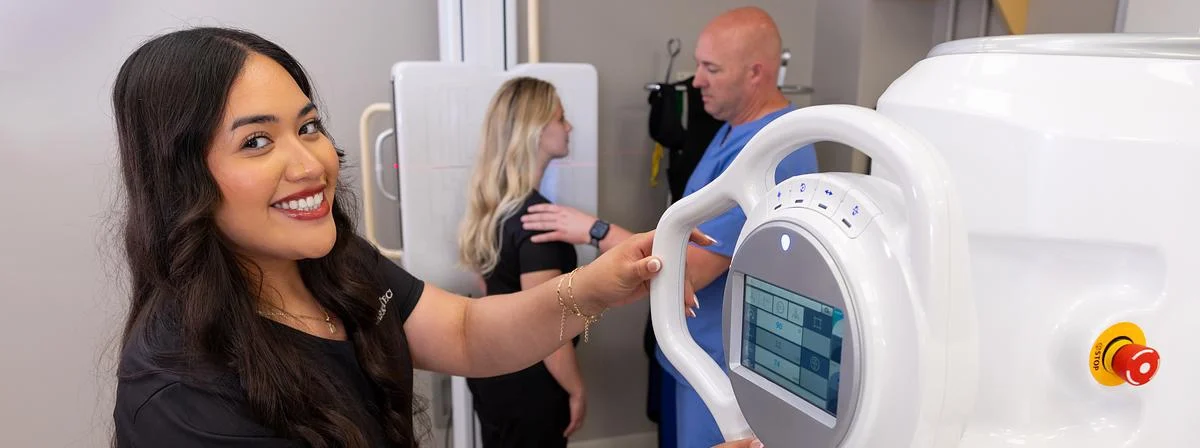
Radiologic Technologists use x-ray machines to take pictures of the inside of the body. These images help doctors find and treat health problems. At Ozarks Tech we train you for the duties and challenges of the career. As a technologist, you are responsible for operating advanced machines and making sure the images are clear and accurate.
You must provide excellent patient care and practice radiation safety. In addition to using technology, technologists spend time with patients. You will explain the imaging process, answer any questions, and help patients feel at ease. This makes it a great career if you enjoy working with both technology and people.
Explore the Radiography program at Ozarks Tech! Contact us today to begin your journey toward this exciting career.
Program Information
Explore our accreditation information, find program contacts and learn more about how to apply for the program.
The Radiography program is a selective, admission-based program. Courses are offered in a hybrid format with a combination of online and in-person courses. Students must complete pre-admission requirements and the below application criteria before they will be considered for admittance to the program. Please use the application checklist to find the requirements for admittance to this program.
Application Requirements and Information
- Radiography Job Shadowing Form
A minimum of four hours of job shadowing must be completed prior to applying for the program. The job shadowing form will be submitted along with the student’s application. - Candidate Selection Form
Selection into the program is based on a point system. Therefore, this form will allow you to track your accumulated points. - Immunization Requirements
Students will be requested at the time of acceptance to submit documentation for required immunizations and TB testing. - Criminal Background Check
For more details, please review the RAD Program Handbook.
General Admissions to Ozarks Tech
Admission to Ozarks Technical Community College is open to all individuals who can benefit from its educational programs. A focus of the college mission is on the academic, career and personal goals of the student. OTC may admit you as a First-Time student just completing their high school, GED or HiSET requirements or as a Transfer student coming from another institution finishing up a certificate or degree. For more information, visit OTC Admissions.
Wondering how you’re going to pay for college? At OTC, we believe that cost shouldn’t be a barrier to earning a degree. Our staff will work with you to make a financial plan. To browse the resources available to you, see paying for college.
At Ozarks Tech, we want your transfer process to be easy. We accomplish this goal through articulation agreements. These agreements are an official partnership to match coursework between schools. This gives you a more seamless transition from Ozarks Tech to a four-year institution.
We have established an agreement for this program. This will simplify the transfer of your credits to partner schools. To understand how this degree will transfer, review the current articulation agreements. Be sure to consult with your transfer school to ensure you’re on the right path toward completing your four-year degree.
To better understand transferring previous course work to Ozarks Tech, refer to 2.04 Transfer of Credit Policy, and to learn how your previous coursework may transfer, refer to Transferring Credits from Another College.
JRCERT Accreditation
The Ozarks Tech Radiography program applied for initial accreditation from the JRCERT in 2025. The program is expected to undergo its first accreditation site visit March of 2026.
Students who successfully complete the program will be eligible to take the ARRT national registry exam during this initial accreditation process.
The Ozarks Technical Community College’s A.A.S. in Radiography Program is seeking initial accreditation from the Joint Review Committee on Education in Radiologic Technology (JRCERT).
The program # is: 07033.
The Radiography program is accredited by the
Joint Review Committee on Education in Radiologic Technology
20 North Wacker Drive, Suite 2850
Chicago, IL 60606-3182
312-704-5300
Email: [email protected]
The program’s current award is: In the initial application phase. General program accreditation information and the current accreditation award letter can be found here.
Admission and Transfer of Credit Policies
Grading System
The Ozarks Tech radiography program uses the following grading scale, which is consistent with the other health science programs at the college.
- A = 100 – 90%
- B = 89 – 80%
- C = 79 – 75%
- D = 74 – 65%
- F = Less than 65%
Students must obtain a C (75%) or higher in all RAD courses to progress with their cohort, otherwise they must complete the return to program process.
The Ozarks Tech Radiography program is approved by the American Registry of Radiologic Technologists(ARRT), program #7767.
Student Learning Outcomes
-
Students will produce quality images and be able to evaluate their images for image quality accurately.
-
Students will be able to communicate effectively with the patient and other healthcare team members.
-
Students will be able to apply critical thinking skills by changing technical factors and adapt their patient care to the different scenarios encountered.
-
Students will demonstrate professionalism and ethical behavior.
-
Students will successfully pass coursework and pass the ARRT national registry exam on the first attempt.
-
Students will be able to perform effectively in a variety of settings within the imaging department.
-
Students will display proficiency and competency for an entry-level imaging professional.
Radiography students gain hands-on experience through approximately 750 hours of clinical rotations at hospitals, clinics, and imaging centers across the region. These rotations vary by semester and may include early mornings, evenings, weekends, or occasional long-distance travel. Students are expected to meet hour requirements tied to course credit and follow all site-specific policies, including dress codes and additional training. Program-specific scrubs, tracking tools, and supplies are required.
Program Mission
Core Values
-
Provide the adult learner with instruction that meets their individual and career needs
-
Use data to drive decisions and steer future development of the student and program
-
Use creativity, innovation, and critical thinking in methods of instruction
-
Develop positive and active members of the community
-
Encourage professional betterment
Goals and Objectives
-
To provide an educational experience in a scholarly classroom and diverse clinical environment to help the students reach their fullest potential in the development of their competency within the field of radiologic sciences.
-
Incorporation of interprofessional collaboration to develop active and knowledgeable healthcare team members.
-
Development of professional and critical thinking skills to be used in both routine and non-routine situations.
-
Provide students with the methodology for applying safe radiation practices for the patient and for the occupational worker.
-
Develop the student’s ability to critique their image and make proper adjustments as needed accurately.
-
Guide the students as they develop their communication skills with peers, patients, and other healthcare team members.
-
Shape the students in their ethical and professional growth.
Ready to expand your career options?
You can earn additional certifications for work in the imaging field. Learn more about what Ozarks Tech has to offer
Magnetic Resonance Imaging (MRI)
Unsure about paying for college?
With the lowest tuition in the region and multiple financial aid options Ozarks Tech has plenty of ways to make college more affordable.
Course Information
Discover overview information, course sequences and specific course descriptions. Or, view the full catalog to see all the details.
Radiography (A.A.S.)
A.A.S. Degree: 79 Hours
The Associates of Applied Science in Radiography is seeking the program’s initial accreditation from the Joint Review Committee on Education in Radiologic Technology (JRCERT). JRCERT, 20 N. Wacker Dr, Suite 2850, Chicago, IL 60606-3182. [email protected]. (312) 704-5300. Currently, the program is operating under its provisional accreditation, and the first site visit for accreditation will occur 12-18 months after students begin the program.
The program is designed to be completed over 28 months (about 2 and a half years), including 12 months of general education courses followed by core radiology courses over the last 16 months. The total credits required to earn the degree are a minimum of 79. The general education courses consist of at least 27 credit hours, and the core radiography courses consist of 52 credit hours.
The program is run in a cohort style, with cohorts beginning in the fall and spring of each year. Acceptance to the program requires a “C” or higher in all general education courses. All RAD pre-fixed courses must be completed with a “C” or higher.
The A.A.S.R.T. provides the student with the opportunity to complete approximately 800 hours of direct patient care experience caring for patients in a variety of clinical settings. Students perform clinical rotations, including level 1 trauma centers, rural hospital systems, outpatient imaging centers, urgent care centers, community health centers, inpatient hospitals, rehabilitation hospitals, surgery centers, and specialty clinics such as orthopedic and neurological centers.
The program’s didactic curriculum focuses on preparing the student to sit for the American Registry of Radiologic Technology (ARRT) national registry exam in radiography. This registry allows them to work as radiologic technologists across the country; please note that some states require additional licensures.
Pre-Admission Requirements – 27 Credit Hours
- BCS 165: Human Anatomy
Human Anatomy
Microscopic and macroscopic examination of the human body structures and systems are the focus of this course. Students evaluate the integration of the various systems within the entire body. The laboratory provides an opportunity for identification and evaluation of representative human models and slides and dissection of comparable mammalian organ systems.
- BCS 205: Human Physiology
Human Physiology
This course examines the organization and function of the human body as a whole and the interrelationships of the various systems. The laboratory teaches the fundamental techniques necessary for the study of life processes. Laboratory activities give the students an opportunity to illustrate principles presented in lecture.
Prerequisite(s): Grade of "C" or better in BCS 165. - CHM 101: Introductory Chemistry (or higher) or
Introductory Chemistry
This is an introductory course designed to study basic chemical principles. Topics include atomic structure, measurement, bonding, properties of gases, acids and bases, solutions, organic nomenclature, functional groups, carbohydrates, lipids, proteins, and nucleic acids. Laboratory activities give students the opportunity to demonstrate chemical principles presented in lecture.
- PHY 105: Introduction to Physics
Introduction to Physics
This course provides an introduction to basic physics. Students will apply the principles of mechanics, energy, waves, matter and atomic theory. Laboratory activities will give students the opportunity to demonstrate physics principles presented in lecture. A previous college level math course is recommended.
Prerequisite(s): Knowledge of algebra, scatter plot graphing, slope and equation of the line, scientific notation, and unit conversions is recommended. - ENG 101: Composition I
Composition I
This course introduces students to college-level reading, thinking, and writing through a series of composition-rhetoric assignments and activities that culminate in a research-supported project. Specifically, students apply critical and creative thinking to evaluate problems, interpret evidence/data, and draw conclusions. As part of this process, students learn to evaluate sources and emerging digital tools for currency, feasibility, truthfulness, credibility, and accuracy. Ultimately, students learn to synthesize knowledge to solve problems. This writing process (thinking, researching, evaluating, and persuading) helps students to develop an essential skill set they can use in their future academic, civic, and professional lives.
or - ENG 100: Composition I With Support
Composition I With Support
This course introduces students to college-level reading, thinking, and writing through a series of composition-rhetoric assignments and activities that culminate in a research-supported project. Specifically, students apply critical and creative thinking to evaluate problems, interpret evidence/data, and draw conclusions. As part of this process, students learn to evaluate sources and emerging digital tools for currency, feasibility, truthfulness, credibility, and accuracy. Ultimately, students learn to synthesize knowledge to solve problems. This writing process (thinking, researching, evaluating, and persuading) helps students to develop an essential skill set they can use in their future academic, civic, and professional lives. English 100 will be driven by the same course objectives as English 101 and satisfy the same requirement.
- ENG 101: Composition I
- HSC 120: Medical Terminology
Medical Terminology
This course introduces the basic word structure in medical terminology with an emphasis on word roots, prefixes, and suffixes using a body systems approach. Topics include conventional pathology, pharmacology, diagnostic and therapeutic procedures, surgical nomenclature, and abbreviations related to each body system. Includes applications and activities that reinforce word building, pronunciation, spelling, and medical terminology commonly used in healthcare.
- HST 120: U.S. History I: to 1865
U.S. History I: to 1865
This course is a survey of the history of the United States from pre-Columbian societies through the Civil War, including formative political, social, economic and cultural developments. It also introduces students to history as an academic discipline and requires analysis, synthesis and evaluation of primary and secondary materials in reading, discussion and writing. HST 120 will satisfy the Missouri state law requiring instruction in the United States and Missouri Constitutions.
or - HST 130: U.S. History II: 1865-Present
U.S. History II: 1865-Present
This course is a survey of the history of the United States from Reconstruction to the present, covering the political, economic, social and cultural developments that have shaped modern America. It introduces students to history as an academic discipline and requires analysis, synthesis and evaluation of primary and secondary materials in reading, discussion and writing. HST 130 will satisfy the Missouri state law requiring instruction in the United States and Missouri Constitutions.
or - PLS 101: American Government and Politics
American Government and Politics
This introductory course familiarizes students with American and Missouri government constitutions, institutions, policies and processes. Students develop an understanding of the foundations, environment, and principles of democracy with key concepts about voting, political parties, campaigns, and interactions between the branches of government. The course emphasis is on the values, rights, and responsiblities that shape public decision making of active and informed citizens in the American political system. This course meets instruction requirements (Missouri Revised Statute 170.011.1) in the Constitution of the United States and the state of Missouri.
- HST 120: U.S. History I: to 1865
- MTH 128: Contemporary Mathematics (or higher)
Contemporary Mathematics
This course provides students with a basic survey of mathematics. Topics include problem solving, modeling, counting methods, probability, statistics and geometry.
- PSY 110: Introduction to Psychology (or higher)
Introduction to Psychology
This course provides an introduction to psychology including history and systems, physiology, human growth and development, sensation and perception, learning, memory, emotion, motivation, personality, adjustment, psychopathology, industrial and social psychology.
Radiography Program Requirements – 52 Credit Hours
- RAD 211: Essentials & Pt Care in X-ray
Essentials & Pt Care in X-ray
This course provides the student with the concepts related to patient privacy and communication. The student will be instructed in the proper technique for collecting vital signs, preventing infection, and performing venipuncture. The student will be provided with instruction on medical emergencies, radiation protection, and MRI safety.
Prerequisite(s): Acceptance into the Radiography program. - RAD 212: Essentials & Pt Care Lab
Essentials & Pt Care Lab
In this course, the student will demonstrate the practical skills associated with the concepts related to patient care and the use of the radiologic equipment. Evaluation of their competency will be performed in different skills lab settings, or clinical settings.
Prerequisite(s): Acceptance into the Radiography program. - RAD 213: Radiographic Anatomy
Radiographic Anatomy
This course focuses on developing the student’s ability to identify the components of the skeletal system as it is displayed on the X-ray image. Students are introduced to basic abnormal pathologies that can be identified on the displayed images. Additional instruction provided will introduce the student to the respiratory, urinary, and gastrointestinal systems to prepare the student for additional course work.
Prerequisite(s): Acceptance into the Radiography program. - RAD 214: Radiographic Physics
Radiographic Physics
The course provides the student with the principles of radiation physics, with emphasis on the creation of the x-ray beam and its quality and target interactions. Explanations are given on how x-rays interact with the body and their effects of radiation on the tissues. This instruction allows the student to build on the knowledge of how to provide protection for the patient and staff.
Prerequisite(s): Acceptance into the Radiography program. - RAD 221: Imaging Equipment
Imaging Equipment
Exposes the student to technical factors, AEC, filtration, beam-restricting devices, grids, digital radiography, and technique charts. Students will gain a comprehensive understanding of the equipment utilized in the X-ray department and its impact on image quality.
Prerequisite(s): Grade of "C" or better in RAD 211, RAD 212, RAD 213, and RAD 214 - RAD 223: Radiography Gen. Procedures
Radiography Gen. Procedures
This course presents the student with the requirements and technical factors related to general positioning of patients for routine exams in the radiology department. Students will learn how to produce high-quality images by through image analysis, implement radiation safety protocols, and honing effective patient communication techniques.
Prerequisite(s): Grade of "C" or better in RAD 211, RAD 212, RAD 213, and RAD 214 - RAD 224: Radiography Gen. Proc. Lab
Radiography Gen. Proc. Lab
Students will master routine imaging exams by practicing positioning techniques on peers, phantoms, and instructors. They’ll also learn proper exposure methods under supervision and refine radiation safety practices and patient communication skills. Physical interactions, including palpation for landmarks, is essential for mastering positioning.
Prerequisite(s): Grade of "C" or better in RAD 211, RAD 212, RAD 213, and RAD 214 - RAD 230: Radiography Adv. Procedures
Radiography Adv. Procedures
This course discusses the positioning procedures required in trauma situations,orthopedic situations, neurologic centers and other non-ideal patient conditions. Students will enhance their learning in performing image analysis and review common pathologies seen on x-ray images.
Prerequisite(s): Grade of "C" or better in RAD 221, RAD 223, RAD 224, and RAD 280 - RAD 231: Radiography Adv. Proc. Lab
Radiography Adv. Proc. Lab
This course provides the hands-on demonstration and practice of the examinations found in trauma situations, orthopedic situations, neurologic centers and other non-ideal patient conditions. Students will review images for quality and apply changes to the technical factors and positioning based on that review.
Prerequisite(s): Grade of "C" or better in RAD 221, RAD 223, RAD 224, and RAD 280 - RAD 233: Fluoroscopic Procedures
Fluoroscopic Procedures
This course covers the exams typically performed under fluoroscopy. Including exams of the upper GI, small bowel, large bowel, arthrography, myelography, ERCPs, urography, cystography, esophagus, swallowing exams, and cholangiography. The course covers the essential equipment and protocols for ensuring patient and personnel safety during fluoroscopic procedures
Prerequisite(s): Grade of "C" or better in RAD 221, RAD 223, RAD 224, and RAD 280 - RAD 234: Fluoroscopic Procedures Lab
Fluoroscopic Procedures Lab
This course provides the student with the opportunity to practice the positions associated with fluoroscopic examinations. The student will demonstrate competency of the exams from the upper GI, small bowel, large bowel, arthrography, myelography, ERCPs, urography, cystography, esophagus, swallowing exams, and cholangiography.
Prerequisite(s): Grade of "C" or better in RAD 221, RAD 223, RAD 224, and RAD 280 - RAD 241: Radiation Biology &Protection
Radiation Biology &Protection
The students will receive a comprehensive overview on the ionizing radiation’s effects on the body’s tissues, the radiosensitivity and somatic effects of the x-ray beam on the body. This course will also examine the regulations and requirements for radiation protection from the various organizations for patients and personnel.
Prerequisite(s): A grade of "C" or better in RAD 230, RAD 231, RAD 233, RAD 234, and RAD 281 - RAD 251: Image Processing and Quality
Image Processing and Quality
The course covers the topics of spatial resolution, contrast, oversaturation, and distortion of the resulting image. Additional topics include the quality control techniques used for various equipment used in the radiology department. The post-processing effects of the digital image are discussed in detail in the course.
Prerequisite(s): Grade of "C" or better in RAD 241 and RAD 282 - RAD 261: Pathology & Sectional Anatomy
Pathology & Sectional Anatomy
The course provides the student with instruction on the commonly seen pathologies found in both x-ray and three-dimensional advanced modality images. The body systems covered include the respiratory, circulatory, urinary, skeletal, digestive, reproductive, nervous, and endocrine systems.
Prerequisite(s): Grade of "C" or better in RAD 251 and RAD 283 - RAD 263: Capstone & Review I
Capstone & Review I
This course will prepare students for the ARRT registry through the review of the eight major categories found on the ARRT (R) examination specifications. The course provides students with specific category review, individualized focus, and mock registry exams. Additionally, students will begin to work on their capstone projects.
Prerequisite(s): Grade of "C" or better in RAD 251 and RAD 283 - RAD 271: Ethics for the Imager
Ethics for the Imager
This course provides students with content covering ethical and legal issues related to patient care, including discussions on current ethical situations found in the imaging profession. Review of the ARRT, ASRT, and other organizations’ codes of ethics, scopes of practice, and continuing education requirements for radiologic technologists.
Prerequisite(s): Grade of "C" or better in RAD 261, RAD 263 and RAD 284 - RAD 273: Capstone & Review II
Capstone & Review II
This course provides students with multiple registry mock examinations, additional personalized review of content areas and test-taking strategies to prepare for the ARRT registry in radiography. Students will present their capstone projects during this course.
Prerequisite(s): Grade of "C" or better in RAD 261, RAD 263 and RAD 284 - RAD 280: Introduction to Clinic
Introduction to Clinic
In this course students begin their clinical experience beginning with orientations and onboarding at various clinical sites, which will require some traveling by the student. The students will gain experiences in the clinical setting while working with patients and registered technologists to build the student’s employable and professional traits and behaviors.
Prerequisite(s): Grade of "C" or better in RAD 211, RAD 212, RAD 213, and RAD 214 - RAD 281: Clinic & Professionalism I
Clinic & Professionalism I
In this course students will perform clinical rotations in a variety of settings, scheduled with the clinical coordinator occurs under the direct supervision of a registered radiologic technologist. Students may be required to travel and perform evening and weekend rotations. During clinical, students will be working with ionizing radiation and need to utilize safe protection practices to limit exposure to the patient, personnel, and themselves.
Prerequisite(s): Grade of "C" or better in RAD 221, RAD 223, RAD 224, and RAD 280 - RAD 282: Clinic & Professionalism II
Clinic & Professionalism II
The course provides students the opportunity to experience rotations that include, but are not limited to, inpatient departments, emergency rooms, operating rooms, outpatient imaging facilities, urgent cares, fluoroscopy examinations, endoscopy cases, neurological and orthopedic centers, rural hospitals, and performing portable exams. As part of the course, students may be required to travel and perform evening and weekend rotations.
Prerequisite(s): Grade of "C" or better in RAD 230, RAD 231, RAD 233, RAD 234, and RAD 281 - RAD 283: Clinic & Professionalism III
Clinic & Professionalism III
This course allows the student to begin working toward completion of their mandatory and elective ARRT clinical competencies and required OTC programmatic clinical competencies. Students will learn about each of the different modalities and will rotate through different modalities As part of the course, students may be required to travel and perform evening and weekend rotations.
Prerequisite(s): Grade of "C" or better in RAD 241 and RAD 282 - RAD 284: Clinic & Professionalism IV
Clinic & Professionalism IV
In this course, students are developing their independence in the clinical setting and working towards completion of the required ARRT and OTC clinical competencies. Students will perform image analysis within the clinical experience. As part of the course, students may be required to travel and perform evening and weekend rotations.
Prerequisite(s): Grade of "C" or better in RAD 251 and RAD 283 - RAD 285: Clinic & Professionalism V
Clinic & Professionalism V
This course is for the student to complete all remaining required competencies for the ARRT and OTC program during this course. As part of the course, students may be required to travel and perform evening and weekend rotations.
Prerequisite(s): Grade of "C" or better in RAD 261, RAD 263, and RAD 284
Locations Offered:
More Tools for Finding Your Path
Notices & Disclaimers
*Costs displayed are based on current tuition and fee rates for the program’s required credit hours, as approved by the OTC Board of Trustees, and are subject to change without notice. Estimates reflect both in-district and out-of-district residency rates. Actual costs, degree completion time, and credit requirements may vary based on residency, prior credits, elective courses, program updates, and enrollment factors. For additional information on attendance costs, visit Cost of Attendance, tuition and fees or contact us at 417-447-6900.
**Graduation rates vary by individual. For details on program enrollment, retention, exam/certification, and employment rates, visit Student Outcomes / Student Right-to-Know. Some careers on this list may require additional education and training. For program-specific accreditation visit OTC Accreditation.
