Start Your Career: By the Numbers
Apply To This ProgramOptions
Complete your courses in a seated, hybrid or online format.
Participate in a field research course to complete a personal project and present findings to your peers.
Transfer
Complete foundational courses needed for a variety of four-year degrees.
Explore the Building Blocks of Life
Discover how life connects and thrives in the world around you. Biology is the starting point to many important careers. Start your education at Ozarks Tech and prepare to transfer into bachelor’s biology programs. Use your degree to pursue a variety of careers, including:
-
Medical doctor
-
Physician’s assistant
-
Research lab technician
-
Ecology and wildlife management
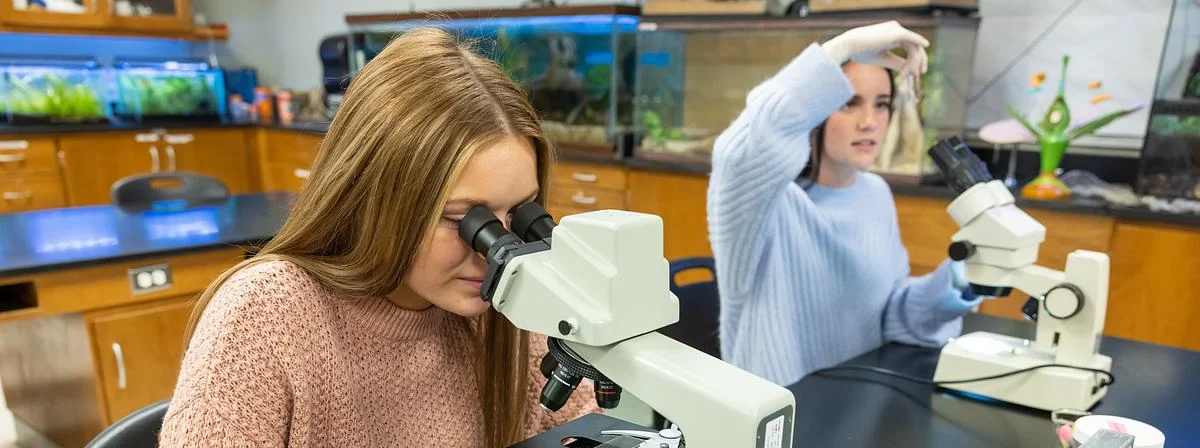
Gain hands-on experience in lab courses that help you understand the principles and laboratory procedures used in biological sciences. You also have a chance to take part in research and community projects.
Start your journey in biology at Ozarks Tech and see where your curiosity can take you.
Program Information
View our accreditation information and learn more about how to apply to Ozarks Tech.
General Admissions to Ozarks Tech
Admission to Ozarks Technical Community College is open to all individuals who can benefit from its educational programs. A focus of the college mission is on the academic, career and personal goals of the student. OTC may admit you as a First-Time student just completing their high school, GED or HiSET requirements or as a Transfer student coming from another institution finishing up a certificate or degree. For more information, visit OTC Admissions.
Wondering how you’re going to pay for college? At OTC, we believe that cost shouldn’t be a barrier to earning a degree. Our staff will work with you to make a financial plan. To browse the resources available to you, see paying for college.
At Ozarks Tech, we want your transfer process to be easy. We accomplish this goal through articulation agreements. These agreements are an official partnership to match coursework between schools. This gives you a more seamless transition from Ozarks Tech to a four-year institution.
We have established an agreement for this program. This will simplify the transfer of your credits to partner schools. To understand how this degree will transfer, review the current articulation agreements. Be sure to consult with your transfer school to ensure you’re on the right path toward completing your four-year degree.
Accreditation
OTC is accredited by the Higher Learning Commission (hlcommission.org), an accreditation agency recognized by the U.S. Department of Education. Our current accreditation status with the HLC is displayed on the page linked below. Our next comprehensive evaluation will be in 2030-2031. View more on OTC Accreditation.
Program Outcomes
Get Involved
Find your community and get involved on campus. Student clubs are a great place to build friendships and professional connections in your field.
Thinking about earning your bachelor’s degree?
After your A.S., you may continue your education at a four-year institution. Bear in mind:
- Admission requirements vary
- Credits may transfer on a course-by-course basis, depending on the transfer institution
Course Information
Discover overview information, course sequences and specific course descriptions. Or, view the full catalog to see all the details.
Biology (A.S.)
A.S. Degree: 62 Hours
This Associate of Science degree program prepares students to transfer to a four-year college or university to major in biology. Because requirements vary at each four-year college or university, students should check with their faculty advisor or the school to which they intend to transfer to ensure they are taking the appropriate courses.
General Education Requirements – 32 Credit Hours
CORE 42 is a statewide general education course of study intended to ensure that all graduates possess a common core of college-level skills and knowledge. CORE 42 specifies the basic competencies and knowledge areas that all students completing degrees at a Missouri public institution of higher education must complete. CORE 42 is comprised of dozens of courses distributed across five knowledge areas. These courses are designated with a Missouri Transfer (MOTR) course number, which guarantees the one-to-one transfer of these courses among all Missouri public institutions of higher education. Please refer to MDHE Core Transfer Curriculum for detailed information on CORE 42 courses.
All knowledge areas below, designated with the CORE 42 logo indicate all courses in that area have been evaluated and provided a MOTR number for transfer to all Missouri public institutions of higher education.
Mathematical Sciences – 5 Credit Hours
- MTH 138: Pre-Calculus Mathematics
Pre-Calculus Mathematics
- MTH 140: Analytic Geometry and Calculus I
Analytic Geometry and Calculus I
Written Communications – 6 Credit Hours
- ENG 101: Composition I
Composition I
or - ENG 100: Composition I With Support
Composition I With Support
- ENG 101: Composition I
- ENG 102: Composition II
Composition II
- ENG 150: Technical Writing
Technical Writing
Oral Communications – 3 Credit Hours
- COM 100: Introduction to Communication
Introduction to Communication
- COM 105: Public Speaking
Public Speaking
- COM 200: Interpersonal Communication
Interpersonal Communication
Humanities and Fine Arts – 3 Credit Hours
- ART 100: Art and Experience
Art and Experience
- ART 101: Art History I
Art History I
- ART 105: Art History II
Art History II
- ART 120: Drawing I
Drawing I
- ASL 101: American Sign Language I
American Sign Language I
- ASL 102: American Sign Language II
American Sign Language II
- CHN 101: Beginning Chinese
Beginning Chinese
- ENG 180: Introduction to Literature
Introduction to Literature
- ENG 260: Survey of World Literature I
Survey of World Literature I
- ENG 265: Survey of World Literature II
Survey of World Literature II
- ENG 240: Survey English Literature I
Survey English Literature I
- ENG 241: Survey English Literature II
Survey English Literature II
- ENG 270: Survey American Literature I
Survey American Literature I
- ENG 271: Survey American Literature II
Survey American Literature II
- FRN 101: Beginning French I
Beginning French I
- FRN 102: Beginning French II
Beginning French II
- GRM 101: Beginning German I
Beginning German I
- GRM 102: Beginning German II
Beginning German II
- MUS 101: Music of the World
Music of the World
- MUS 105: Western Music Appreciation
Western Music Appreciation
- MUS 106: Jazz Appreciation
Jazz Appreciation
- MUS 110: Music Fundamentals
Music Fundamentals
- MUS 235: OTC Concert Choir
OTC Concert Choir
- PHL 101: Introduction to Philosophy
Introduction to Philosophy
- PHL 105: Introduction to Ethics
Introduction to Ethics
- REL 100: Intro Religions Of The World
Intro Religions Of The World
- REL 101: Intro to Old Testament
Intro to Old Testament
- REL 102: Intro to New Testament
Intro to New Testament
- SPN 101: Beginning Spanish I
Beginning Spanish I
- SPN 102: Beginning Spanish II
Beginning Spanish II
- THR 101: Introduction to Theater
Introduction to Theater
Natural Sciences – 9 Credit Hours
- BIO 160: General Biology I
General Biology I
- CHM 160: General Chemistry I
General Chemistry I
- CHM 161: General Chemistry I Lab
General Chemistry I Lab
Social and Behavioral Sciences – 6 Credit Hours (include at least one Civics course, PLS 101 or HST 120 or HST 130)
- ANT 101: Introduction to Anthropology
Introduction to Anthropology
- ANT 220: Cultural Anthropology
Cultural Anthropology
- COM 150: Intro Mass Communication
Intro Mass Communication
- CRM 210: Intro to Criminal Justice
Intro to Criminal Justice
- ECO 270: Principles of Macroeconomics
Principles of Macroeconomics
- ECO 275: Principles of Microeconomics
Principles of Microeconomics
- GRY 101: World Geography
World Geography
- HST 105: Ancient and Medieval World History
Ancient and Medieval World History
- HST 106: Modern World History
Modern World History
- HST 120: U.S. History I: to 1865
U.S. History I: to 1865
- HST 130: U.S. History II: 1865-Present
U.S. History II: 1865-Present
- PLS 101: American Government and Politics
American Government and Politics
- PLS 201: International Relations
International Relations
- PSY 110: Introduction to Psychology
Introduction to Psychology
- PSY 130: Life Span Development Psychology
Life Span Development Psychology
- SOC 101: Introduction to Sociology
Introduction to Sociology
- SOC 210: Urban Sociology
Urban Sociology
Program Specific Courses – 21 Credit Hours
- BIO 170: General Biology II
General Biology II
- BIO 250: Genetics
Genetics
- CHM 170: General Chemistry II
General Chemistry II
and - CHM 171: General Chemistry II Lab
General Chemistry II Lab
- CHM 170: General Chemistry II
- CHM 200: Survey of Organic Chemistry
Survey of Organic Chemistry
- PHY 120: General Physics I
General Physics I
or - PHY 220: Physics Engrs & Scientists I
Physics Engrs & Scientists I
- PHY 120: General Physics I
- PHY 130: General Physics II
General Physics II
or - PHY 222: Physics Engrs & Scientists II
Physics Engrs & Scientists II
- PHY 130: General Physics II
Institutional Electives – 9 Credit Hours
The A.S. Biology degree at OTC requires the completion of 62 credit hours. The 9 elective hours for this category can consist of any course numbered 100 or higher from any area of study that a student is eligible to enroll. For the most accurate transferability of a course, a student should contact the institution to which they plan to transfer.
Locations Offered:
More Tools for Finding Your Path
Notices & Disclaimers
*Costs displayed are based on current tuition and fee rates for the program’s required credit hours, as approved by the OTC Board of Trustees, and are subject to change without notice. Estimates reflect both in-district and out-of-district residency rates. Actual costs, degree completion time, and credit requirements may vary based on residency, prior credits, elective courses, program updates, and enrollment factors. For additional information on attendance costs, visit Cost of Attendance, tuition and fees or contact us at 417-447-6900.
**Graduation rates vary by individual. For details on program enrollment, retention, exam/certification, and employment rates, visit Student Outcomes / Student Right-to-Know. Some careers on this list may require additional education and training. For program-specific accreditation visit OTC Accreditation.
