Precision Machining Program

Precision Machining Technology

Shape your future with in-demand machining skills.

See How You Can Afford It

2 Yrs. 62 Credit Hours
4 Semesters


$12,361 – $16,104*

Basic skills to start your career.

See How You Can Afford It

1 Yr. 32 Credit Hours
2 Semesters


$6,716 – $8,604*

Accelerated course of study to complement your current role.

See How You Can Afford It

1 Yr. 32 Credit Hours
2 Semesters


$6,716 – $8,604*

Build Your Future at Ozarks Tech

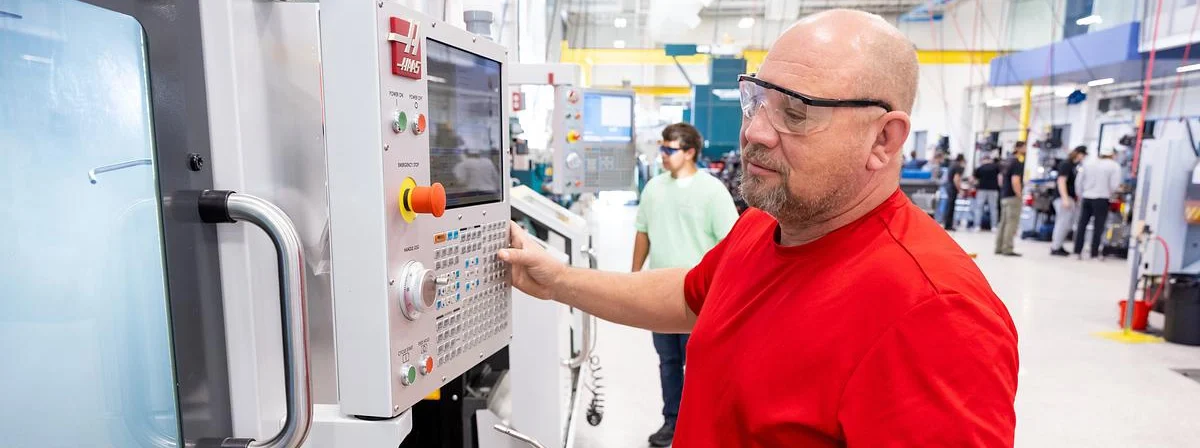
Ever wonder how everyday products are made with such detail and accuracy? Precision machining is the process that makes it happen. In our program, you’ll learn how to use special tools and machines to shape and build parts used in many industries.

As a student, you’ll:

  • Set up and program CNC (Computer Numerical Control) machines.
  • Use computer software to design and make parts (CAD/CAM).
  • Measure parts with high-tech tools like Coordinate Measuring Machines (CMM).

These hands-on skills are in high demand. After finishing the program, you could work as a:

  • CNC operator or programmer
  • Quality control technician
  • General machinist

With training in precision machining, you’ll be ready to succeed in a fast-paced and exciting career!

Program Information

View our accreditation information, find program contacts and learn more about how to apply for the program.

General Admissions to Ozarks Tech

Admission to Ozarks Technical Community College is open to all individuals who can benefit from its educational programs. A focus of the college mission is on the academic, career and personal goals of the student. OTC may admit you as a First-Time student just completing their high schoolGED or HiSET requirements or as a Transfer student coming from another institution finishing up a certificate or degree. For more information, visit OTC Admissions.

Wondering how you’re going to pay for college? At OTC, we believe that cost shouldn’t be a barrier to earning a degree. Our staff will work with you to make a financial plan. To browse the resources available to you, see paying for college.

At Ozarks Tech, we want your transfer process to be easy. We accomplish this goal through articulation agreements. These agreements are an official partnership to match coursework between schools. This gives you a more seamless transition from Ozarks Tech to a four-year institution.

We have established an agreement for this program. This will simplify the transfer of your credits to partner schools. To understand how this degree will transfer, review the current articulation agreements. Be sure to consult with your transfer school to ensure you’re on the right path toward completing your four-year degree.

OTC is accredited by the Higher Learning Commission (hlcommission.org), an accreditation agency recognized by the U.S. Department of Education. Our current accreditation status with the HLC is displayed on the page linked below. Our next comprehensive evaluation will be in 2030-2031. View more on OTC Accreditation.

Program Outcomes

View program outcomes.

Landon Vinson

Industrial & Manufacturing Department Chair

417-447-6615

Industrial & Manufacturing Team

Find Your Community

Getting involved is a great way to build connections and find your community on campus. With a variety of clubs and organizations and campus events it’s easy to find your people.

Life at Ozarks Tech

Looking for something a little different?

Check out similar programs that may be the right fit for you.

Manufacturing Technology 

Welding Technology

Industrial & Engineering Technology Programs

Course Information

Discover overview information, course sequences and specific course descriptions. Or, view the full catalog to see all the details.

Precision Machining Technology (A.A.S.)

A.A.S. Degree: 62 Hours

Precision machining is a highly technical, advanced process that is essential to manufacture the products we use in our daily lives. The Precision Machining Technology program provides hands-on training with advanced machine tools and teaches the fundamental skills needed to precisely manufacture products and tooling. Students in the program learn technologies including Computer Numerical Control (CNC) setup and programming, Computer-Aided Design and Manufacturing (CAD/CAM), and advanced inspection equipment such as Coordinate Measuring Machines (CMM). The wide range of skills taught in this program provide many employment opportunities in manufacturing including CNC operator, general machinist, CNC setup technician, CNC programmer, quality control technician, and manufacturing engineering technician.

Precision Machining Technology Program Requirements – 46 Credit Hours

Precision Machining Technology Program Requirements – 46 Credit Hours

  • Credits: 3

    Mechanical Dimensioning & Tolerancing

    This course focuses on the interpretation and application of American National Standards Institute (ANSI) and American Society of Mechanical Engineers (ASME) Y14.5M current drafting standards and rules for dimensioning and tolerancing mechanical prints utilizing a computer aided drafting system.

    Prerequisite(s): Recommend concurrent enrollment in DDT 100 for all DDT majors.
  • Credits: 4

    Machining Fundamentals I

    This is a fundamental course designed to introduce students to precision machining. Students will utilize manual and CNC equipment to produce parts from blueprints.

  • Credits: 4

    CNC Programming – G & M Code

    Computer Numerical Control (CNC) is a technology that is used widely in modern manufacturing to produce precise parts using computer-controlled machine tools. This course is designed to introduce students to the fundamentals of reading and writing the G and M code that controls these machines.

  • Credits: 4

    CAD/CAM Essentials

    Computer Aided Drafting (CAD) refers to using computer software to create a design. Computer Aided Manufacturing (CAM) refers to using computer software to create CNC machine code from a CAD design. In this course, students will learn how to use CAD/CAM software to create 3D models and program CNC machine tools.

  • Credits: 4

    Adv. Blueprint Reading & QC

    This course is designed to teach advanced blueprint interpretation skills as well as the proper use of dimensional inspection equipment. These skills are essential for machinists and quality inspectors.

  • Credits: 4

    Machining Fundamentals II

    This course is designed to expand on the equipment and skills used in Machining Fundamentals I. Practical laboratory assignments will expand a students’ knowledge and ability to produce precise parts from blueprints using conventional and CNC machine tools.

    Prerequisite(s): A grade of "C" or better in PMT 125.
  • Credits: 4

    CNC Setup and Operation

    This course is designed to teach the fundamental skills needed to safely and efficiently setup and operate a variety of computer-controlled (CNC) machine tools.

    Prerequisite(s): PMT 135 or concurrent enrollment.
  • Credits: 4

    Advanced CAD/CAM

    This course will expand on the concepts used in CAD/CAM Essentials by teaching additional CAD/CAM strategies and techniques for programming components of increasing complexity. Tooling design will also be introduced.

    Prerequisite(s): A grade of "C" or higher in PMT 135 and  PMT 145. 
  • Credits: 4

    Adv. Machining Processes I

    This course builds on knowledge gained in prior courses and teaches advanced machining and work-holding techniques.

    Prerequisite(s): PMT 225 or concurrent enrollment, and PMT 145 and PMT 235. 
    • Credits: Variable 1-3

      Co-operative Education/Internship

      This course entails a supervised work experience in the major field which provides the student with the opportunity to make practical application of the knowledge and skills attained through coursework. An individualized instructional management plan will determine goals to be accomplished. Seminars may also be required.

      Prerequisite(s): Instructor consent.
    • or
    • Credits: 4

      MFG Processes & Materials

      This lecture/lab course focuses on the study of mechanical, chemical, physical properties, and structure of engineering materials with heat treating of ferrous and nonferrous metals, and an investigation of the methods used to process these materials.

  • Credits: 4

    Manufacturing Capstone

    This course will provide the student the opportunity to apply skills, knowledge, collaboration and creativity to a complete a real-world manufacturing project in a collaborative environment.

    Prerequisite(s): MFG 115; and DDT 280 or MEC 260 or PMT 250 or WLD 235 or WLD 236 or concurrent enrollment or department chair consent.
  • Credits: 1

    Occupational Seminar

    Note: It is recommended students have 30 hours completed towards their degree program prior to enrolling in this course.  Instruction for this course includes career identification, self-assessment, resume’ development, preparation of cover letters, completion of applications for local jobs, learning the online employment application process, research of local companies, jobs available, and current salary ranges, job searching techniques and tools, interviewing skills, follow-up steps after the job interview and on-the-job performance expectations.

    Related Electives: May choose from the following program areas: CIS, CSC, CST, CYB, DDT, HRA, ITI, MEC, MFG, PMT, WLD.

General Education Requirements – 16 Credit Hours

General Education Requirements – 16 Credit Hours

The Missouri Department of Higher Education has identified a common set of general education courses that have been adopted statewide. These courses are called the “CORE 42.”  CORE 42 courses are guaranteed to transfer to any Missouri public college or university to satisfy general education requirements.

Courses in knowledge areas below, designated with the CORE 42 logo indicates courses in that area have been evaluated and provided a MOTR number for transfer to all Missouri public institutions of higher education.

Courses that do not have this designation may still transfer to public and private colleges and universities in Missouri and elsewhere, but students are encouraged to check the transfer equivalency website of the institution to which they plan to transfer to confirm.

Please refer to the MDHE Core Transfer Curriculum for detailed information on CORE 42 courses.

Mathematical Sciences – 3 Credit Hours

Mathematical Sciences – 3 Credit Hours

  • Credits: 3
    Applied Technical Mathematics

    Course content includes the fundamental processes of mathematics with emphasis on problem-solving techniques. This course covers mathematical principles and concepts applicable to the technical trades utilizing introductory algebra, geometry, elementary trigonometry, and basic statistical methods.

  • Credits: 4
    Intermediate Algebra

    This course is an extension of basic algebra and includes factoring, rational expressions, linear equations, quadratic equations, functions, graphs, radicals, complex numbers and applications.

  • Credits: 3
    Contemporary Mathematics

    This course provides students with a basic survey of mathematics. Topics include problem solving, modeling, counting methods, probability, statistics and geometry.

  • Credits: 4
    Cont Mathematics with Support

    This course provides students with a basic survey of mathematics. Topics include problem solving, modeling, counting methods, probability, statistics and geometry. MTH 128S will be driven by the same objectives as MTH 128, and satisfy the same requirement. The course design will provide students with more time, support, and individualized instruction to accomplish those objectives.

  • Credits: 3
    Introductory Statistics

    This is the first course in statistics for students whose college and career paths require knowledge of the fundamentals of the collection, analysis, and interpretation of data. Topics include distributions, measures of central tendency and dispersion, elementary probability, sampling, estimation of parameters, hypothesis testing, regression and correlation.  

  • Credits: 3
    Algebra for Calculus

    This course is a standard course in college-level algebra necessary for further studies in mathematics. Topics include solving equations, systems of equations, and inequalities; properties of functions; polynomial, rational, exponential, logarithmic functions and their graphs.

  • Credits: 4
    Algebra for Calculus With Support

    This course is a standard course in college-level algebra necessary for further studies in mathematics. Topics include solving equations, systems of equations, and inequalities; properties of functions; polynomial, rational, exponential, logarithmic functions and their graphs. MTH 130S will be driven by the same objectives as MTH 130, and satisfy the same requirement. The course design will provide students with more time, support, and individualized instruction to accomplish those objectives.

  • Credits: 3
    Trigonometry

    This course is a study of trigonometric function and their graphs, identities, equations and applications. Topics include an introduction to polar coordinates, vectors, and solutions of right and oblique triangles.

    Prerequisite(s): Grade of "C" or better in MTH 130 or satisfactory score on the ACT.
  • Credits: 5
    Pre-Calculus Mathematics

    This course prepares students for calculus by integrating both college-level algebra and trigonometry. Topics include solving equations, systems of equations, and inequalities; properties of functions; polynomial, rational, radical, exponential, logarithmic, and trigonometric functions and their graphs; analytic trigonometry; and vectors. This course is designed for students with a prior background in algebra and trigonometry.

    Prerequisite(s): Grade of "B" or better in MTH 110 or satisfactory score on the ACT.
  • Credits: 5
    Analytic Geometry and Calculus I

    This is the first course in a three-semester sequence. Topics include an introduction to analytic geometry, limits and continuity, the derivative and differential, the definite integral and applications.

    Prerequisite(s): Grade of "C" or better in MTH 131 or MTH 138 or satisfactory score on the ACT.
  • Credits: 5
    Analytic Geometry and Calculus II

    This is the second course in a three-semester sequence. Topics include techniques of formal integration, applications of definite integration, infinite sequences and series, parametrized curves and polar coordinates.

    Prerequisite(s): Grade of "C" or better in MTH 140.
  • Credits: 3
    Statistical Methods

    Students study basic concepts of statistics and probability applicable to all disciplines. Topics include distributions, measures of central tendency and dispersion, elementary probability, sampling, estimation of parameters, hypothesis testing, regression and correlation.

    Prerequisite(s): Grade of "C" or better in MTH 128 or MTH 130 or satisfactory score on the ACT.
  • Credits: 3
    Discrete Mathematics

    This course provides an introduction to discrete mathematics.  Topics include logic, basic counting, discrete probability, recursion, sets and relations, graphs and trees.

    Prerequisite(s): Grade of "C" or better in MTH 131 or MTH 138 or satisfactory score on the ACT.
  • Credits: 3
    Algebraic Structures

    This course provides an introduction to techniques of mathematical reasoning and formal mathematical proof. Topics include logic, set theory, relations, functions, and number theory. 

    Prerequisite(s): Grade of "C" or better in MTH 140.
  • Credits: 3
    Linear Algebra

    This course is a study of vector spaces, matrices, linear transformations, determinants, quadratic forms, eigenvalues, eigenvectors, canonical forms and inner-product spaces. Emphasis is placed on rigorous proof and the development of mathematical maturity.

    Prerequisite(s): Grade of "C" or better in MTH 141.
  • Credits: 3
    Analytic Geometry and Calculus III

    This is the third course in a three-semester sequence. Topics include vector-valued functions, solid analytic geometry, partial differentiation, multiple integration and line and surface integrals in vector fields.

    Prerequisite(s): Grade of "C" or better in MTH 141.
  • Credits: 3
    Differential Equations

    This is an introduction to the techniques available for the solution of ordinary differential equations. Topics include first and second order equations, systems of differential equations, Laplace transforms, series solutions, numerical methods and applications.

    Prerequisite(s): Grade of "C" or better in MTH 141. 
Written Communications – 3 Credit Hours

Written Communications – 3 Credit Hours

    • Credits: 3
      Composition I

      This course introduces students to college-level reading, thinking, and writing through a series of composition-rhetoric assignments and activities that culminate in a research-supported project. Specifically, students apply critical and creative thinking to evaluate problems, interpret evidence/data, and draw conclusions. As part of this process, students learn to evaluate sources and emerging digital tools for currency, feasibility, truthfulness, credibility, and accuracy. Ultimately, students learn to synthesize knowledge to solve problems. This writing process (thinking, researching, evaluating, and persuading) helps students to develop an essential skill set they can use in their future academic, civic, and professional lives.

    • or
    • Credits: 5
      Composition I With Support

      This course introduces students to college-level reading, thinking, and writing through a series of composition-rhetoric assignments and activities that culminate in a research-supported project. Specifically, students apply critical and creative thinking to evaluate problems, interpret evidence/data, and draw conclusions. As part of this process, students learn to evaluate sources and emerging digital tools for currency, feasibility, truthfulness, credibility, and accuracy. Ultimately, students learn to synthesize knowledge to solve problems. This writing process (thinking, researching, evaluating, and persuading) helps students to develop an essential skill set they can use in their future academic, civic, and professional lives.  English 100 will be driven by the same course objectives as English 101 and satisfy the same requirement.

Oral/Written Communications – 3 Credit Hours

Oral/Written Communications – 3 Credit Hours

  • Credits: 3
    Introduction to Communication

    This course provides an introduction to the study of communication, including interpersonal communication, small group dynamics, and public speaking.

  • Credits: 3
    Public Speaking

    This is an introductory course in research, composition, delivery, and evaluation of speeches for a variety of purposes and occasions. Students develop skills in critical listening and analysis through small group and individual activities.

  • Credits: 3
    Technical Writing

    This course emphasizes developing the student’s ability to write clearly, concisely and accurately. Students practice collecting, analyzing, interpreting and presenting information in a variety of technical documents used in professional settings while using proper research and documentation techniques, sound visual design principles and effective writing styles suitable for a specific communicative context. Throughout, emphasis will be placed on honing skills in audience analysis, analytical reading, critical thinking, research methods and clear writing.

    Prerequisite(s): ENG 100 or ENG 101.
  • Credits: 3
    Interpersonal Communication

    This course is designed as an introduction to the theory and practice of interpersonal communication. Students learn how to become both effective and appropriate communicators in a variety of contexts. Students also develop good listening and responding skills, conflict management strategies, sensitivity to language and an understanding of cultural and gender differences.

    Prerequisite(s): Grade of "C" or better inENG 100 or ENG 101. 
Natural Sciences – 4 Credit Hours

Natural Sciences – 4 Credit Hours

  • Credits: 4
    Technical Physics

    This course entails a survey of basic physics for students majoring in technical fields. Students will learn how the concepts of force, work, rate, resistance, energy, power, and force transformation are related to mechanical, fluid, thermal, and electrical systems. Laboratory activities will give the students an opportunity to demonstrate the principles of physics, as presented in lecture.

    Prerequisite(s): Grade of "C" or better in TEC 108 or higher
  • Credits: 4
    Life Science

    This course covers a study of the biological principles that apply to all living systems. A survey of living organisms with an emphasis on how life functions on earth and how living things have adapted over time is explored. Laboratory activities give students the opportunity to apply biological principles presented in lecture.

  • Credits: 4
    General Biology I

    This course is an introductory biology course for biology majors and minors. It provides an introduction to the concepts of biological structure and function at the molecular and cellular level, genetics and evolution. Students have the opportunity to demonstrate in the laboratory the principles presented in lecture.

  • Credits: 4
    Introductory Chemistry

    This is an introductory course designed to study basic chemical principles. Topics include atomic structure, measurement, bonding, properties of gases, acids and bases, solutions, organic nomenclature, functional groups, carbohydrates, lipids, proteins, and nucleic acids. Laboratory activities give students the opportunity to demonstrate chemical principles presented in lecture.

  • Credits: 4
    General Chemistry I

    This course is a study of the fundamental laws and theories of chemical structures and reactions. Topics include: atomic theory, stoichiometry, aqueous reactions, properties of gases, liquids, and solids, periodicity, bonding, thermodynamics, and properties of solutions. This course is recommended for all those majoring in Science as well as Chemistry majors and minors.

    Prerequisite(s): Grade of "C" or better in MTH 110 or higher, or satisfactory score on the ACT.
  • Credits: 4
    Introduction to Physics

    This course provides an introduction to basic physics. Students will apply the principles of mechanics, energy, waves, matter and atomic theory. Laboratory activities will give students the opportunity to demonstrate physics principles presented in lecture. A previous college level math course is recommended.

    Prerequisite(s): Knowledge of algebra, scatter plot graphing, slope and equation of the line, scientific notation, and unit conversions is recommended.
  • Credits: 4
    General Physics I

    This is an algebra based physics course. Students learn about the principles and applications of mechanics, wave motion and heat. Laboratory activities give students an opportunity to demonstrate physics principles presented in lecture. This course is designed for earth science, biology, chemistry, health and medical majors.

    Prerequisite(s): Grade of "C" or better in MTH 130 or equivalent (MTH 131 recommended).
  • Credits: 5
    Physics Engrs & Scientists I

    This is a calculus based physics course. Students learn about the principles and applications of mechanics, wave motion and heat. Laboratory activities give students the opportunity to develop the basic skills in data collection and analysis required in physics. This course is designed for pre-engineering, physics, chemistry and pre-med majors.

    Prerequisite(s): Grade of "C" or better in MTH 140.
Social and Behavioral Sciences – 3 Credit Hours

Social and Behavioral Sciences – 3 Credit Hours

  • Credits: 3
    American Government and Politics

    This introductory course familiarizes students with American and Missouri government constitutions, institutions, policies and processes. Students develop an understanding of the foundations, environment, and principles of democracy with key concepts about voting, political parties, campaigns, and interactions between the branches of government. The course emphasis is on the values, rights, and responsiblities that shape public decision making of active and informed citizens in the American political system. This course meets instruction requirements (Missouri Revised Statute 170.011.1) in the Constitution of the United States and the state of Missouri.

  • Credits: 3
    U.S. History I: to 1865

    This course is a survey of the history of the United States from pre-Columbian societies through the Civil War, including formative political, social, economic and cultural developments. It also introduces students to history as an academic discipline and requires analysis, synthesis and evaluation of primary and secondary materials in reading, discussion and writing. HST 120 will satisfy the Missouri state law requiring instruction in the United States and Missouri Constitutions.

  • Credits: 3
    U.S. History II: 1865-Present

    This course is a survey of the history of the United States from Reconstruction to the present, covering the political, economic, social and cultural developments that have shaped modern America. It introduces students to history as an academic discipline and requires analysis, synthesis and evaluation of primary and secondary materials in reading, discussion and writing.  HST 130 will satisfy the Missouri state law requiring instruction in the United States and Missouri Constitutions.

Precision Machining Technology Certificate

Certificate: 32 Hours

Precision machining is a highly technical, advanced process that is essential to manufacture the products we use in our daily lives. The Precision Machining Technology program provides hands-on training with advanced machine tools and teaches the fundamental skills needed to precisely manufacture products and tooling. Students in the program learn technologies including Computer Numerical Control (CNC) setup and programming, Computer-Aided Design and Manufacturing (CAD/CAM), and advanced inspection equipment such as Coordinate Measuring Machines (CMM). The wide range of skills taught in this program provide many employment opportunities in manufacturing including CNC operator, general machinist, CNC setup technician, CNC programmer, quality control technician, and manufacturing engineering technician.

Precision Machining Technology Certificate Requirements

Precision Machining Technology Certificate Requirements

  • Credits: 4

    Machining Fundamentals I

    This is a fundamental course designed to introduce students to precision machining. Students will utilize manual and CNC equipment to produce parts from blueprints.

  • Credits: 4

    CNC Programming – G & M Code

    Computer Numerical Control (CNC) is a technology that is used widely in modern manufacturing to produce precise parts using computer-controlled machine tools. This course is designed to introduce students to the fundamentals of reading and writing the G and M code that controls these machines.

  • Credits: 4

    CAD/CAM Essentials

    Computer Aided Drafting (CAD) refers to using computer software to create a design. Computer Aided Manufacturing (CAM) refers to using computer software to create CNC machine code from a CAD design. In this course, students will learn how to use CAD/CAM software to create 3D models and program CNC machine tools.

  • Credits: 4

    Adv. Blueprint Reading & QC

    This course is designed to teach advanced blueprint interpretation skills as well as the proper use of dimensional inspection equipment. These skills are essential for machinists and quality inspectors.

  • Credits: 4

    Machining Fundamentals II

    This course is designed to expand on the equipment and skills used in Machining Fundamentals I. Practical laboratory assignments will expand a students’ knowledge and ability to produce precise parts from blueprints using conventional and CNC machine tools.

    Prerequisite(s): A grade of "C" or better in PMT 125.
  • Credits: 4

    CNC Setup and Operation

    This course is designed to teach the fundamental skills needed to safely and efficiently setup and operate a variety of computer-controlled (CNC) machine tools.

    Prerequisite(s): PMT 135 or concurrent enrollment.
  • Credits: 4

    Advanced CAD/CAM

    This course will expand on the concepts used in CAD/CAM Essentials by teaching additional CAD/CAM strategies and techniques for programming components of increasing complexity. Tooling design will also be introduced.

    Prerequisite(s): A grade of "C" or higher in PMT 135 and  PMT 145. 
  • Credits: 4

    Adv. Machining Processes I

    This course builds on knowledge gained in prior courses and teaches advanced machining and work-holding techniques.

    Prerequisite(s): PMT 225 or concurrent enrollment, and PMT 145 and PMT 235. 

Precision Machining Technology Specialist Certificate

Certificate: 32 Hours

Precision machining is a highly technical, advanced process that is essential to manufacture the products we use in our daily lives. The Precision Machining Technology program provides hands-on training with advanced machine tools and teaches the fundamental skills needed to precisely manufacture products and tooling. Students in the program learn technologies including Computer Numerical Control (CNC) setup and programming, Computer-Aided Design and Manufacturing (CAD/CAM), and advanced inspection equipment such as Coordinate Measuring Machines (CMM). The wide range of skills taught in this program provide many employment opportunities in manufacturing including CNC operator, general machinist, CNC setup technician, CNC programmer, quality control technician, and manufacturing engineering technician.

Precision Machining Technology Specialist Requirements

Precision Machining Technology Specialist Requirements

  • Credits: 32

    Precision Mach. Specialist

    This course will introduce students to the foundational skills and knowledge of precision machining.  Students will learn to interpret production blueprints, utilize manual and Computer Numerical Control (CNC) equipment to produce parts from blueprints, learn fundamental skills in reading and writing the G & M code to control CNC machines, and correctly use dimensional inspection equipment. Students will learn to use Computer Aided Drafting (CAD) and Computer Aided Manufacturing (CAM) software to create 3D models and program Computer Numeric Control (CNC) machines.  Students will also learn to use advanced measuring tools to perform quality control inspections and produce quality components.


    Note: PMT 285 is accelerated and satisfies completion of the following PMT courses: PMT 125, PMT 135, PMT 145, PMT 150, PMT 225, PMT 235, PMT 245, PMT 250.

Locations Offered:

Notices & Disclaimers

*Costs displayed are based on current tuition and fee rates for the program’s required credit hours, as approved by the OTC Board of Trustees, and are subject to change without notice. Estimates reflect both in-district and out-of-district residency rates. Actual costs, degree completion time, and credit requirements may vary based on residency, prior credits, elective courses, program updates, and enrollment factors. For additional information on attendance costs, visit Cost of Attendancetuition and fees or contact us at 417-447-6900.

**Graduation rates vary by individual. For details on program enrollment, retention, exam/certification, and employment rates, visit Student Outcomes / Student Right-to-Know. Some careers on this list may require additional education and training. For program-specific accreditation visit OTC Accreditation.