
Start Your Career: By the Numbers
Apply To This ProgramIndustry Input
Local employers help keep our programs up to date with current technology changes, so you’re prepared when you graduate.
Start Your Engines & Your Future
Do you like working with cars or fixing things? At Ozarks Tech, our Automotive Technology program helps you turn that passion into a career.
In this program, you’ll learn how cars and trucks work, and how to:
- Repair and rebuild engines
- Fix brakes
- Improve engine performance
- Work on manual & automatic transmissions
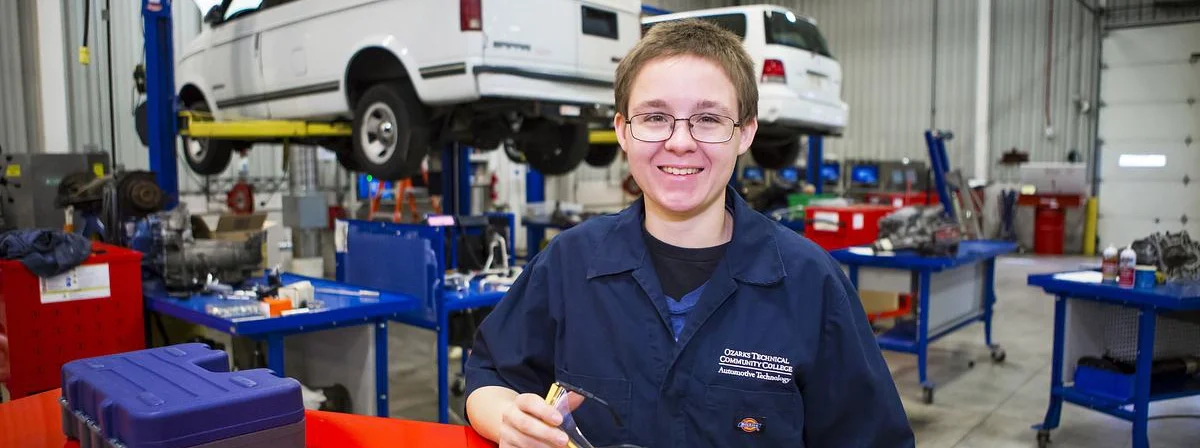
You’ll spend lots of time in our hands-on lab, working on real vehicles. Your instructors will teach you how to troubleshoot problems, identify critical vehicle components and talk with customers.
The auto-industry is changing fast. With more focus on safety and electronics, your courses will help you stay ahead of the curve and get ready for today’s job market.
Program Information: Automotive Technology
View our accreditation information, find program contacts and learn more about how to apply for the program.
General Admissions to Ozarks Tech
Admission to Ozarks Technical Community College is open to all individuals who can benefit from its educational programs. A focus of the college mission is on the academic, career and personal goals of the student. OTC may admit you as a First-Time student just completing their high school, GED or HiSET requirements or as a Transfer student coming from another institution finishing up a certificate or degree. For more information, visit OTC Admissions.
Wondering how you’re going to pay for college? At OTC, we believe that cost shouldn’t be a barrier to earning a degree. Our staff will work with you to make a financial plan. To browse the resources available to you, see paying for college.
At Ozarks Tech, we want your transfer process to be easy. We accomplish this goal through articulation agreements. These agreements are an official partnership to match coursework between schools. This gives you a more seamless transition from Ozarks Tech to a four-year institution.
We have established an agreement for this program. This will simplify the transfer of your credits to partner schools. To understand how this degree will transfer, review the current articulation agreements. Be sure to consult with your transfer school to ensure you’re on the right path toward completing your four-year degree.
Accreditation
The degree program is accredited by the ASE Foundation (NATEF), 1503 Edwards Ferry Rd., NE Suite 401 Leesburg, VA 20176, (703) 669-6650.
Program Mission
The mission of the Automotive Technology program at Ozarks Technical Community College is to provide students with the necessary knowledge and skills to diagnose and repair automobiles in various entry-level automotive positions. The program uses the Automotive Service Education Foundation guidelines with the aid of a technical advisory committee to develop course content and a competency list that will provide the student with the knowledge and skills to be successful in the automotive industry.
Program Goals
- Practice safety by selecting appropriate attire, handling materials properly, and correctly using tools and equipment.
- Identify the careers available in the automotive technology field.
- Develop respect for rules, regulations, laws, competent work habits, and ethical conduct.
- Demonstrate practical decision-making, problem-solving, and leadership skills.
- Demonstrate familiarity with terminology, skills, materials, tools, and equipment used in automotive technology.
- Select, inspect, and maintain the proper tools and equipment for specific job performance.
- Demonstrate knowledge of when, how, and why to remove or replace parts.
- Demonstrate a strong foundation for furthering training in the field of automotive technology.
- OTC is accredited by the Higher Learning Commission (hlcommission.org), an accreditation agency recognized by the U.S. Department of Education. Our current accreditation status with the HLC is displayed on the page linked below. Our next comprehensive evaluation will be in 2030-2031. View more information on OTC accreditation.
OTC is accredited by the Higher Learning Commission (hlcommission.org), an accreditation agency recognized by the U.S. Department of Education. Our current accreditation status with the HLC is displayed on the page linked below. Our next comprehensive evaluation will be in 2030-2031. View more on OTC Accreditation.
Program Outcomes
Looking for something a little different?
Check out similar programs that may be the right fit for you.
Check out similar programs that may be the right fit for you.
Auto Collision Repair Technology
Find Your Community
Getting involved is a great way to build connections and find your community on campus. With a variety of clubs and organizations and campus events it’s easy to find your people.
Course Information
Discover overview information, course sequences and specific course descriptions. Or, view the full catalog to see all the details.
Automotive Technology (A.A.S.)
Program Length: 2 Years
Location: Springfield Campus
A.A.S. Degree: 63 Hours
Under the supervision of certified instructors experienced in the industry, students learn fundamentals of automotive systems design, operation, diagnosis and repair. Classroom concepts and theory are applied in the shop environment where troubleshooting, service procedures, estimating and customer relations are practiced. The automotive industry is changing and growing, with increasing emphasis on safety and electronics. Potential employers include automotive dealerships, independent repair shops, service stations, and product sales and service. The degree program is accredited by the ASE Education Foundation, 1503 Edwards Ferry Rd, NE, Suite 401, Leesburg, VA 20176. The Web address is https://www.aseeducationfoundation.org/.
Automotive Technology Certificate
Program Length: 1 Year
Location: Springfield Campus
Certificate: 32 Hours
Under the supervision of certified instructors experienced in the industry, students learn fundamentals of automotive systems design, operation, diagnosis and repair. Classroom concepts and theory are applied in the shop environment where troubleshooting, service procedures, estimating and customer relations are practiced. The automotive industry is changing and growing, with increasing emphasis on safety and electronics. Potential employers include automotive dealerships, independent repair shops, service stations, and product sales and service. The degree program is accredited by the ASE Education Foundation, 1503 Edwards Ferry Rd, NE, Suite 401, Leesburg, VA 20176. The Web address is https://www.aseeducationfoundation.org/.
More Tools for Finding Your Path
Notices & Disclaimers
*Costs displayed are based on current tuition and fee rates for the program’s required credit hours, as approved by the OTC Board of Trustees, and are subject to change without notice. Estimates reflect both in-district and out-of-district residency rates. Actual costs, degree completion time, and credit requirements may vary based on residency, prior credits, elective courses, program updates, and enrollment factors. For additional information on attendance costs, visit Cost of Attendance, tuition and fees or contact us at 417-447-6900.
**Graduation rates vary by individual. For details on program enrollment, retention, exam/certification, and employment rates, visit Student Outcomes / Student Right-to-Know. Some careers on this list may require additional education and training. For program-specific accreditation visit OTC Accreditation.