
Paramedicine Program

Paramedicine

Learn advanced emergency care.

See How You Can Afford It

2 Yrs. 64 Credit Hours
4 Semesters


$15,870 – $19,790*

Training to provide life-saving care.

See How You Can Afford It

1 Yr. 52 Credit Hours
2 Semesters


$12,011 – $15,163*

Learn advanced emergency care.

See How You Can Afford It

2 Yrs. 64 Credit Hours
4 Semesters


$15,870 – $19,790*

Training to provide life-saving care.

See How You Can Afford It

1 Yr. 52 Credit Hours
2 Semesters


$12,011 – $15,163*

Hands-On Training in Life-Saving Skills

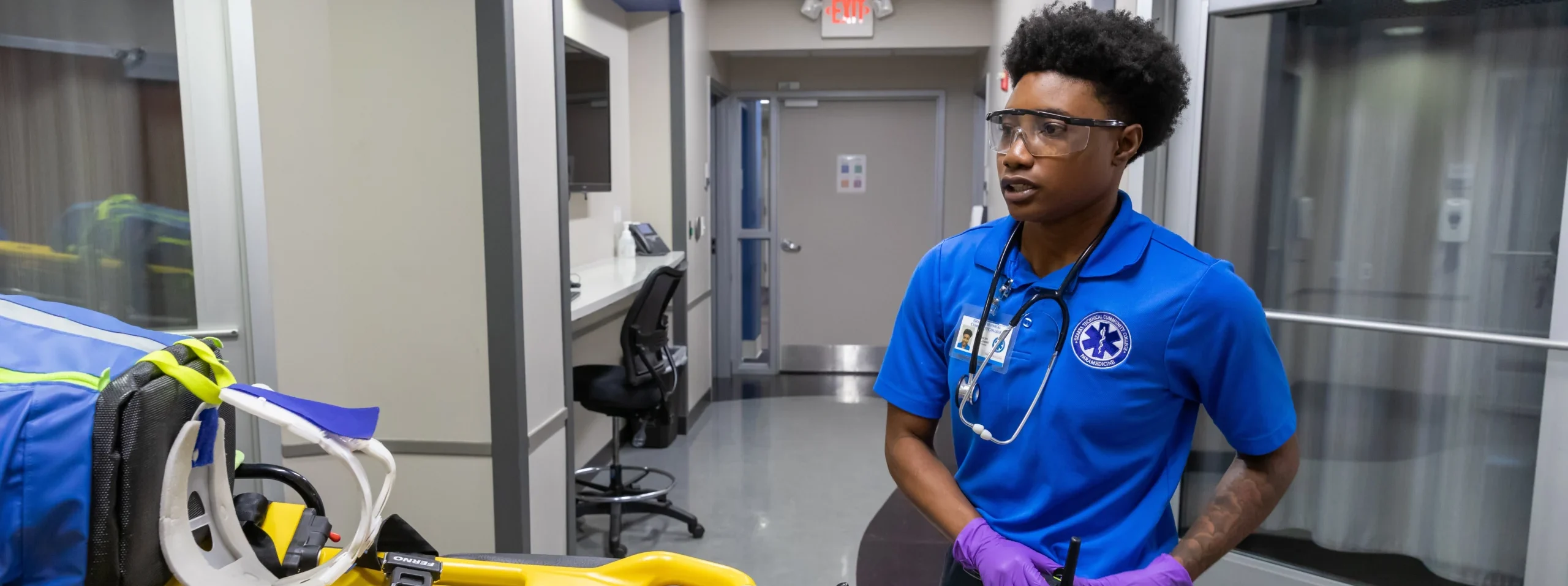
Start a career providing advanced life-saving care as a paramedic. Paramedics work as a part of a team to make quick decisions and provide first response care. At Ozarks Tech you gain the skills and confidence needed to save lives.

Grow your skill set through hands-on practice in clinics and field internships. You’ll practice:

  • Administering CPR or oxygen

  • Treating injuries

  • Performing advanced medical care

  • Collaborating with other emergency teams

After finishing the program, you’ll be ready to earn certification and apply for your license to practice in Missouri.

Program Information

Explore our accreditation information, find program contacts and learn more about how to apply for the program.

The Paramedicine program requires a separate application process in addition to the general Ozarks Tech admission process.

Candidate Selection Form – Traditional

Candidate Selection Form – Hybrid

Application Requirements and Information

General Admissions to Ozarks Tech

Admission to Ozarks Technical Community College is open to all individuals who can benefit from its educational programs. A focus of the college mission is on the academic, career and personal goals of the student. OTC may admit you as a First-Time student just completing their high schoolGED or HiSET requirements or as a Transfer student coming from another institution finishing up a certificate or degree. For more information, visit OTC Admissions.

Wondering how you’re going to pay for college? At OTC, we believe that cost shouldn’t be a barrier to earning a degree. Our staff will work with you to make a financial plan. To browse the resources available to you, see paying for college.

At Ozarks Tech, we want your transfer process to be easy. We accomplish this goal through articulation agreements. These agreements are an official partnership to match coursework between schools. This gives you a more seamless transition from Ozarks Tech to a four-year institution.

We have established an agreement for this program. This will simplify the transfer of your credits to partner schools. To understand how this degree will transfer, review the current articulation agreements. Be sure to consult with your transfer school to ensure you’re on the right path toward completing your four-year degree.

The Ozarks Technical Community College Paramedic Program is accredited by the Commission on Accreditation of Allied Health Education Programs (www.caahep.org) upon the recommendation of the Committee on Accreditation of Educational Programs for the Emergency Medical Services Professions (CoAEMSP).
CAAHEP Logo

Commission on Accreditation of Allied Health Education Programs
9355 113 St. N,
#7709
Seminole, FL 33775
www.caahep.org

OTC is accredited by the Higher Learning Commission (hlcommission.org), an accreditation agency recognized by the U.S. Department of Education. Our current accreditation status with the HLC is displayed on the page linked below. Our next comprehensive evaluation will be in 2030-2031. View more on OTC Accreditation.

Mission Statement

To prepare competent entry-level paramedics and support them with high-quality continuing education and career advancement opportunities.

Program Outcomes

NREMT Paramedic Pass Rate 

  • 2020:  100%
  • 2021:  100%
  • 2022:  100%
  • 2023:  100%
  • 2024: 96%

Paramedic Program Retention 

  • 2020:  71%
  • 2021:  89.5%
  • 2022:  47%
  • 2023:  70%
  • 2024: 92.6%

Paramedic Positive Job Placement

  • 2020:  100%
  • 2021:  100%
  • 2022:  100%
  • 2023:   100%
  • 2024: 96%

View Program Outcomes

Brian Rohlman
Paramedicine Program Director
417-447-8844

Paramedicine Team

The paramedicine programs advisory committee brings prospective and insight to the Paramedicine and EMT programs, keeping courses content consistent with current practices in the field.

  • Dr. Tom Lewis – Medical Director

Get Involved

Get connected with other students and find support throughout the program.

The Student Paramedicine Association (SPA) is a student group of aspiring EMTs and paramedics who participate in community service, educate the public about the profession and work to enhance the experience of Ozarks Tech Paramedicine students.

Learn more about the Student Paramedicine Association

Looking for something a little different?

Check out similar programs that might be the right fit for you.

Emergency Medical Technician (EMT) Certificate

Fire Science Technology

Registered Nursing

Practical Nursing


Course Information

Discover overview information, course sequences and specific course descriptions. Or, view the full catalog to see all the details.

Paramedicine (A.A.S.)

A.A.S Degree: 64 Hours

The Paramedic is an allied health professional whose primary focus is to provide advanced emergency medical care for critical and emergent patients who access the emergency medical system. This individual possesses the complex knowledge and skills necessary to provide patient care and transportation. Paramedics function as part of a comprehensive EMS response, under medical oversight. Paramedics perform interventions with the basic and advanced equipment typically found on an ambulance. The Paramedic is a link from the scene into the health care system.

This is a selective admission program that requires a valid EMT license.

An application packet is available online or by contacting the EMS department at [email protected].  Please see faculty members for further advisement.

Missouri Department of Health and Senior Services, Bureau of Emergency Medical Services, PO Box 570, Jefferson City, MO 65102, (573) 751-6356  https://health.mo.gov/safety/ems/

This program is accredited by the Committee on Accreditation of Education Programs for the EMS Professions (CoAEMSP), 8301 Lakeview Parkway, Suite 111-312, Rowlett, TX 75088, (214) 703-8445  https://coaemsp.org/

This program is accredited by the Commission on Accreditation of Allied Health Education Program (CAAHEP), 9355 – 113th St. N, #7709, Seminole, FL 33775   727.210.2350  https://www.caahep.org/

Pre-Admission Requirements – 11 Credit Hours

Pre-Admission Requirements – 11 Credit Hours

  • Credits: 4 *

    Human Anatomy

    Microscopic and macroscopic examination of the human body structures and systems are the focus of this course. Students evaluate the integration of the various systems within the entire body. The laboratory provides an opportunity for identification and evaluation of representative human models and slides and dissection of comparable mammalian organ systems.

  • Credits: 4 *

    Human Physiology

    This course examines the organization and function of the human body as a whole and the interrelationships of the various systems. The laboratory teaches the fundamental techniques necessary for the study of life processes. Laboratory activities give the students an opportunity to illustrate principles presented in lecture.

    Prerequisite(s): Grade of "C" or better in BCS 165.
  • Credits: 3

    EMS Essentials

    This course provides the transition from EMT to paramedic. Students will gain an in depth understanding of research and the effect evidence based medicine has on the pre-hospital environment. Key foundational concepts for the paramedic program are also introduced. This is a required course for admission to the paramedic program. 

    Prerequisite(s): EMS 101 course completion or an EMT license prior to this course is required. 
Paramedic Program Requirements – 41 Credit Hours

Paramedic Program Requirements – 41 Credit Hours


  • Credits: 12

    Paramedic I

    This is the initial course of the required sequence for paramedic students accepted into the paramedic program. The material covered in this course is required for paramedic students to continue in the program, in clinical, and all subjects are required for successful program completion. 

    Prerequisite(s): Admission to the Paramedic program.
    Corequisite(s): EMS 211 
  • Credits: 5

    Paramedic II

    This is the second course of the required sequence for paramedic students accepted into the paramedic program. The material covered in this course is required for paramedic students to continue in the program, in clinical, and all subjects are required for successful program completion. 

    Prerequisite(s): EMS 201 
    Corequisite(s): EMS 212 
  • Credits: 7

    Paramedic III

    This is the final instructional course before the paramedic capstone for paramedic students accepted into the paramedic program. The material covered in this course is required for paramedic students to continue in the program, in clinical, and all subjects are required for successful program completion. 

    Prerequisite(s): EMS 202 
  • Credits: 2

    Paramedic Capstone

    This course is intended to determine if the paramedic student has met the minimum program requirements and is ready to enter the workforce. Certification courses may also be completed during this course. Upon successful completion of this course, the student will be authorized to take the NREMT written exam.

    Prerequisite(s): EMS 202 
  • Credits: 3

    Clinical I

    This course encompasses a clinical experience in which students utilize the skills learned in the didactic portion of the program in the hospital, where those skills can be refined.

    Prerequisite(s): Admission to the EMS Paramedic program.
    Corequisite(s): EMS 201 
  • Credits: 2

    Clinical II

    This course is a continuing clinical experience in which students utilize the skills learned in the didactic portion of the program in the hospital, where those skills can be refined.

    Prerequisite(s): Grade of "C" or better in EMS 201.
  • Credits: 2

    Clinical III

    This course is a continuing clinical experience in which students utilize the skills learned in the didactic portion of the program in the hospital, where those skills can be refined.

    Prerequisite(s): Grade of "C" or better in EMS 203.
  • Credits: 8

    Paramedic Internship

    This course entails a field experience in which students utilize the skills learned in the didactic and clinical portions of the program under the supervision of an experienced paramedic preceptor.

    Corequisite(s): EMS 203 
General Education Requirements – 12 Credit Hours

General Education Requirements – 12 Credit Hours

The Missouri Department of Higher Education has identified a common set of general education courses that have been adopted statewide. These courses are called the “CORE 42.”  CORE 42 courses are guaranteed to transfer to any Missouri public college or university to satisfy general education requirements.

Courses in knowledge areas below, designated with the CORE 42 logo indicates courses in that area have been evaluated and provided a MOTR number for transfer to all Missouri public institutions of higher education.

Courses that do not have this designation may still transfer to public and private colleges and universities in Missouri and elsewhere, but students are encouraged to check the transfer equivalency website of the institution to which they plan to transfer to confirm.

Please refer to the MDHE Core Transfer Curriculum for detailed information on CORE 42 courses.

Mathematical Sciences – 3 Credit Hours

Mathematical Sciences – 3 Credit Hours

  • Credits: 3 *
    Contemporary Mathematics

    This course provides students with a basic survey of mathematics. Topics include problem solving, modeling, counting methods, probability, statistics and geometry.

  • Credits: 4
    Cont Mathematics with Support

    This course provides students with a basic survey of mathematics. Topics include problem solving, modeling, counting methods, probability, statistics and geometry. MTH 128S will be driven by the same objectives as MTH 128, and satisfy the same requirement. The course design will provide students with more time, support, and individualized instruction to accomplish those objectives.

  • Credits: 3
    Introductory Statistics

    This is the first course in statistics for students whose college and career paths require knowledge of the fundamentals of the collection, analysis, and interpretation of data. Topics include distributions, measures of central tendency and dispersion, elementary probability, sampling, estimation of parameters, hypothesis testing, regression and correlation.  

  • Credits: 3
    Algebra for Calculus

    This course is a standard course in college-level algebra necessary for further studies in mathematics. Topics include solving equations, systems of equations, and inequalities; properties of functions; polynomial, rational, exponential, logarithmic functions and their graphs.

  • Credits: 4
    Algebra for Calculus With Support

    This course is a standard course in college-level algebra necessary for further studies in mathematics. Topics include solving equations, systems of equations, and inequalities; properties of functions; polynomial, rational, exponential, logarithmic functions and their graphs. MTH 130S will be driven by the same objectives as MTH 130, and satisfy the same requirement. The course design will provide students with more time, support, and individualized instruction to accomplish those objectives.

  • Credits: 5
    Pre-Calculus Mathematics

    This course prepares students for calculus by integrating both college-level algebra and trigonometry. Topics include solving equations, systems of equations, and inequalities; properties of functions; polynomial, rational, radical, exponential, logarithmic, and trigonometric functions and their graphs; analytic trigonometry; and vectors. This course is designed for students with a prior background in algebra and trigonometry.

    Prerequisite(s): Grade of "B" or better in MTH 110 or satisfactory score on the ACT.
  • Credits: 3
    Trigonometry

    This course is a study of trigonometric function and their graphs, identities, equations and applications. Topics include an introduction to polar coordinates, vectors, and solutions of right and oblique triangles.

    Prerequisite(s): Grade of "C" or better in MTH 130 or satisfactory score on the ACT.
  • Credits: 5
    Analytic Geometry and Calculus I

    This is the first course in a three-semester sequence. Topics include an introduction to analytic geometry, limits and continuity, the derivative and differential, the definite integral and applications.

    Prerequisite(s): Grade of "C" or better in MTH 131 or MTH 138 or satisfactory score on the ACT.
  • Credits: 5
    Analytic Geometry and Calculus II

    This is the second course in a three-semester sequence. Topics include techniques of formal integration, applications of definite integration, infinite sequences and series, parametrized curves and polar coordinates.

    Prerequisite(s): Grade of "C" or better in MTH 140.
  • Credits: 3
    Statistical Methods

    Students study basic concepts of statistics and probability applicable to all disciplines. Topics include distributions, measures of central tendency and dispersion, elementary probability, sampling, estimation of parameters, hypothesis testing, regression and correlation.

    Prerequisite(s): Grade of "C" or better in MTH 128 or MTH 130 or satisfactory score on the ACT.
  • Credits: 3
    Algebraic Structures

    This course provides an introduction to techniques of mathematical reasoning and formal mathematical proof. Topics include logic, set theory, relations, functions, and number theory. 

    Prerequisite(s): Grade of "C" or better in MTH 140.
  • Credits: 3
    Linear Algebra

    This course is a study of vector spaces, matrices, linear transformations, determinants, quadratic forms, eigenvalues, eigenvectors, canonical forms and inner-product spaces. Emphasis is placed on rigorous proof and the development of mathematical maturity.

    Prerequisite(s): Grade of "C" or better in MTH 141.
  • Credits: 3
    Analytic Geometry and Calculus III

    This is the third course in a three-semester sequence. Topics include vector-valued functions, solid analytic geometry, partial differentiation, multiple integration and line and surface integrals in vector fields.

    Prerequisite(s): Grade of "C" or better in MTH 141.
  • Credits: 3
    Differential Equations

    This is an introduction to the techniques available for the solution of ordinary differential equations. Topics include first and second order equations, systems of differential equations, Laplace transforms, series solutions, numerical methods and applications.

    Prerequisite(s): Grade of "C" or better in MTH 141. 
Written Communications – 3 Credit Hours

Written Communications – 3 Credit Hours

    • Credits: 3
      Composition I

      This course introduces students to college-level reading, thinking, and writing through a series of composition-rhetoric assignments and activities that culminate in a research-supported project. Specifically, students apply critical and creative thinking to evaluate problems, interpret evidence/data, and draw conclusions. As part of this process, students learn to evaluate sources and emerging digital tools for currency, feasibility, truthfulness, credibility, and accuracy. Ultimately, students learn to synthesize knowledge to solve problems. This writing process (thinking, researching, evaluating, and persuading) helps students to develop an essential skill set they can use in their future academic, civic, and professional lives.

    • or
    • Credits: 5
      Composition I With Support

      This course introduces students to college-level reading, thinking, and writing through a series of composition-rhetoric assignments and activities that culminate in a research-supported project. Specifically, students apply critical and creative thinking to evaluate problems, interpret evidence/data, and draw conclusions. As part of this process, students learn to evaluate sources and emerging digital tools for currency, feasibility, truthfulness, credibility, and accuracy. Ultimately, students learn to synthesize knowledge to solve problems. This writing process (thinking, researching, evaluating, and persuading) helps students to develop an essential skill set they can use in their future academic, civic, and professional lives.  English 100 will be driven by the same course objectives as English 101 and satisfy the same requirement.

  • Credits: 3
    Composition II

    This course continues developing students’ abilities to use research and writing to make informed and ethical arguments; effectively communicating these arguments to professional and expert audiences in a research-supported project. Moreover, the course further develops students’ skills in critical and creative thinking to evaluate problems, interpret evidence/data, and draw conclusions.

    Emphasis is placed on honing skills of audience analysis, analytical reading, problem solving, research methods—including both primary and secondary research—and persuasive writing. Also, this course will acquaint students with patterns and conventions of multiple disciplinary communities. This writing process (thinking, researching, evaluating, and applying rhetorical strategy) prepares students for their academic and professional futures.

    Prerequisite(s): ENG 100 or ENG 101.
Oral Communications – 3 Credit Hours

Oral Communications – 3 Credit Hours

  • Credits: 3
    Introduction to Communication

    This course provides an introduction to the study of communication, including interpersonal communication, small group dynamics, and public speaking.

  • Credits: 3
    Public Speaking

    This is an introductory course in research, composition, delivery, and evaluation of speeches for a variety of purposes and occasions. Students develop skills in critical listening and analysis through small group and individual activities.

  • Credits: 3
    Interpersonal Communication

    This course is designed as an introduction to the theory and practice of interpersonal communication. Students learn how to become both effective and appropriate communicators in a variety of contexts. Students also develop good listening and responding skills, conflict management strategies, sensitivity to language and an understanding of cultural and gender differences.

    Prerequisite(s): Grade of "C" or better inENG 100 or ENG 101. 
Social and Behavioral Sciences – 3 Credit Hours

Social and Behavioral Sciences – 3 Credit Hours

  • Credits: 3
    American Government and Politics

    This introductory course familiarizes students with American and Missouri government constitutions, institutions, policies and processes. Students develop an understanding of the foundations, environment, and principles of democracy with key concepts about voting, political parties, campaigns, and interactions between the branches of government. The course emphasis is on the values, rights, and responsiblities that shape public decision making of active and informed citizens in the American political system. This course meets instruction requirements (Missouri Revised Statute 170.011.1) in the Constitution of the United States and the state of Missouri.

Paramedicine Certificate

Certificate: 52 Hours

The Paramedic is an allied health professional whose primary focus is to provide advanced emergency medical care for critical and emergent patients who access the emergency medical system. This individual possesses the complex knowledge and skills necessary to provide patient care and transportation. Paramedics function as part of a comprehensive EMS response, under medical oversight. Paramedics perform interventions with the basic and advanced equipment typically found on an ambulance. The Paramedic is a link from the scene into the health care system.

This is a selective admission program that requires a valid EMT license.

An application packet is available online or by contacting the EMS department at [email protected].  Please see faculty members for further advisement.

Missouri Department of Health and Senior Services, Bureau of Emergency Medical Services , PO Box 570, Jefferson City, MO 65102, (573) 751-6356  https://health.mo.gov/safety/ems/

This program is accredited by the Committee on Accreditation of Education Programs for the EMS Professions (CoAEMSP), 8301 Lakeview Parkway, Suite 111-312, Rowlett, TX 75088, (214) 703-8445  https://coaemsp.org/

This program is accredited by the Commission on Accreditation of Allied Health Education Program (CAAHEP), 9355 – 113th St. N, #7709, Seminole, FL 33775   727.210.2350  https://www.caahep.org/

Paramedic Certificate Program Requirements

Paramedic Certificate Program Requirements

(All courses must be completed with a grade of “C” or better)

  • Credits: 4

    Human Anatomy

    Microscopic and macroscopic examination of the human body structures and systems are the focus of this course. Students evaluate the integration of the various systems within the entire body. The laboratory provides an opportunity for identification and evaluation of representative human models and slides and dissection of comparable mammalian organ systems.

  • Credits: 4

    Human Physiology

    This course examines the organization and function of the human body as a whole and the interrelationships of the various systems. The laboratory teaches the fundamental techniques necessary for the study of life processes. Laboratory activities give the students an opportunity to illustrate principles presented in lecture.

    Prerequisite(s): Grade of "C" or better in BCS 165.
  • Credits: 3

    EMS Essentials

    This course provides the transition from EMT to paramedic. Students will gain an in depth understanding of research and the effect evidence based medicine has on the pre-hospital environment. Key foundational concepts for the paramedic program are also introduced. This is a required course for admission to the paramedic program. 

    Prerequisite(s): EMS 101 course completion or an EMT license prior to this course is required. 
  • Credits: 12

    Paramedic I

    This is the initial course of the required sequence for paramedic students accepted into the paramedic program. The material covered in this course is required for paramedic students to continue in the program, in clinical, and all subjects are required for successful program completion. 

    Prerequisite(s): Admission to the Paramedic program.
    Corequisite(s): EMS 211 
  • Credits: 5

    Paramedic II

    This is the second course of the required sequence for paramedic students accepted into the paramedic program. The material covered in this course is required for paramedic students to continue in the program, in clinical, and all subjects are required for successful program completion. 

    Prerequisite(s): EMS 201 
    Corequisite(s): EMS 212 
  • Credits: 7

    Paramedic III

    This is the final instructional course before the paramedic capstone for paramedic students accepted into the paramedic program. The material covered in this course is required for paramedic students to continue in the program, in clinical, and all subjects are required for successful program completion. 

    Prerequisite(s): EMS 202 
  • Credits: 2

    Paramedic Capstone

    This course is intended to determine if the paramedic student has met the minimum program requirements and is ready to enter the workforce. Certification courses may also be completed during this course. Upon successful completion of this course, the student will be authorized to take the NREMT written exam.

    Prerequisite(s): EMS 202 
  • Credits: 3

    Clinical I

    This course encompasses a clinical experience in which students utilize the skills learned in the didactic portion of the program in the hospital, where those skills can be refined.

    Prerequisite(s): Admission to the EMS Paramedic program.
    Corequisite(s): EMS 201 
  • Credits: 2

    Clinical II

    This course is a continuing clinical experience in which students utilize the skills learned in the didactic portion of the program in the hospital, where those skills can be refined.

    Prerequisite(s): Grade of "C" or better in EMS 201.
  • Credits: 2

    Clinical III

    This course is a continuing clinical experience in which students utilize the skills learned in the didactic portion of the program in the hospital, where those skills can be refined.

    Prerequisite(s): Grade of "C" or better in EMS 203.
  • Credits: 8

    Paramedic Internship

    This course entails a field experience in which students utilize the skills learned in the didactic and clinical portions of the program under the supervision of an experienced paramedic preceptor.

    Corequisite(s): EMS 203 

Paramedicine – Community Paramedic Certificate of Specialization

Certificate of Specialization: 15 Hours

This program is designed to educate the student in aspects of community based care required to qualify the student to write the CP-C certification examination offered by the International Board of Specialty Certification. The certificate of specialization consists of two components: classroom and clinical experiences. Incorporated in these areas are the pre-hospital environment, community and personal needs assessment, chronic disease monitoring and interventions, utilization and coordination of community health and social services.

Applicants to this program must be a currently licensed paramedic. 

Community Paramedic Program Requirements – 15 Credit Hours

Community Paramedic Program Requirements – 15 Credit Hours

Certificate of Specialization: 15 Hours

This program is designed to educate the student in aspects of community based care required to qualify the student to write the CP-C certification examination offered by the International Board of Specialty Certification. The certificate of specialization consists of two components: classroom and clinical experiences. Incorporated in these areas are the pre-hospital environment, community and personal needs assessment, chronic disease monitoring and interventions, utilization and coordination of community health and social services.

Applicants to this program must be a currently licensed paramedic. 

  • Credits: 7

    Paramedic III

    This is the final instructional course before the paramedic capstone for paramedic students accepted into the paramedic program. The material covered in this course is required for paramedic students to continue in the program, in clinical, and all subjects are required for successful program completion. 

    Prerequisite(s): EMS 202 
  • Credits: 8

    Community Paramedic

    This course is designed to educate the student in aspects of community based care required to qualify the student to write the CP-C certification examination offered by the International Board of Specialty Certification. The course consists of two components: classroom and clinical experiences. Incorporated in these areas are the pre-hospital environment, community and personal needs assessment, chronic disease monitoring and interventions, utilization and coordination of community health and social services.

    Prerequisite(s): Paramedic license

Paramedicine – Critical Care Transport Certificate of Specialization

Certificate of Specialization – 15 Hours

The Critical Care Transport program is designed to prepare students to provide (ICU)-level care during transport of various types of critically ill patients. A broad base of emergency and critical care physiology, pathophysiology, pharmacology, and treatments will be covered as well as advanced skills that would be above and beyond the normal scope of a paramedic. Fundamentals of flight transport, CAMTS requirements, and flight physiology will also be covered. It is expected that students who successfully complete this course will test for and obtain certification as a critical care paramedic or flight paramedic. The certification will come from a national or international certifying body.

Critical Care Transport Program Requirements

Critical Care Transport Program Requirements

  • Credits: 6

    Critical Care Transport

    The Critical Care Transport course is designed to prepare students to provide (ICU)-level care during transport of various types of critically ill patients. A broad base of emergency and critical care physiology, pathophysiology, pharmacology, and treatments will be covered as well as advanced skills that would be above and beyond the normal scope of a paramedic. Fundamentals of flight transport, CAMTS requirements, and flight physiology will also be covered. It is expected that students who successfully complete this course will test for and obtain certification as a critical care paramedic or flight paramedic. The certification will come from a national or international certifying body.

    Prerequisite(s): Instructor consent.  Must be a Licensed paramedic with a minimum 2 years of field experience. 
  • Credits: 7

    Paramedic III

    This is the final instructional course before the paramedic capstone for paramedic students accepted into the paramedic program. The material covered in this course is required for paramedic students to continue in the program, in clinical, and all subjects are required for successful program completion. 

    Prerequisite(s): EMS 202 

Notices & Disclaimers

*Costs displayed are based on current tuition and fee rates for the program’s required credit hours, as approved by the OTC Board of Trustees, and are subject to change without notice. Estimates reflect both in-district and out-of-district residency rates. Actual costs, degree completion time, and credit requirements may vary based on residency, prior credits, elective courses, program updates, and enrollment factors. For additional information on attendance costs, visit Cost of Attendancetuition and fees or contact us at 417-447-6900.

**Graduation rates vary by individual. For details on program enrollment, retention, exam/certification, and employment rates, visit Student Outcomes / Student Right-to-Know. Some careers on this list may require additional education and training. For program-specific accreditation visit OTC Accreditation.