
Ozarks Technical Community College uses Integrated Planning to connect every program and department to the college’s mission, and strategic priorities. This page provides an overview of what Integrated Planning is, why it matters, who’s involved, and what happens during each part of the three-year cycle.
Explore the sections below to learn more about:
- What Integrated Planning is
- Who participates
- How it works across a three-year cycle
Integrated Planning Overview
Integrated Planning is a meaningful, streamlined, and collaborative process designed to help Ozarks Tech programs and departments align with the college’s mission and strategic plan.
Integrated Planning brings together:
- Assessment of Student Learning
- Program Review
- Three-Year Planning
- New Budget Requests
Every Ozarks Tech program and department participates in Integrated Planning.
The process is supported by Strategic Planning, Institutional Research, Assessment and Accreditation, Finance, and Administrative Services. It’s informed by HLC Criteria, the college’s mission and strategic plan, and the OTC Cares Framework. Programs and departments use data to assess student learning, reflect on goals, and plan for the future.
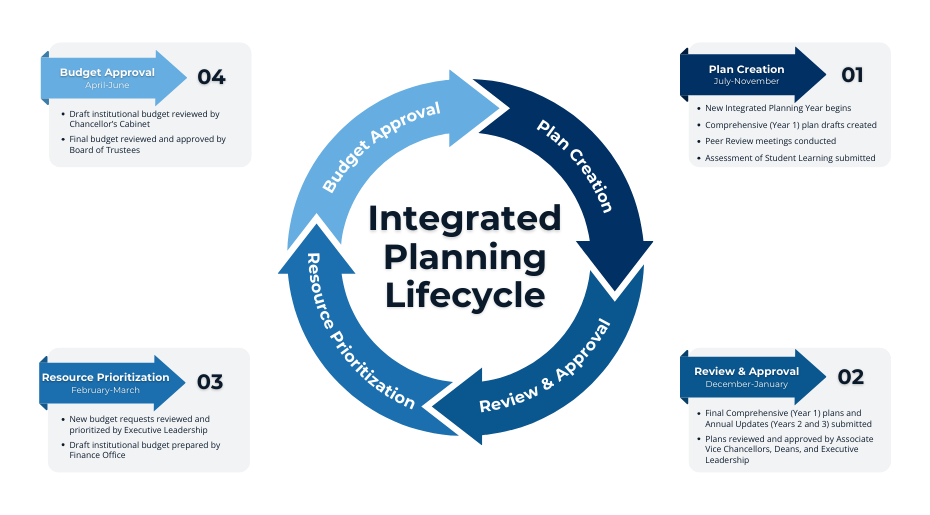
Integrated Planning follows a three-year cycle that begins July 1 and ends June 30 of the following year.
Each year, programs and departments:
- Reflect on previous goals and data
- Set new goals and identify budget needs
- Report progress and make adjustments
This cycle keeps planning continuous, focused, and aligned with the college’s priorities.
Integrated Planning is a shared responsibility across the college.
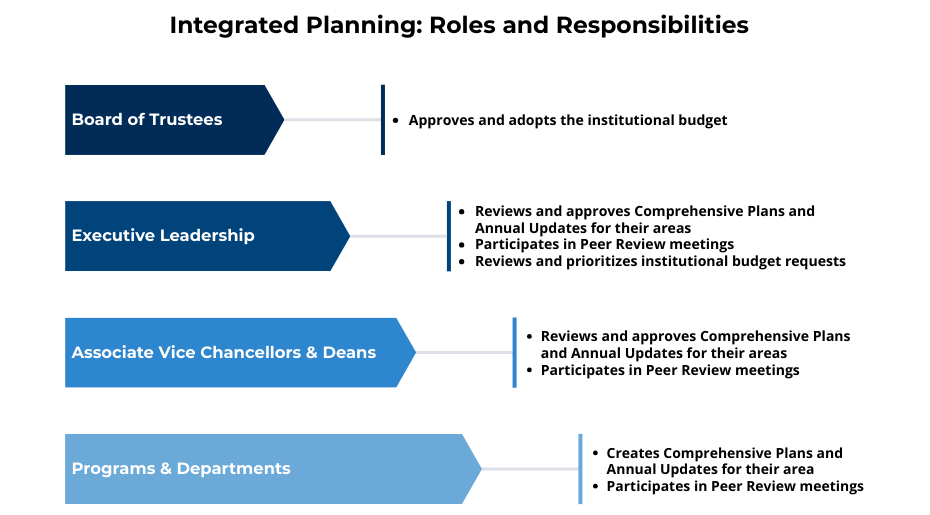
Key participants include:
- Programs and Departments reflect on previous goals and data, set new goals and identify resource needs, and report progress and make adjustments
- Associate Vice Chancellors and Deans review and approve plan submissions
- Executive Leadership reviews and approves plans and prioritizes budget needs
- Board of Trustees approves the final college budget
Leaders from programs and departments, Associate Vice Chancellors and Deans, and Executive Leadership also participate in the Peer Review process.
Collaboration across these groups strengthens accountability, strategic alignment, and continuous improvement.
Integrated Planning combines several planning efforts into one unified system.

Components include:
- Program Review
Self-evaluation completed by programs and departments using data and guided questions based on HLC Criteria, the college’s Strategic Plan, and OTC Cares. - Three-Year Plan
Forward-looking plan developed by program and department leaders. It outlines goals, measurable benchmarks, and any new budget needs for the next three years. - New Budget Request
Requests for funding of new items such as capital projects, equipment, technology, personnel, or one-time needs not covered by the current operational budget. - Peer Review Meeting
Collaborative meeting with Peer Reviewers, program and department leaders, executive leadership, and a facilitator to review and provide feedback on the Comprehensive Plan. - Assessment of Student Learning Annual Report (Instructional Units Only)
Annual summary of assessment activities, findings, and how results have been used to improve student learning, curriculum, or instruction. - Annual Update
Yearly update in years 2 and 3 of the planning cycle. It documents progress, outcomes, challenges, and any adjustments to goals. New budget requests may be submitted as part of this update.
Each component is completed in specific years based on the unit’s place in the cycle. The timing of each component depends on the program or department’s position in the three-year cycle.
- Year 1
- Program Review
- Three-Year Plan
- New Budget Requests (if applicable)
- Assessment of Student Learning
- Peer Review Meeting
- Years 2 and 3
- Annual Updates
- New Budget Requests (if applicable)
- Assessment of Student Learning
