
Commitment to Assessment of Student Learning
Ozarks Technical Community College is committed providing evidence of the quality of our educational experiences and programs, in order to fulfill our mission and our responsibility to the communities that support us. A focus on demonstrating student performance on course, departmental or programmatic, and institutional learning outcomes is critical to Ozarks Tech’s overall institutional effectiveness. The assessment process produces student learning data that drives Ozarks Tech’s curriculum, planning and budgeting processes.
Below you will find resources for faculty, as well as the general public, that explain Ozarks Tech’s assessment of student learning process in more detail. You will also find student learning outcome assessment data organized by academic year.
Assessment
Ozarks Tech implemented a one-size-fits-all assessment plan for academic programs in 2008. However, as an institution, we now better understand that the value of assessment lies in the utility of the process and data for the end user. In 2013, we shifted to an approach that embraces a variety of assessment methods.
Externally Mandated Assessment Standards.
Evidence from programs with externally mandated assessment standards is collected from instruments specified by external agencies or accrediting bodies. Typically, these assessments involve multiple measures including both summative (standardized licensure or board exams) and formative data (course pass rates, credentialing exams specific to content of one course, etc.).Each accrediting body sets their own achievement standards, which typically range from 90% to 100%.
Non-Externally Mandated Assessment Standards
Evidence from programs without externally mandated assessment standards is data on student achievement of course level learning outcomes. These standards tie the course learning outcomes, when applicable, to state-level curricular goals. Instructors gather the data using a variety of locally-developed instruments. These tools may consist of observation checklists to essay responses graded using rubrics. Instructors design them to be an appropriate measure for the skill described by each course objective. Academic departments use the data for curricular and instructional revision. Each department sets achievement standards for the course objectives. The benchmarks they set, which vary between 70% and 100%, measure achievement for every course objective.
After several years of review and revision, updated Institutional Learning Outcomes (ILOs) were adopted in 2022, with the input of faculty, staff, students, and community members. These student learning outcomes are the broadly stated knowledge, skills, and attitudes that students are expected to achieve as a result of their overall experiences with Ozarks Technical Community College. Performance indicators are examples of specific, measurable actions that students will know or be able to perform.
The assessment of student learning outcomes and performance indicators supports continuous improvement and ensures the college maintains high standards for teaching and learning.
Communication
Students will communicate effectively.
Critical Reasoning
Students will apply problem-solving strategies effectively.
Information Literacy
Students will locate, evaluate, and use information effectively.
Cultural and Global Awareness
Students will build cultural awareness to navigate cross-cultural differences.
Professional Preparedness
Students will demonstrate knowledge, skills, and behaviors that contribute to professional success.
Assessment of student learning helps the college understand what students know, think, and can do as a result of their educational experiences. This report documents how well students are meeting the institutional student learning outcomes. Assessment reports support continuous improvement and ensure the college maintains high standards for teaching and learning.
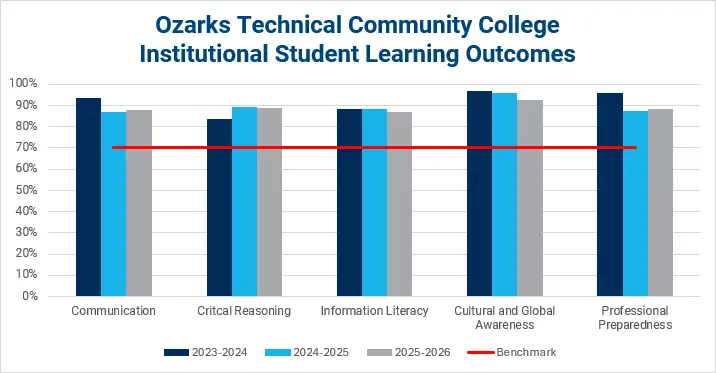
Note: To obtain copies of programmatic assessment results, please contact [email protected].