
Step into healthcare as a phlebotomy technician and play a vital role in collecting and preparing blood samples for testing and diagnosis.
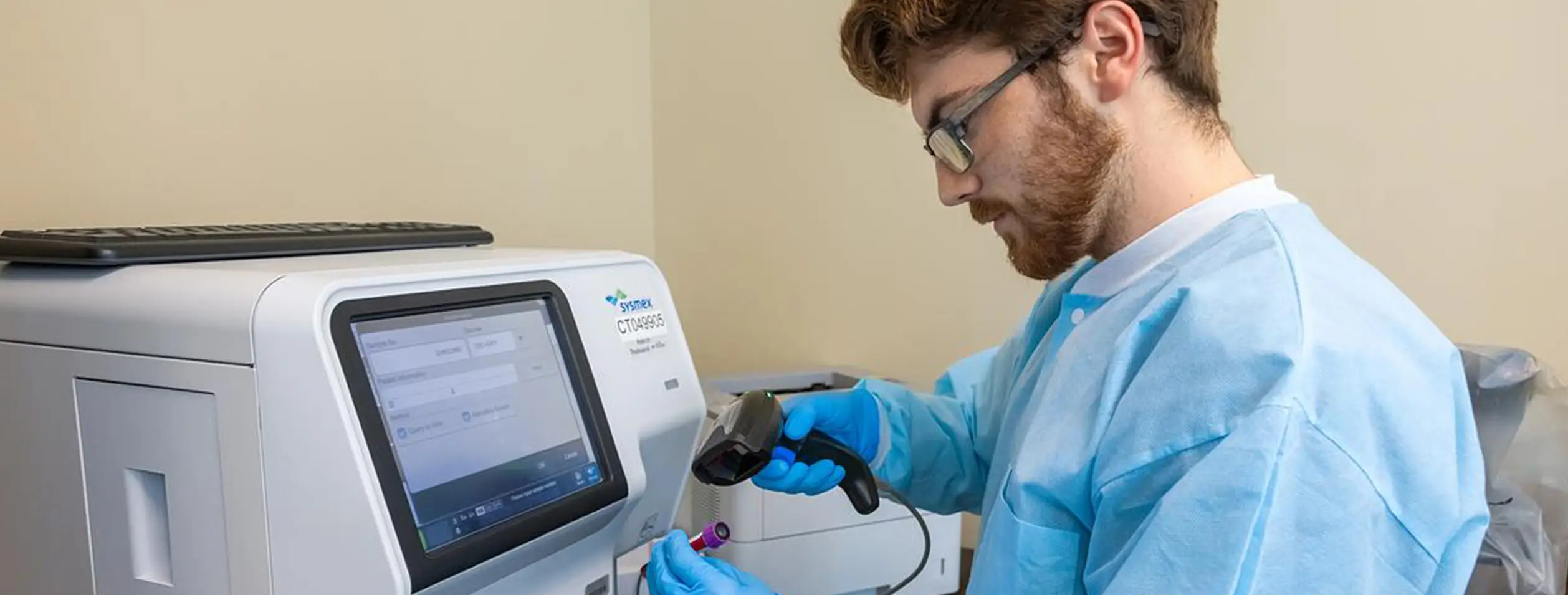
Collect, Prepare, and Support Patient Testing
Phlebotomy technicians are essential members of the healthcare team. You’ll work in hospitals, urgent care centers, diagnostic labs, blood donor centers, and physician offices—helping patients feel at ease while ensuring accurate, efficient sample collection.
You’ll learn to:
-
Safely draw blood and handle specimens
-
Maintain and use laboratory equipment
-
Prepare and label samples for testing
-
Follow strict safety and infection-control procedures
-
Support patient comfort and communication during collection
Phlebotomy offers an excellent entry point into healthcare, with growing demand and opportunities to build experience across a range of medical environments.
Training Options
ALHS 120: Phlebotomy Technician Program
Credits: 7
Lec 3.36 Lab .64 Practicum 3
Tier Rate: Tier II
The phlebotomy course prepares the student to draw blood from patients for clinical laboratory analysis. Students will learn the theory and principles relating to blood collection during the lectures. Upon successful completion of the lecture series, students will gain proficiency in the performance of these skills during clinical rotations at area hospitals and/or clinics. The course is designed to meet the eligibility requirements of the American Society of Clinical Pathologists Board of Registry Certification Examination [Phb(ASCP)]. Prerequisite(s): Instructor Consent.
Course Details and Requirements
- Can I do my clinicals on the weekends? Clinical hours are done when clinics are open. This is typically Monday – Friday from 8 am – 5 pm.
- I already work as a phlebotomist. Can I count my working time toward my clinical hours? This is on a case-by-case basis. Please talk with your instructor on the first night of class. Clinical must be completed in a CLIA approved lab, so this will be the deciding factor for most cases.
- How many clinical hours are required for my certification? The ASCP requires phlebotomy students to receive a minimum of 100 sticks and 100 clinical hours. These are two separate requirements that must be achieved.
- How long is this program? This program is 14 weeks long.
- Who makes my clinical schedule? This is put together by your instructor and our clinical coordinator after the start of the program.
- Are vaccines required for the program? Yes, you are required to upload copies of your vaccination history to our third party, my record tracker, within the first couple of weeks of the program. This must be completed before you are placed in a clinical environment.
- Is a background check required for the program? Yes! You must successfully pass a federal, criminal, and local background check. Information will be sent to you after the first night of class from our clinical coordinator to your OTC email address. These must come back clear before you can start your clinical rotation.
- Is a drug screen required to complete clinical? Yes! You must successfully pass a urine drug screen before being placed in a clinical environment.
- What happens if I do not pass any of the above requirements? If you do not meet any of the above, you will not be allowed to continue in the program.
- What do I wear in clinical? Scrubs are available for purchase at the Ozarks Tech bookstore. You will be required to wear these. They are to remain clean, unwrinkled, and odor free. You will need a couple of ink pens and a notebook to take notes. Cell phones are not allowed in the clinical environment. If you are a smoker, you should NOT smell of smoke when you attend clinic.
- When does my class meet? Class is online and meets one night a week face to face. Attendance is mandatory and once your clinical is set up, your clinical days are mandatory.
- I’m scared of needles. Do I have to be poked in the lab? The short answer is no. We don’t and can’t force you to be poked. However, you will want live practice, and our class size is small. There is a strong likelihood that if you refuse others to practice on you, your peers may not want you to practice on them. Most students want live practice prior to clinicals. And most students are nervous about needles at first. The instructors are very well trained and are in there watching for your safety.
- What is considered passing? In order to sit for certification, you must have a minimum of 75% as a final grade and complete the clinical requirement.
- What certification do I receive?You will be eligible to sit for the American Society fo Clinical Pathology (ASCP) PBT Certification Board of Certification (ascp.org)
- How do I receive my books? All books are electronic and will be available on the first night of class.
Allied Health FAQs
Submit the Ozarks Tech Application . On the application, choose “Enroll in Short Term Training” as your educational goal at OTC
- Your application will be reviewed and if approved, you will receive an offer of admission in your application portal
- After the offer of admission has been accepted, you will be granted permission to register for the course.
You will also be required to complete a background check and submit documentation of immunizations.
All applicants accepted into a Health Sciences program will have a criminal background check performed. This is necessary because of our affiliations with numerous clinical education sites. This will be done through a contracted agency. At the present time, if the program you are planning to enter requires licensure or certification by a national or state organization, it will be the decision of that agency as to your qualifications to apply for licensure or certification. Your acceptance into an OTC Health Sciences program or the completion of the program does not guarantee the eligibility to apply for licensure or certification. Students with a felony or a significant criminal history may not be able to participate in clinical experiences at some of our sites and may not be able to apply for a license to
practice.
For more information, check the Health Sciences admissions requirements page.
Ready to Get Started?
If you are not a current student, you will need to apply prior to registering for courses.