
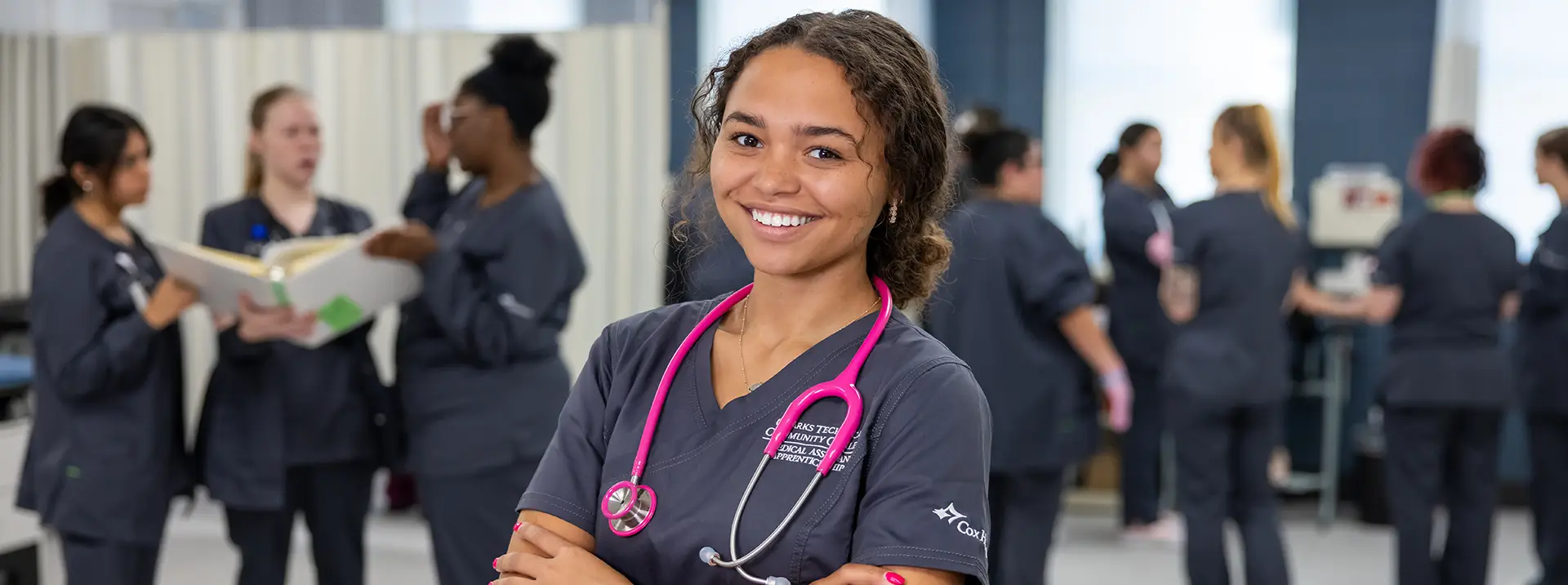
Support Patients and Healthcare Teams
Medical assistants are key members of the healthcare team, working closely with doctors and nurses in clinics and other medical settings. You’ll handle both patient care and administrative tasks that keep operations running smoothly.
You’ll learn to:
- Take patient histories and record vital signs
- Assist with exams and procedures
- Administer vaccinations
- Prepare and maintain medical instruments
- Manage patient records and scheduling
- Communicate with patients and healthcare staff
Our students consistently demonstrate this preparation, with a 100% certification exam pass rate in 2025 and a 99% pass rate in 2024—both 16% above the national average.
Medical assistants are needed in clinics, physicians’ offices, and specialty care centers, where they help ensure each patient receives efficient, compassionate care.
Program Pathways
Ozarks Tech offers two ways for you to complete this program. One way is the evening path, which meets two nights a week. Students also need to do 160 hours of clinical work during weekdays. This means working twice weekly to finish the clinical hours before the program ends.
The other way is the apprenticeship program, which meets Monday – Friday for eight hours daily, either in class or in a clinical setting. For more information on this process, please visit the Cox Health Medical Assistant Apprenticeship job listing. Students in the apprenticeship program are employees of CoxHealth.
Training Options
ALHS 130: Medical Assistant Comprehensive
Duration: 16 Weeks
Credits: 0
Lec 0 Lab 0 Practicum 0
Cost: $6995
Short-Term Course Credits: 0 The Medical Assistant Program is designed for those students wishing to begin their career path in the healthcare industry. The medical assistant is an unlicensed member of the healthcare team that is trained in multiple skills. Medical Assistants work mainly in outpatient or ambulatory care facilities and are cross trained to perform administrative and clinical duties. This 16 week accelerated program will teach the student to perform the skills of a medical assistant and give the student the foundational knowledge needed to successfully fulfill that role. Students will need access to a computer during the program. The class will meet as scheduled throughout the week. Prerequisite(s): Instructor Consent.
Course Details and Requirements
- Can I do my clinicals on weekends? Clinical hours are done when clinics are open. This is typically Monday through Friday from 8 to 5.
- I already work as an MA. Can I count my working time toward my clinical hours? No- You may not do clinicals at the clinic in which you work.
- Why can’t I do my clinicals at my clinic? We want you to get the education you are paying for, and that includes the benefit of being trained. If you do your clinicals at the clinic in which you already work, we fear you’ll be treated as staff instead of a student. You deserve to learn new skills and practice them.
- Can I get paid for clinicals? Not typically. Some students that already work in clinics under the bigger employers here (Cox and Mercy) might get paid for clinicals, but this is very rare.
- I have to work. How many hours are the clinicals? 160 hours done in the last half of the 16-week program.
- Do I have to do 40 hours a week in clinicals? You can if you prefer, but most students have to work while doing this program. We do require at least 20 hours per week.
- Who makes my clinical schedule? You do. You will sit down with the clinic manager during the initial meeting/interview and work with the manager to make your schedule. One you both sign your schedule, it is considered “set in stone” at that point and you are expected to attend all of the days and hours you have marked. You are expected to be on time, and not to miss. We encourage you to make a plan, and then a back up plan for transportation, childcare, etc.
- What do I wear during clinicals? Your neat, clean, unwrinkled blue school scrub uniform. Your uniform also consists of a couple black ink pens, a pad to write down questions, your watch with a second hand, your stethoscope, deodorant, appropriate underclothes, and no scented perfumes or lotions. If you smoke, you are NOT to smell of smoke.
- When is class? The apprenticeship class is Monday – Friday from 8am-5pm, every other day. It will alternate between class time and clinicals for 14 of the 16 weeks.
- Can I turn my homework in late? Not without discussing it with your instructor PRIOR to the work being late. We are training you to do a job, and work assignments have to be turned in on time.
- I’m scared of needles. Do I have to be poked in the lab? The short answer is no. We don’t and can’t force you to be poked. However, you will want live practice, and our evening classes tend to be pretty small. There is a strong likelihood that if you refuse others to practice on you, your peers may not want you to practice on them. Most students want live practice prior to clinicals. And most students are nervous about needles at first. The instructors are very well trained and are in there watching for your safety.
- Are vaccines required for the program? Yes, you are required to upload copies of your vaccination history to our third party, my record tracker, within the first couple of weeks of the program. This must be completed before you are placed in a clinical environment.
- Is a background check required for the program? Yes! You must successfully pass a federal, criminal, and local background check. Information will be sent to you after the first night of class from our clinical coordinator to your OTC email address. These must come back clear before you can start your clinical rotation.
- Is a drug screen required to complete clinical? Yes! You must successfully pass a urine drug screen before being placed in a clinical environment.
- What happens if I do not pass any of the above requirements? If you do not meet any of the above, you will not be allowed to continue in the program.
- What exactly is a medical assistant? Here is a quick overview (duties vary from medical practice to medical practice depending on location, size, specialty, and state law):
Clinical Duties (may include, but not limited to):
- Taking medical histories
- Explaining treatment procedures to patients
- Preparing patients for examinations
- Assisting the physician during examinations
- Collecting and preparing laboratory specimens
- Performing basic laboratory tests
Allied Health FAQs
Submit the Ozarks Tech Application to get started.
You will also be required to complete a background check and submit documentation of immunizations.
All applicants accepted into a Health Sciences program will have a criminal background check performed. This is necessary because of our affiliations with numerous clinical education sites. This will be done through a contracted agency. At the present time, if the program you are planning to enter requires licensure or certification by a national or state organization, it will be the decision of that agency as to your qualifications to apply for licensure or certification. Your acceptance into an OTC Health Sciences program or the completion of the program does not guarantee the eligibility to apply for licensure or certification. Students with a felony or a significant criminal history may not be able to participate in clinical experiences at some of our sites and may not be able to apply for a license to
practice.
For more information, check the Health Sciences admissions requirements page.
Ready to Get Started?
If you are not a current student, you will need to apply prior to registering for courses.