Start Your Career: By the Numbers
Apply To This ProgramChoose from multiple program options to advance your career.
Find employment opportunities locally, statewide, nationally and internationally.
Be a Hero in Your Community
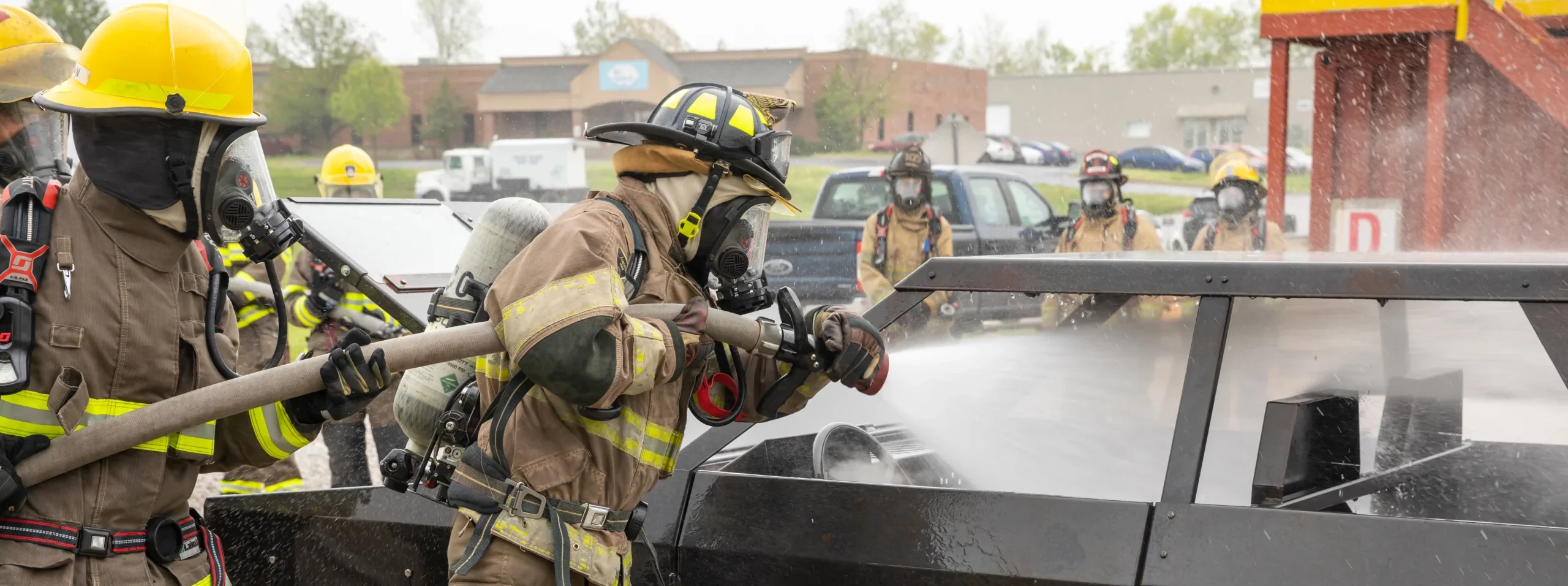
Want a job where you can help people every day? Firefighters and fire safety experts protect lives and property. At Ozarks Tech, you’ll build skills to enter a successful career in this exciting and important field.
The Fire Science programs gives you the knowledge and skills to pursue multiple careers, including:
- Firefighter
- Fire Inspector
- Fire Investigator
- Fire Safety Specialist
Whether you’re just starting out or already working in fire services, there’s a program to match your experience and take you to the next step. You’ll learn important skills in classes like Fire Prevention, Fire Hydraulics, and Fire Protection Systems.
With nearly 100 fire departments in southwest Missouri, there are lots of job opportunities close to home — and even more across the country or around the world!
The associate degree is accredited by the International Fire Service Accreditation Congress (IFSAC), so you’ll graduate with a trusted and respected credential.
Program Information
Explore our accreditation information, find program contacts and learn more about how to apply to Ozarks Tech.
General Admissions to Ozarks Tech
Admission to Ozarks Technical Community College is open to all individuals who can benefit from its educational programs. A focus of the college mission is on the academic, career and personal goals of the student. OTC may admit you as a First-Time student just completing their high school, GED or HiSET requirements or as a Transfer student coming from another institution finishing up a certificate or degree. For more information, visit OTC Admissions.
Wondering how you’re going to pay for college? At OTC, we believe that cost shouldn’t be a barrier to earning a degree. Our staff will work with you to make a financial plan. To browse the resources available to you, see paying for college.
At Ozarks Tech, we want your transfer process to be easy. We accomplish this goal through articulation agreements. These agreements are an official partnership to match coursework between schools. This gives you a more seamless transition from Ozarks Tech to a four-year institution.
We have established an agreement for this program. This will simplify the transfer of your credits to partner schools. To understand how this degree will transfer, review the current articulation agreements. Be sure to consult with your transfer school to ensure you’re on the right path toward completing your four-year degree.
The associate degree is accredited by the International Fire Service Accreditation Congress (IFSAC),1723 West Tyler Avenue; Stillwater, OK 74078 405.744.8303 ifsac.org
The program’s next review will take place during the Fall 2025 semester.
OTC is accredited by the Higher Learning Commission (hlcommission.org), an accreditation agency recognized by the U.S. Department of Education. Our current accreditation status with the HLC is displayed on the page linked below. Our next comprehensive evaluation will be in 2030-2031. View more on OTC Accreditation.
The Goals of the Fire Science Technology program at Ozarks Technical Community College include:
- Encourage and promote excellence in teaching and scholarship by respecting the process of learning, believing in the importance of scholarly learning and the role of the student in the process.
- Increase student acceptance, recognition and realization of industry training standards.
- Increase student acceptance, recognition and realization of industry performance standards.
- Prepare graduates with workable skills using computer literacy, technical communication, critical thinking and problem solving skills.
The above goals feed into the Institutional Learning Outcomes of:
- Communication – Students will demonstrate effective communication skills, including listening, speaking and writing, in order to advance academically and professionally.
- Employability – Students will develop career competencies and self-management skills needed to gain employment in their chosen professions.
- Professionalism – Students will develop personal and professional relationships by demonstrating ethical behavior, collaborative work and constructive conflict resolution to promote success and advancement in their careers.
- Critical Reasoning – Students will demonstrate the ability to problem solve through the processes of analyzing, reflecting, reasoning and forming conclusions and judgments on a variety of math concepts, ideas, issues and information.
- Information Literacy – Students will demonstrate how to create, retrieve, organize and analyze information, including information from digital and technological sources.
- Cultural and Global Awareness – Students will demonstrate the ability to recognize and respect the impact of different cultures, ethnic groups and values on society and the interdependence of people around the globe.
Program Outcomes
Graduate Student Learning Survey Results
Fire Science Technology Associate of Applied Science Degree
Fire Service Administration Associate of Science Degree
Program Outcomes
Mission Statement
The mission of the Fire Science Technology program is to educate, train, and prepare students for employment, promotion and advancement in a firefighting career by providing opportunities to new and current firefighters thereby increasing their employment, promotional and advancement probability.
Find Your Community
Getting involved is a great way to build connections and find your community on campus. With a variety of clubs and organizations and campus events it’s easy to find your people.
Thinking about earning your bachelor’s degree?
After your A.A.S., you may continue your education at a four-year institution. Bear in mind:
- Admission requirements vary
- Credits may transfer on a course-by-course basis
Course Information
Discover overview information, course sequences and specific course descriptions. Or, view the full catalog to see all the details.
Fire Science Technology (A.A.S.)
A.A.S. Degree: 63 Hours
Career departments, volunteer departments and departments with both career and volunteer firefighters combine to comprise approximately 100 fire departments throughout southwest Missouri. The Fire Science Technology program provides learning opportunities which introduce, develop and reinforce academic and occupational knowledge, skills and attitudes required for job acquisition, retention and advancement. Additionally, the program provides opportunities to retrain and upgrade present knowledge and skills. Career choices for Fire Science Technology students include the following: firefighter, fire inspector, fire instructor, fire investigator, fire protection systems installer, U.S. Forest Service, as well as various military branches. OTC graduates have employment opportunities locally, statewide, nationally and internationally. The program is accredited by the International Fire Service Accreditation Congress (IFSAC).
OTC has developed procedures for evaluating past training experiences and certification; inquiries should be directed to the lead instructor or department chair.
Students wishing to transfer to a four-year institution are strongly encouraged to seek the advice of the lead instructor or department chair of the FST program to determine courses appropriate for transfer.
This program is accredited by the International Fire Service Accreditation Congress (IFSAC), 1723 West Tyler Avenue, Stillwater, OK, 74078-8705 (405) 744-8303 https://ifsac.org/
Fire Science Technology Program Requirements – 44 Credit Hours
- EMS 101: Emergency Medical Technician – Basic
Emergency Medical Technician – Basic
This course is designed to prepare students to perform care of acutely ill or injured patients primarily in the out of hospital setting. Basic resuscitation, extrication, trauma care, initial patient assessment and triage, stabilization and transport of various patients are key components of this course. The course prepares students to test for national certification and state licensure. This course is the first step to becoming a paramedic.
Prerequisite(s): Selective Admission. Students must apply, attend an EMT orientation, and be released to register by the Paramedicine department before they can register for this course. Students must completed the required application process, background check, drug screening, immunizations, and attend the required orientation.Corequisite(s): BLS CPR Certification. EMS 100 is the suggested option for this. Alternate options with the OTC Sim Center or other American Heart Association instructors are appropriate. - FST 101: Principles Emergency Services
Principles Emergency Services
This course provides an overview to fire protection and emergency services; career opportunities in fire protection and related fields; culture and history of emergency services; fire loss analysis; organization and function of private and public protection services; fire departments as a part of local governments; laws and regulations affecting the fire service; fire service nomenclature; specific fire protection functions; basic fire chemistry and physics; introduction to fire protection systems; introduction to fire strategy and tactics; life safety initiatives.
- FST 102: Building Construction
Building Construction
Firefighters must understand building construction to understand the behavior of buildings under fire conditions.The student is introduced to the principles, methods, techniques and terminology used in building construction and how building construction relates to fire protection and fire safety. The elements of construction and engineering design of structures relating to fire protection is emphasized. Structural components and structural collapse are studied. The different classifications of buildings and how building construction and codes affect fire and life safety are discussed. This course is written to the National Fire Academy (NFA) FESHE curriculum
- FST 105: Introduction to Firefighter 1&2
Introduction to Firefighter 1&2
This course is based on the National Fire Protection Association 1001, Standard for Firefighter Professional Qualifications (current edition). The performance requirements and practical skills necessary to perform the duties of a firefighter are introduced. Topics include fire service organization, safety, fire behavior, self-contained breathing apparatus, ropes, hose, ladders, rescue, ventilation, salvage, overhaul, portable fire extinguishers, emergency medical care, fire control, water supply and fire prevention. Individuals successfully completing this course and meeting the requirements of Missouri Division of Fire Safety will be eligible for certification as Firefighter I and II by the Division of Fire Safety. This course serves as the initial step for Firefighter 172 certification.
Prerequisite(s): FST 120 or concurrent enrollment. - FST 106: Firefighter I and II
Firefighter I and II
This course is based on the National Fire Protection Association 1001, “Standard for Fire Fighter Professional Qualifications,” current edition. The performance requirements and practical skills necessary to perform the duties of a firefighter are thoroughly covered. Topics include fire service orientation, safety, fire behavior, selfcontained breathing apparatus, ropes, hoses, ladders, rescue, ventilation, salvage, overhaul, portable fire extinguishers, emergency medical care, fire control, water supply and fire prevention. Individuals successfully completing this course and meeting the requirements of Missouri Division of Fire Safety will be eligible for certification as Firefighter I and II by the Division of Safety.
Prerequisite(s): Grade of "C" or better in FST 105 and FST 120.Corequisite(s): FST 120 can be taken concurrently. - FST 107: Fire Prevention
Fire Prevention
This course provides fundamental knowledge relating to the field of fire prevention. Topics include history and philosophy of fire prevention, organization and operation of the fire prevention bureau, use and application of fire codes and standards, plans review, fire inspection, fire and life safety education, and fire investigation.This course is written to the National Fire Academy (NFA) FESHE curriculum.
- FST 109: Fire Hydraulics
Fire Hydraulics
This course provides a foundation of theoretical knowledge in order to understand the principles of the use of water in fire protection & to apply hydraulic principles to analyze and to solve water supply problems.
- FST 110: Principle of Firefighter & Emergency Services Safety & Survival
Principle of Firefighter & Emergency Services Safety & Survival
This Course introduces the basic principles and history related to the national firefighter life safety initiatives, focusing on the need for cultural and behavioral change throughout the emergency services.
- FST 117: Fire Protection Systems
Fire Protection Systems
This course provides information relating to the features of design & operation of fire alarm systems, water based fire suppression systems, special hazard fire suppression systems, water supplies for fire protection, and portable fire extinguishers.
- FST 120: Hazardous Materials
Hazardous Materials
This course is based on NFPA 472, Standard for Professional Competence of Responders to Hazardous Materials Incidents (current edition). This course focuses on chemical characteristics and reactions related to the storage, transportation and handling of hazardous materials. Emphasis is placed on the handling of hazardous materials emergencies, fire control and containment. Individuals successfully completing this course and meeting the requirements of the Missouri Division of Fire Safety will be eligible for state certification to the Hazardous Materials Operations level by the Division of Fire Safety.
- FST 260: Technical Rescue Core
Technical Rescue Core
This course is based on Chapter 5, NFPA 1006 – 2013 Standard for Rescue Technician Professional Qualifications, and facilitates ProBoard and/or IFSAC certifications in one or more of the technician level rescue specialties identified in Chapters 6 through 19. Designed for both fire department and emergency service personnel and private industry, this course provides responders with a basic understanding of technical rescue incidents and their hazards. The course is a combination of theory and practical demonstrations touching on the topics of: Rescue scene site operations Rescue incident victim management Rescue equipment maintenance Rescue ropes and rigging Practical and classroom sessions focus on stabilizing the incident, accessing and stabilizing the patient. Realistic training evolutions using effective equipment and techniques ensure student retention of this material.
- FST 280: Capstone Assessment
Capstone Assessment
The purpose of this course is to allow the student to apply the knowledge acquired from their educational experience in the Fire Science Technology Program toward an internship with a fire department to include the completion of a project, goals, and a reflection paper. A student must earn a Grade of “C” or better in this course to meet the FST graduation requirements.
Prerequisite(s): NoneCorequisite(s): None - TEC 285: Occupational Seminar
Occupational Seminar
Note: It is recommended students have 30 hours completed towards their degree program prior to enrolling in this course. Instruction for this course includes career identification, self-assessment, resume’ development, preparation of cover letters, completion of applications for local jobs, learning the online employment application process, research of local companies, jobs available, and current salary ranges, job searching techniques and tools, interviewing skills, follow-up steps after the job interview and on-the-job performance expectations.
General Education Requirements – 19 Credit Hours
The Missouri Department of Higher Education has identified a common set of general education courses that have been adopted statewide. These courses are called the “CORE 42.” CORE 42 courses are guaranteed to transfer to any Missouri public college or university to satisfy general education requirements.
Courses in knowledge areas below, designated with the CORE 42 logo indicates courses in that area have been evaluated and provided a MOTR number for transfer to all Missouri public institutions of higher education.
Courses that do not have this designation may still transfer to public and private colleges and universities in Missouri and elsewhere, but students are encouraged to check the transfer equivalency website of the institution to which they plan to transfer to confirm.
Please refer to the MDHE Core Transfer Curriculum for detailed information on CORE 42 courses.
Mathematical Sciences – 3 Credit Hours
- TEC 108: Applied Technical Mathematics
Applied Technical Mathematics
Course content includes the fundamental processes of mathematics with emphasis on problem-solving techniques. This course covers mathematical principles and concepts applicable to the technical trades utilizing introductory algebra, geometry, elementary trigonometry, and basic statistical methods.
- MTH 105: Business Math
Business Math
This course is designed to prepare students to apply mathematics to business situations. Topics include banking, purchasing, pricing, payroll and payroll taxes, interest, mortgages, depreciation, inventory and business statistics.
- MTH 110: Intermediate Algebra
Intermediate Algebra
This course is an extension of basic algebra and includes factoring, rational expressions, linear equations, quadratic equations, functions, graphs, radicals, complex numbers and applications.
- MTH 128: Contemporary Mathematics
Contemporary Mathematics
This course provides students with a basic survey of mathematics. Topics include problem solving, modeling, counting methods, probability, statistics and geometry.
- MTH 128S: Cont Mathematics with Support
Cont Mathematics with Support
This course provides students with a basic survey of mathematics. Topics include problem solving, modeling, counting methods, probability, statistics and geometry. MTH 128S will be driven by the same objectives as MTH 128, and satisfy the same requirement. The course design will provide students with more time, support, and individualized instruction to accomplish those objectives.
- MTH 129: Introductory Statistics
Introductory Statistics
This is the first course in statistics for students whose college and career paths require knowledge of the fundamentals of the collection, analysis, and interpretation of data. Topics include distributions, measures of central tendency and dispersion, elementary probability, sampling, estimation of parameters, hypothesis testing, regression and correlation.
- MTH 130: Algebra for Calculus
Algebra for Calculus
This course is a standard course in college-level algebra necessary for further studies in mathematics. Topics include solving equations, systems of equations, and inequalities; properties of functions; polynomial, rational, exponential, logarithmic functions and their graphs.
- MTH 130S: Algebra for Calculus With Support
Algebra for Calculus With Support
This course is a standard course in college-level algebra necessary for further studies in mathematics. Topics include solving equations, systems of equations, and inequalities; properties of functions; polynomial, rational, exponential, logarithmic functions and their graphs. MTH 130S will be driven by the same objectives as MTH 130, and satisfy the same requirement. The course design will provide students with more time, support, and individualized instruction to accomplish those objectives.
- MTH 131: Trigonometry
Trigonometry
This course is a study of trigonometric function and their graphs, identities, equations and applications. Topics include an introduction to polar coordinates, vectors, and solutions of right and oblique triangles.
Prerequisite(s): Grade of "C" or better in MTH 130 or satisfactory score on the ACT. - MTH 138: Pre-Calculus Mathematics
Pre-Calculus Mathematics
This course prepares students for calculus by integrating both college-level algebra and trigonometry. Topics include solving equations, systems of equations, and inequalities; properties of functions; polynomial, rational, radical, exponential, logarithmic, and trigonometric functions and their graphs; analytic trigonometry; and vectors. This course is designed for students with a prior background in algebra and trigonometry.
Prerequisite(s): Grade of "B" or better in MTH 110 or satisfactory score on the ACT. - MTH 140: Analytic Geometry and Calculus I
Analytic Geometry and Calculus I
This is the first course in a three-semester sequence. Topics include an introduction to analytic geometry, limits and continuity, the derivative and differential, the definite integral and applications.
Prerequisite(s): Grade of "C" or better in MTH 131 or MTH 138 or satisfactory score on the ACT. - MTH 141: Analytic Geometry and Calculus II
Analytic Geometry and Calculus II
This is the second course in a three-semester sequence. Topics include techniques of formal integration, applications of definite integration, infinite sequences and series, parametrized curves and polar coordinates.
Prerequisite(s): Grade of "C" or better in MTH 140. - MTH 210: Statistical Methods
Statistical Methods
Students study basic concepts of statistics and probability applicable to all disciplines. Topics include distributions, measures of central tendency and dispersion, elementary probability, sampling, estimation of parameters, hypothesis testing, regression and correlation.
Prerequisite(s): Grade of "C" or better in MTH 128 or MTH 130 or satisfactory score on the ACT. - MTH 214: Discrete Mathematics
Discrete Mathematics
This course provides an introduction to discrete mathematics. Topics include logic, basic counting, discrete probability, recursion, sets and relations, graphs and trees.
Prerequisite(s): Grade of "C" or better in MTH 131 or MTH 138 or satisfactory score on the ACT. - MTH 215: Algebraic Structures
Algebraic Structures
This course provides an introduction to techniques of mathematical reasoning and formal mathematical proof. Topics include logic, set theory, relations, functions, and number theory.
Prerequisite(s): Grade of "C" or better in MTH 140. - MTH 230: Linear Algebra
Linear Algebra
This course is a study of vector spaces, matrices, linear transformations, determinants, quadratic forms, eigenvalues, eigenvectors, canonical forms and inner-product spaces. Emphasis is placed on rigorous proof and the development of mathematical maturity.
Prerequisite(s): Grade of "C" or better in MTH 141. - MTH 240: Analytic Geometry and Calculus III
Analytic Geometry and Calculus III
This is the third course in a three-semester sequence. Topics include vector-valued functions, solid analytic geometry, partial differentiation, multiple integration and line and surface integrals in vector fields.
Prerequisite(s): Grade of "C" or better in MTH 141. - MTH 241: Differential Equations
Differential Equations
This is an introduction to the techniques available for the solution of ordinary differential equations. Topics include first and second order equations, systems of differential equations, Laplace transforms, series solutions, numerical methods and applications.
Prerequisite(s): Grade of "C" or better in MTH 141.
Written Communications – 3 Credit Hours
- ENG 101: Composition I
Composition I
This course introduces students to college-level reading, thinking, and writing through a series of composition-rhetoric assignments and activities that culminate in a research-supported project. Specifically, students apply critical and creative thinking to evaluate problems, interpret evidence/data, and draw conclusions. As part of this process, students learn to evaluate sources and emerging digital tools for currency, feasibility, truthfulness, credibility, and accuracy. Ultimately, students learn to synthesize knowledge to solve problems. This writing process (thinking, researching, evaluating, and persuading) helps students to develop an essential skill set they can use in their future academic, civic, and professional lives.
or - ENG 100: Composition I With Support
Composition I With Support
This course introduces students to college-level reading, thinking, and writing through a series of composition-rhetoric assignments and activities that culminate in a research-supported project. Specifically, students apply critical and creative thinking to evaluate problems, interpret evidence/data, and draw conclusions. As part of this process, students learn to evaluate sources and emerging digital tools for currency, feasibility, truthfulness, credibility, and accuracy. Ultimately, students learn to synthesize knowledge to solve problems. This writing process (thinking, researching, evaluating, and persuading) helps students to develop an essential skill set they can use in their future academic, civic, and professional lives. English 100 will be driven by the same course objectives as English 101 and satisfy the same requirement.
- ENG 101: Composition I
Oral/Written Communications – 3 Credit Hours
- COM 100: Introduction to Communication
Introduction to Communication
This course provides an introduction to the study of communication, including interpersonal communication, small group dynamics, and public speaking.
- COM 105: Public Speaking
Public Speaking
This is an introductory course in research, composition, delivery, and evaluation of speeches for a variety of purposes and occasions. Students develop skills in critical listening and analysis through small group and individual activities.
- COM 200: Interpersonal Communication
Interpersonal Communication
This course is designed as an introduction to the theory and practice of interpersonal communication. Students learn how to become both effective and appropriate communicators in a variety of contexts. Students also develop good listening and responding skills, conflict management strategies, sensitivity to language and an understanding of cultural and gender differences.
Prerequisite(s): Grade of "C" or better inENG 100 or ENG 101. - ENG 102: Composition II
Composition II
This course continues developing students’ abilities to use research and writing to make informed and ethical arguments; effectively communicating these arguments to professional and expert audiences in a research-supported project. Moreover, the course further develops students’ skills in critical and creative thinking to evaluate problems, interpret evidence/data, and draw conclusions.
Emphasis is placed on honing skills of audience analysis, analytical reading, problem solving, research methods—including both primary and secondary research—and persuasive writing. Also, this course will acquaint students with patterns and conventions of multiple disciplinary communities. This writing process (thinking, researching, evaluating, and applying rhetorical strategy) prepares students for their academic and professional futures.
Prerequisite(s): ENG 100 or ENG 101. - ENG 150: Technical Writing
Technical Writing
This course emphasizes developing the student’s ability to write clearly, concisely and accurately. Students practice collecting, analyzing, interpreting and presenting information in a variety of technical documents used in professional settings while using proper research and documentation techniques, sound visual design principles and effective writing styles suitable for a specific communicative context. Throughout, emphasis will be placed on honing skills in audience analysis, analytical reading, critical thinking, research methods and clear writing.
Prerequisite(s): ENG 100 or ENG 101.
Natural Sciences – 4 Credit Hours
- BCS 165: Human Anatomy
Human Anatomy
Microscopic and macroscopic examination of the human body structures and systems are the focus of this course. Students evaluate the integration of the various systems within the entire body. The laboratory provides an opportunity for identification and evaluation of representative human models and slides and dissection of comparable mammalian organ systems.
- BIO 100: Life Science
Life Science
This course covers a study of the biological principles that apply to all living systems. A survey of living organisms with an emphasis on how life functions on earth and how living things have adapted over time is explored. Laboratory activities give students the opportunity to apply biological principles presented in lecture.
- BIO 105: Environmental Science
Environmental Science
This course will survey basic environmental science topics including; how ecosystems function, standards of sustainability, and the impact of humans on the biosphere. Outdoor and indoor laboratory activities provide students with a hands on opportunity to apply principles presented in lecture.
- BIO 160: General Biology I
General Biology I
This course is an introductory biology course for biology majors and minors. It provides an introduction to the concepts of biological structure and function at the molecular and cellular level, genetics and evolution. Students have the opportunity to demonstrate in the laboratory the principles presented in lecture.
- CHM 101: Introductory Chemistry
Introductory Chemistry
This is an introductory course designed to study basic chemical principles. Topics include atomic structure, measurement, bonding, properties of gases, acids and bases, solutions, organic nomenclature, functional groups, carbohydrates, lipids, proteins, and nucleic acids. Laboratory activities give students the opportunity to demonstrate chemical principles presented in lecture.
- CHM 160: General Chemistry I
General Chemistry I
This course is a study of the fundamental laws and theories of chemical structures and reactions. Topics include: atomic theory, stoichiometry, aqueous reactions, properties of gases, liquids, and solids, periodicity, bonding, thermodynamics, and properties of solutions. This course is recommended for all those majoring in Science as well as Chemistry majors and minors.
Prerequisite(s): Grade of "C" or better in MTH 110 or higher, or satisfactory score on the ACT. - PHY 105: Introduction to Physics
Introduction to Physics
This course provides an introduction to basic physics. Students will apply the principles of mechanics, energy, waves, matter and atomic theory. Laboratory activities will give students the opportunity to demonstrate physics principles presented in lecture. A previous college level math course is recommended.
Prerequisite(s): Knowledge of algebra, scatter plot graphing, slope and equation of the line, scientific notation, and unit conversions is recommended. - PHY 110: Introduction to Geology
Introduction to Geology
This course is an introduction to basic geology. Students learn about the principles and applications of mineralogy, petrology, structural geology, geomorphology and historical geology. Laboratory skills necessary for the study of geology are introduced. A previous college level course is recommended.
- PHY 115: Introduction to Astronomy
Introduction to Astronomy
This course provides an introduction to basic astronomy. Students will learn about the composition, dynamics, evolution of planets, stars, and the universe. Laboratory activities will give students the opportunity to demonstrate physics principles presented in lecture. One evening field trip is required. A previous college level math course is recommended.
- PHY 120: General Physics I
General Physics I
This is an algebra based physics course. Students learn about the principles and applications of mechanics, wave motion and heat. Laboratory activities give students an opportunity to demonstrate physics principles presented in lecture. This course is designed for earth science, biology, chemistry, health and medical majors.
Prerequisite(s): Grade of "C" or better in MTH 130 or equivalent (MTH 131 recommended).
Social and Behavioral Sciences – 6 Credit Hours (include one Civics course, PLS 101 or HST 120 or HST 130)
- ANT 101: Introduction to Anthropology
Introduction to Anthropology
This course introduces the student to the four subfields of anthropology: physical/biological, ethnology/cultural, linguistic and archaeological/material. The human condition will be studied using the various methods and theories that are specific to each sub-discipline.
- ANT 220: Cultural Anthropology
Cultural Anthropology
Cultural Anthropology, also known as ethnology, social anthropology or sociocultural anthropology, is the largest of the four ‘fields’ or subdisciplines of anthropology. Cultural anthropologists study the ways in which people live throughout the world and write accounts of cultures, known as ethnographies, to gain insights into the human condition. Cultural anthropology also compares the ways of living, developing concepts and theories that apply to all cultures and making cross-cultural generalizations about human behavior.
Prerequisite(s): ANT 101 or SOC 101. - COM 150: Intro Mass Communication
Intro Mass Communication
The media are everywhere, and they affect almost every aspect of our lives, including our knowledge of the world around us: the decisions we make as consumers and the values we embrace. Print and electronic media are covered in this course.
Prerequisite(s): COM 100 or COM 105. - CRM 210: Intro to Criminal Justice
Intro to Criminal Justice
This is an introductory course in the philosophical and historical background of the American criminal justice system and its primary components: law enforcement, courts, and corrections. Students will examine the organization, purpose, and functions of the three components in the administration of criminal justice.
- ECO 270: Principles of Macroeconomics
Principles of Macroeconomics
This course provides an introduction to the origin and derivation of economic systems. This course includes a look at the structure, organization, operation, and the goals of the United States economic system. A study in basic economic principles, including the role of the government in conducting economic policies (spending and taxes), the role of the Federal Reserve in managing the supply of money, and the role of others (including households and businesses) in determining economic outcomes is included. This course prepares students for further study in economics.
- ECO 275: Principles of Microeconomics
Principles of Microeconomics
This course is an introduction to microeconomic analysis. It is an in-depth look at the behavior of the individual and businesses as it relates to the determination of the price structure, distribution of income, and trade. This course is an examination of the participants and structures of the marketplace.
Prerequisite(s): ECO 270. - GRY 101: World Geography
World Geography
Students in this course learn the role of geography in the economic, political and social development of each of the regions studied and how the various world regions interact with one another.
- HST 105: Ancient and Medieval World History
Ancient and Medieval World History
This course is a survey of human societies throughout the world from the first humans through the ancient and medieval periods. Students will study the interaction of geography and technology with human societies, the impact of diverse religions, beliefs and cultures, the transformation of economic systems, and the formation of governments, states and empires.
- HST 106: Modern World History
Modern World History
This course is a survey of the increasing interconnection of human societies throughout the world from the Age of Exploration through the 21st century. Students will study the changing worldwide impact of religions, science and technology, theories and ideologies in shaping societies, economies, nations and empires, global conflicts and connections.
- HST 120: U.S. History I: to 1865
U.S. History I: to 1865
This course is a survey of the history of the United States from pre-Columbian societies through the Civil War, including formative political, social, economic and cultural developments. It also introduces students to history as an academic discipline and requires analysis, synthesis and evaluation of primary and secondary materials in reading, discussion and writing. HST 120 will satisfy the Missouri state law requiring instruction in the United States and Missouri Constitutions.
- HST 130: U.S. History II: 1865-Present
U.S. History II: 1865-Present
This course is a survey of the history of the United States from Reconstruction to the present, covering the political, economic, social and cultural developments that have shaped modern America. It introduces students to history as an academic discipline and requires analysis, synthesis and evaluation of primary and secondary materials in reading, discussion and writing. HST 130 will satisfy the Missouri state law requiring instruction in the United States and Missouri Constitutions.
- PLS 101: American Government and Politics
American Government and Politics
This introductory course familiarizes students with American and Missouri government constitutions, institutions, policies and processes. Students develop an understanding of the foundations, environment, and principles of democracy with key concepts about voting, political parties, campaigns, and interactions between the branches of government. The course emphasis is on the values, rights, and responsiblities that shape public decision making of active and informed citizens in the American political system. This course meets instruction requirements (Missouri Revised Statute 170.011.1) in the Constitution of the United States and the state of Missouri.
- PLS 201: International Relations
International Relations
This course is a study of international relations, international behavior, and the role of the nation-state within the international system. Areas of concentration include foreign policy, major social and political forces at work in the contemporary world, theories of international relations, nationalism and conflict/cooperation.
Prerequisite(s): PLS 101 or GRY 101. - PSY 110: Introduction to Psychology
Introduction to Psychology
This course provides an introduction to psychology including history and systems, physiology, human growth and development, sensation and perception, learning, memory, emotion, motivation, personality, adjustment, psychopathology, industrial and social psychology.
- PSY 130: Life Span Development Psychology
Life Span Development Psychology
This course examines human development’s physical, cognitive, social, and emotional changes. The stages of development are discussed in the class, including the challenges individuals face along the developmental journey. The curriculum also studies the optimal conditions for humans to grow and flourish. The scientific principles introduced in the class are applied in a case study format.
- SOC 101: Introduction to Sociology
Introduction to Sociology
This course is an inquiry into the nature of society, the foundation of group life, institutions, structure of society and the role of the individual as a group member. Emphasis on implications for social change is encouraged.
- SOC 215: Deconstructing Social Problems
Deconstructing Social Problems
This course is a critical examination of social problems that exist in modern societies. Social problems will be addressed through an analysis of how they are constructed, the sociological approach to problems, and an exploration of why problems persist. Policies related to reducing social problems will be discussed with an emphasis on what we can do in our community to decrease the negative consequences of social problems.
Prerequisite(s): Completion of 12 credit hours; 100 level or above.
Fire Science – Fundamental Firefighting Certificate
Certificate: 38 Hours
Becoming a firefighter is a big commitment of time and service. On the most basic level, firefighters control and put out fires and respond to emergencies. Due to the wide range of duties involved in the job, firefighters must receive expert training to handle tasks such as connecting hoses and pumps, rescuing and treating the injured, writing reports on incidents and potential fire causes, educating the public about safety, conducting routine drills, and maintaining fire equipment. This certificate program addresses the foundational skills universal to all structural firefighters. Everyone must start with learning the Basics. Breaking that training into smaller “parts” can make it easier to fit the training into a busy schedule. While emergency services organization training requirements can vary from entity to entity, most public safety entities require all applicants to complete some post-secondary education and career training.
The Fundamental Firefighting Certificate program prepares students for employment, for entry into a formal undergraduate degree program, or qualifying the student for advancement in specific duties and organizational roles. The program concentrates on courses in the professional field without requiring students to complete a year or more of general education studies. The Fundamental Firefighting Certificate Program is a specially designed firefighting certificate for students wanting to pursue entry level opportunities as firefighters. OTC’s Fire Science Technology Program has developed a one-year certificate program that combines practical and classroom instruction into a nationally recognized certificate program. The education received in this program is applicable to the OTC Fire Science Technology A.A.S. degree program in fire science.
This program is accredited by the International Fire Service Accreditation Congress (IFSAC), 1723 West Tyler Avenue, Stillwater, OK, 74078-8705 (405) 744-8303 https://ifsac.org/
Fire Science – Fundamental Firefighting Certificate Requirements
- FST 101: Principles Emergency Services
Principles Emergency Services
This course provides an overview to fire protection and emergency services; career opportunities in fire protection and related fields; culture and history of emergency services; fire loss analysis; organization and function of private and public protection services; fire departments as a part of local governments; laws and regulations affecting the fire service; fire service nomenclature; specific fire protection functions; basic fire chemistry and physics; introduction to fire protection systems; introduction to fire strategy and tactics; life safety initiatives.
- FST 102: Building Construction
Building Construction
Firefighters must understand building construction to understand the behavior of buildings under fire conditions.The student is introduced to the principles, methods, techniques and terminology used in building construction and how building construction relates to fire protection and fire safety. The elements of construction and engineering design of structures relating to fire protection is emphasized. Structural components and structural collapse are studied. The different classifications of buildings and how building construction and codes affect fire and life safety are discussed. This course is written to the National Fire Academy (NFA) FESHE curriculum
- FST 103: Emergency Medical Responder
Emergency Medical Responder
This course focuses on the role of the Emergency Medical First Responder to initiate immediate lifesaving care to critical patients who access the emergency medical system through 911.
- FST 105: Introduction to Firefighter 1&2
Introduction to Firefighter 1&2
This course is based on the National Fire Protection Association 1001, Standard for Firefighter Professional Qualifications (current edition). The performance requirements and practical skills necessary to perform the duties of a firefighter are introduced. Topics include fire service organization, safety, fire behavior, self-contained breathing apparatus, ropes, hose, ladders, rescue, ventilation, salvage, overhaul, portable fire extinguishers, emergency medical care, fire control, water supply and fire prevention. Individuals successfully completing this course and meeting the requirements of Missouri Division of Fire Safety will be eligible for certification as Firefighter I and II by the Division of Fire Safety. This course serves as the initial step for Firefighter 172 certification.
Prerequisite(s): FST 120 or concurrent enrollment. - FST 106: Firefighter I and II
Firefighter I and II
This course is based on the National Fire Protection Association 1001, “Standard for Fire Fighter Professional Qualifications,” current edition. The performance requirements and practical skills necessary to perform the duties of a firefighter are thoroughly covered. Topics include fire service orientation, safety, fire behavior, selfcontained breathing apparatus, ropes, hoses, ladders, rescue, ventilation, salvage, overhaul, portable fire extinguishers, emergency medical care, fire control, water supply and fire prevention. Individuals successfully completing this course and meeting the requirements of Missouri Division of Fire Safety will be eligible for certification as Firefighter I and II by the Division of Safety.
Prerequisite(s): Grade of "C" or better in FST 105 and FST 120.Corequisite(s): FST 120 can be taken concurrently. - FST 107: Fire Prevention
Fire Prevention
This course provides fundamental knowledge relating to the field of fire prevention. Topics include history and philosophy of fire prevention, organization and operation of the fire prevention bureau, use and application of fire codes and standards, plans review, fire inspection, fire and life safety education, and fire investigation.This course is written to the National Fire Academy (NFA) FESHE curriculum.
- FST 108: Fire Behavior & Combustion
Fire Behavior & Combustion
This course explores the theories and fundamentals of how and why fires start, spread, and how they are controlled.
Prerequisite(s): NoneCorequisite(s): None - FST 110: Principle of Firefighter & Emergency Services Safety & Survival
Principle of Firefighter & Emergency Services Safety & Survival
This Course introduces the basic principles and history related to the national firefighter life safety initiatives, focusing on the need for cultural and behavioral change throughout the emergency services.
- FST 117: Fire Protection Systems
Fire Protection Systems
This course provides information relating to the features of design & operation of fire alarm systems, water based fire suppression systems, special hazard fire suppression systems, water supplies for fire protection, and portable fire extinguishers.
- FST 120: Hazardous Materials
Hazardous Materials
This course is based on NFPA 472, Standard for Professional Competence of Responders to Hazardous Materials Incidents (current edition). This course focuses on chemical characteristics and reactions related to the storage, transportation and handling of hazardous materials. Emphasis is placed on the handling of hazardous materials emergencies, fire control and containment. Individuals successfully completing this course and meeting the requirements of the Missouri Division of Fire Safety will be eligible for state certification to the Hazardous Materials Operations level by the Division of Fire Safety.
- FST 260: Technical Rescue Core
Technical Rescue Core
This course is based on Chapter 5, NFPA 1006 – 2013 Standard for Rescue Technician Professional Qualifications, and facilitates ProBoard and/or IFSAC certifications in one or more of the technician level rescue specialties identified in Chapters 6 through 19. Designed for both fire department and emergency service personnel and private industry, this course provides responders with a basic understanding of technical rescue incidents and their hazards. The course is a combination of theory and practical demonstrations touching on the topics of: Rescue scene site operations Rescue incident victim management Rescue equipment maintenance Rescue ropes and rigging Practical and classroom sessions focus on stabilizing the incident, accessing and stabilizing the patient. Realistic training evolutions using effective equipment and techniques ensure student retention of this material.
Locations Offered:
More Tools for Finding Your Path
Notices & Disclaimers
*Costs displayed are based on current tuition and fee rates for the program’s required credit hours, as approved by the OTC Board of Trustees, and are subject to change without notice. Estimates reflect both in-district and out-of-district residency rates. Actual costs, degree completion time, and credit requirements may vary based on residency, prior credits, elective courses, program updates, and enrollment factors. For additional information on attendance costs, visit Cost of Attendance, tuition and fees or contact us at 417-447-6900.
**Graduation rates vary by individual. For details on program enrollment, retention, exam/certification, and employment rates, visit Student Outcomes / Student Right-to-Know. Some careers on this list may require additional education and training. For program-specific accreditation visit OTC Accreditation.