Start Your Career: By the Numbers
Apply To This ProgramHybrid courses give you increased flexibility.
Provide Essential Support in Your Community
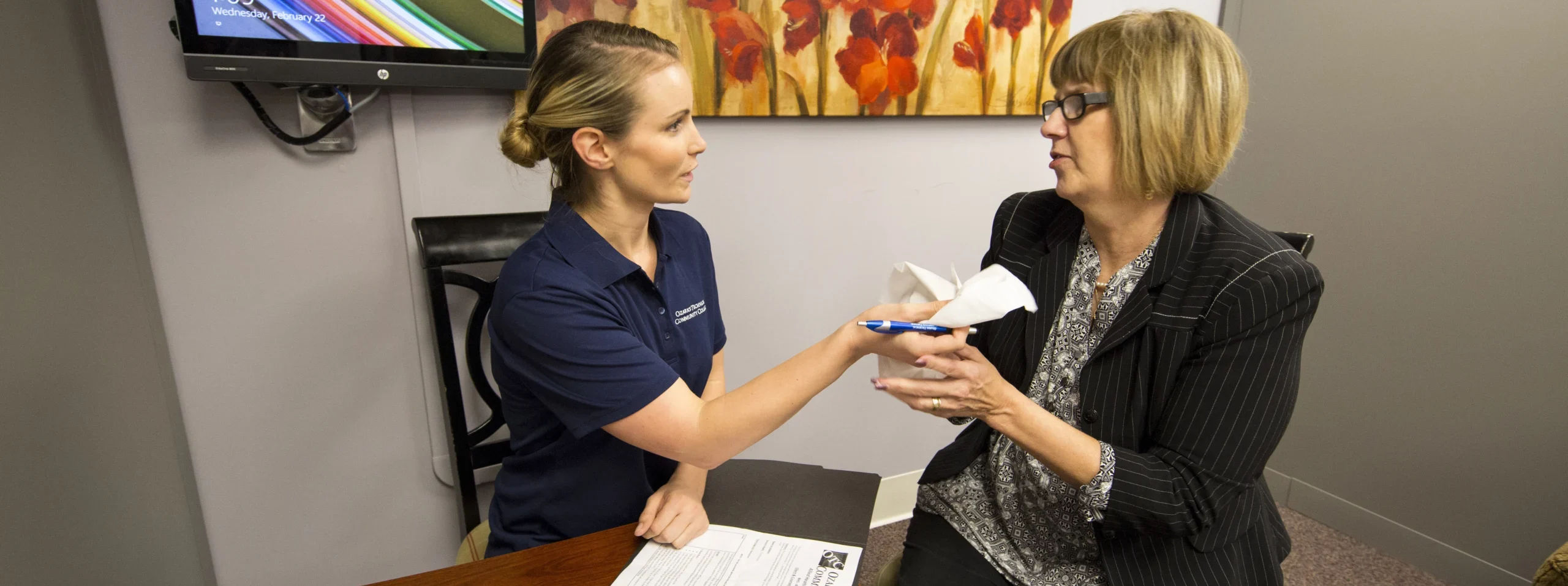
Make a difference in your community. The Behavioral Health Support (BHS) program gives you skills to help people build healthier and more stable lives. Gain training to work alongside mental health professionals in crisis care and long-term support.
Take your education beyond the classroom with practicum experiences. You gain hands-on training to provide resources and support in real settings, including:
-
Rehab clinics
-
Youth Support Centers.
-
Schools
-
Community and home-based services
Ozarks Tech partners with the Missouri Department of Mental Health, giving you strong local and statewide job opportunities.
Program Information
Explore our accreditation information, find program contacts and learn more about how to apply for the program.
The Behavioral Health Support program requires a separate application process in addition to the general Ozarks Tech Admission Process
General Admissions to Ozarks Tech
Admission to Ozarks Technical Community College is open to all individuals who can benefit from its educational programs. A focus of the college mission is on the academic, career and personal goals of the student. OTC may admit you as a First-Time student just completing their high school, GED or HiSET requirements or as a Transfer student coming from another institution finishing up a certificate or degree. For more information, visit OTC Admissions.
Wondering how you’re going to pay for college? At OTC, we believe that cost shouldn’t be a barrier to earning a degree. Our staff will work with you to make a financial plan. To browse the resources available to you, see paying for college.
At Ozarks Tech, we want your transfer process to be easy. We accomplish this goal through articulation agreements. These agreements are an official partnership to match coursework between schools. This gives you a more seamless transition from Ozarks Tech to a four-year institution.
We have established an agreement for this program. This will simplify the transfer of your credits to partner schools. To understand how this degree will transfer, review the current articulation agreements. Be sure to consult with your transfer school to ensure you’re on the right path toward completing your four-year degree.
Shy Wells
Behavioral Health Support Program Director
417-447-2692
Accreditation
The Behavioral Health Support Program is supported by the Missouri Department of Mental Health.
OTC is accredited by the Higher Learning Commission (hlcommission.org), an accreditation agency recognized by the U.S. Department of Education. Our current accreditation status with the HLC is displayed on the page linked below. Our next comprehensive evaluation will be in 2030-2031. View more on OTC Accreditation.
Program Outcomes
- Know and understand the field of mental health and human services.
- Analyze and remember legal and ethical issues as they relate to targeted populations.
- Understand, evaluate, and apply fundamental concepts and approaches to elicit behavior modifications.
- Evaluate real-world situations to apply effective evidence-based best practices.
- Acquire professional skills including communication, time management, positive work ethic, and trauma-informed care.
Find Your Community
Getting involved is a great way to build connections and find your community on campus. With a variety of clubs and organizations and campus events it’s easy to find your people.
Looking for something a little different?
Check out similar programs that might be the right fit for you.
Course Information
Discover overview information, course sequences and specific course descriptions. Or, view the full catalog to see all the details.
Behavioral Health Support (A.A.S.)
A.A.S. Degree: 61 Hours
The Associate of Applied Science in Behavioral Health Support provides the training for employment as a Community Support Specialist/Care Coordinator. The Community Support Specialist/ Care Coordinator serves an essential role in achieving better client outcomes, better client experiences and reduced costs; the triple aim of today’s health care system. They assist clients with their behavioral health and physical health symptoms and interface with a variety of community agencies; i.e. schools, health providers, corrections, housing, employment and social services. Employment options upon completion of this degree include but are no limited to: Entry level positions in state, county, and local human service agencies, substance counseling, positions in private or public treatment and rehabilitation centers, schools, and other human service agencies. This is a selective admission program.
Behavioral Health Support Program Requirements – 34 Credit Hours
- BHS 200: Introduction to Behavioral Health Support
Introduction to Behavioral Health Support
Students are introduced to the programs and services offered by Community Behavioral Health Centers. Skills and ethical considerations needed to work with various clients are discussed. Students are introduced to diagnosis, the recovery/resiliency model, and caresystems with the Community Support model as well as an overview of legal issues and responsibilities in the field.
- BHS 210: Legal and Ethical Issues
Legal and Ethical Issues
This course examines the legal and ethical issues related to servies for clients served by Behavioral Health Centers. Topics include guardianship, custody and conservatorship, client rights, fraud and abuse, detention and other legal and court issues. Ethical standards, professional and personal boundaries are discussed.
Prerequisite(s): BHS 200. - BHS 220: Systems of Care
Systems of Care
This course provides a holistic approach to care. Approaches that promote active participation by the client in decision making and self-advocacy are examined. Techniques to motivate clients toward personal responsibility for resiliency and recovery are introduced along with the development of wellness plans and support networks.
Prerequisite(s): BHS 200 - BHS 230: Substance Use Disorders
Substance Use Disorders
This course is the study of chemical use and dependency, including the cycle of addiction and recovery. Comprehensive substance use treatment and rehabilitation models in a variety of settings will be examined.
Prerequisite(s): BHS 210 - BHS 240: Client Interactions I
Client Interactions I
Students will be introduced to the techniques for assuring consistency, accountability and effectiveness for intake operations. Topics include the concept of intake, the purpose and types of assessment tolls utilized for determining risk and treatment needs. Skills will be developed in conducting interviews, establishing client rapport, eliciting client information, and utilization of proper clinical tools for documentation within a treatment plan.
Prerequisite(s): BHS 210 - BHS 250: Chronic Health Care Issues
Chronic Health Care Issues
This course presents content on health promotion and health education and the importance to both the individual
and the community. Program planning is covered in this course to help in developing change projects within the organization as well as to help develop health improvement programs with clients and groups.
Attention is placed on several aspects of health including a general overview of chronic diseases, how nutrition and physical activity play a role in overall health, and how smoking leads to many chronic diseases. The connection between mental health and physical health is the main focus of this course and will be discussed in depth throughout the course content.
Prerequisite(s): BHS 230 - BHS 260: Family and Youth Issues
Family and Youth Issues
This course will examine family dynamics and problem patterns within the family unit. Family and youth interventions and problem prevention will be addressed. The Community Support role in family intervention is explored.
Prerequisite(s): BHS 230; Grade of "C" or better in PSY 130. - BHS 270: Client Interactions II
Client Interactions II
This course examines techniques of working with others for collaboration, conflict resolution, crisis intervention and de-escalation. Listening and responding skills will be practiced along with developing skills to manage the dynamic differences presented by the clients and the communities served. Challenging client issues will be presented and resolutions examined.
Prerequisite(s): BHS 230 - BHS 280: Evidence Based Treatment
Evidence Based Treatment
This course will introduce students to cognitive behavioral therapy, parent management training, parent-child interaction therapy, and other evidence based practices. The types of medications commonly prescribed for emotional, personality, and physical disorders will be identified along with the requirements of administering and observing self-administration of medications.
Prerequisite(s): BHS 250; Grade of "C" or better in PSY 285. - BHS 291: Field Practicum I
Field Practicum I
This course is a field placement designed to provide a student with observation and practical experience in a behavioral health community center or similar service agency or provider. The course will compare and contrast how various populations are being served and how agencies collaborate and integrate services to meet client needs. Passing a background check and drug test is required for this course.
Prerequisite(s): Grade of "C" or better in BHS 200, BHS 210, BHS 220.Corequisite(s): BHS 230 . - BHS 292: Field Practicum II
Field Practicum II
This course provides students with practical experience in Behavioral Health Centers. Students participate in intake, assessment and treatment planning and learn how to conduct functional behavioral interventions plans and make informed decisions when working with clients having behavioral health issues.
Corequisite(s): BHS 250, BHS 260 - BHS 293: Field Practicum III
Field Practicum III
This course provides student with practical experience in Community Behavioral Health Centers and other community service agencies. Students will gain experience working with a variety of client populations facing a variety of behavioral issues. They will gain experience in how agencies coordinate and integrate treatment and how a comprehensive individualized treatment plan is developed.
Corequisite(s): BHS 280
General Education Requirements – 21 Credit Hours
The Missouri Department of Higher Education has identified a common set of general education courses that have been adopted statewide. These courses are called the “CORE 42.” CORE 42 courses are guaranteed to transfer to any Missouri public college or university to satisfy general education requirements.
Courses in knowledge areas below, designated with the CORE 42 logo indicates courses in that area have been evaluated and provided a MOTR number for transfer to all Missouri public institutions of higher education.
Courses that do not have this designation may still transfer to public and private colleges and universities in Missouri and elsewhere, but students are encouraged to check the transfer equivalency website of the institution to which they plan to transfer to confirm.
Please refer to the MDHE Core Transfer Curriculum for detailed information on CORE 42 courses.
Mathematical Sciences – 3 Credit Hours
- MTH 105: Business Math
Business Math
This course is designed to prepare students to apply mathematics to business situations. Topics include banking, purchasing, pricing, payroll and payroll taxes, interest, mortgages, depreciation, inventory and business statistics.
- MTH 110: Intermediate Algebra
Intermediate Algebra
This course is an extension of basic algebra and includes factoring, rational expressions, linear equations, quadratic equations, functions, graphs, radicals, complex numbers and applications.
- MTH 128: Contemporary Mathematics
Contemporary Mathematics
This course provides students with a basic survey of mathematics. Topics include problem solving, modeling, counting methods, probability, statistics and geometry.
- MTH 128S: Cont Mathematics with Support
Cont Mathematics with Support
This course provides students with a basic survey of mathematics. Topics include problem solving, modeling, counting methods, probability, statistics and geometry. MTH 128S will be driven by the same objectives as MTH 128, and satisfy the same requirement. The course design will provide students with more time, support, and individualized instruction to accomplish those objectives.
- MTH 129: Introductory Statistics
Introductory Statistics
This is the first course in statistics for students whose college and career paths require knowledge of the fundamentals of the collection, analysis, and interpretation of data. Topics include distributions, measures of central tendency and dispersion, elementary probability, sampling, estimation of parameters, hypothesis testing, regression and correlation.
- MTH 130: Algebra for Calculus
Algebra for Calculus
This course is a standard course in college-level algebra necessary for further studies in mathematics. Topics include solving equations, systems of equations, and inequalities; properties of functions; polynomial, rational, exponential, logarithmic functions and their graphs.
- MTH 130S: Algebra for Calculus With Support
Algebra for Calculus With Support
This course is a standard course in college-level algebra necessary for further studies in mathematics. Topics include solving equations, systems of equations, and inequalities; properties of functions; polynomial, rational, exponential, logarithmic functions and their graphs. MTH 130S will be driven by the same objectives as MTH 130, and satisfy the same requirement. The course design will provide students with more time, support, and individualized instruction to accomplish those objectives.
- MTH 131: Trigonometry
Trigonometry
This course is a study of trigonometric function and their graphs, identities, equations and applications. Topics include an introduction to polar coordinates, vectors, and solutions of right and oblique triangles.
Prerequisite(s): Grade of "C" or better in MTH 130 or satisfactory score on the ACT. - MTH 138: Pre-Calculus Mathematics
Pre-Calculus Mathematics
This course prepares students for calculus by integrating both college-level algebra and trigonometry. Topics include solving equations, systems of equations, and inequalities; properties of functions; polynomial, rational, radical, exponential, logarithmic, and trigonometric functions and their graphs; analytic trigonometry; and vectors. This course is designed for students with a prior background in algebra and trigonometry.
Prerequisite(s): Grade of "B" or better in MTH 110 or satisfactory score on the ACT. - MTH 140: Analytic Geometry and Calculus I
Analytic Geometry and Calculus I
This is the first course in a three-semester sequence. Topics include an introduction to analytic geometry, limits and continuity, the derivative and differential, the definite integral and applications.
Prerequisite(s): Grade of "C" or better in MTH 131 or MTH 138 or satisfactory score on the ACT. - MTH 141: Analytic Geometry and Calculus II
Analytic Geometry and Calculus II
This is the second course in a three-semester sequence. Topics include techniques of formal integration, applications of definite integration, infinite sequences and series, parametrized curves and polar coordinates.
Prerequisite(s): Grade of "C" or better in MTH 140. - MTH 210: Statistical Methods
Statistical Methods
Students study basic concepts of statistics and probability applicable to all disciplines. Topics include distributions, measures of central tendency and dispersion, elementary probability, sampling, estimation of parameters, hypothesis testing, regression and correlation.
Prerequisite(s): Grade of "C" or better in MTH 128 or MTH 130 or satisfactory score on the ACT. - MTH 215: Algebraic Structures
Algebraic Structures
This course provides an introduction to techniques of mathematical reasoning and formal mathematical proof. Topics include logic, set theory, relations, functions, and number theory.
Prerequisite(s): Grade of "C" or better in MTH 140. - MTH 230: Linear Algebra
Linear Algebra
This course is a study of vector spaces, matrices, linear transformations, determinants, quadratic forms, eigenvalues, eigenvectors, canonical forms and inner-product spaces. Emphasis is placed on rigorous proof and the development of mathematical maturity.
Prerequisite(s): Grade of "C" or better in MTH 141. - MTH 240: Analytic Geometry and Calculus III
Analytic Geometry and Calculus III
This is the third course in a three-semester sequence. Topics include vector-valued functions, solid analytic geometry, partial differentiation, multiple integration and line and surface integrals in vector fields.
Prerequisite(s): Grade of "C" or better in MTH 141. - MTH 241: Differential Equations
Differential Equations
This is an introduction to the techniques available for the solution of ordinary differential equations. Topics include first and second order equations, systems of differential equations, Laplace transforms, series solutions, numerical methods and applications.
Prerequisite(s): Grade of "C" or better in MTH 141.
Written Communications – 3 Credit Hours
- ENG 101: Composition I
Composition I
This course introduces students to college-level reading, thinking, and writing through a series of composition-rhetoric assignments and activities that culminate in a research-supported project. Specifically, students apply critical and creative thinking to evaluate problems, interpret evidence/data, and draw conclusions. As part of this process, students learn to evaluate sources and emerging digital tools for currency, feasibility, truthfulness, credibility, and accuracy. Ultimately, students learn to synthesize knowledge to solve problems. This writing process (thinking, researching, evaluating, and persuading) helps students to develop an essential skill set they can use in their future academic, civic, and professional lives.
or - ENG 100: Composition I With Support
Composition I With Support
This course introduces students to college-level reading, thinking, and writing through a series of composition-rhetoric assignments and activities that culminate in a research-supported project. Specifically, students apply critical and creative thinking to evaluate problems, interpret evidence/data, and draw conclusions. As part of this process, students learn to evaluate sources and emerging digital tools for currency, feasibility, truthfulness, credibility, and accuracy. Ultimately, students learn to synthesize knowledge to solve problems. This writing process (thinking, researching, evaluating, and persuading) helps students to develop an essential skill set they can use in their future academic, civic, and professional lives. English 100 will be driven by the same course objectives as English 101 and satisfy the same requirement.
- ENG 101: Composition I
Oral Communications – 3 Credit Hours
- COM 100: Introduction to Communication
Introduction to Communication
This course provides an introduction to the study of communication, including interpersonal communication, small group dynamics, and public speaking.
- COM 105: Public Speaking
Public Speaking
This is an introductory course in research, composition, delivery, and evaluation of speeches for a variety of purposes and occasions. Students develop skills in critical listening and analysis through small group and individual activities.
Social and Behavioral Sciences – 12 Credit Hours
- HST 120: U.S. History I: to 1865
U.S. History I: to 1865
This course is a survey of the history of the United States from pre-Columbian societies through the Civil War, including formative political, social, economic and cultural developments. It also introduces students to history as an academic discipline and requires analysis, synthesis and evaluation of primary and secondary materials in reading, discussion and writing. HST 120 will satisfy the Missouri state law requiring instruction in the United States and Missouri Constitutions.
or - HST 130: U.S. History II: 1865-Present
U.S. History II: 1865-Present
This course is a survey of the history of the United States from Reconstruction to the present, covering the political, economic, social and cultural developments that have shaped modern America. It introduces students to history as an academic discipline and requires analysis, synthesis and evaluation of primary and secondary materials in reading, discussion and writing. HST 130 will satisfy the Missouri state law requiring instruction in the United States and Missouri Constitutions.
or - PLS 101: American Government and Politics
American Government and Politics
This introductory course familiarizes students with American and Missouri government constitutions, institutions, policies and processes. Students develop an understanding of the foundations, environment, and principles of democracy with key concepts about voting, political parties, campaigns, and interactions between the branches of government. The course emphasis is on the values, rights, and responsiblities that shape public decision making of active and informed citizens in the American political system. This course meets instruction requirements (Missouri Revised Statute 170.011.1) in the Constitution of the United States and the state of Missouri.
- HST 120: U.S. History I: to 1865
- PSY 110: Introduction to Psychology
Introduction to Psychology
This course provides an introduction to psychology including history and systems, physiology, human growth and development, sensation and perception, learning, memory, emotion, motivation, personality, adjustment, psychopathology, industrial and social psychology.
- PSY 130: Life Span Development Psychology
Life Span Development Psychology
This course examines human development’s physical, cognitive, social, and emotional changes. The stages of development are discussed in the class, including the challenges individuals face along the developmental journey. The curriculum also studies the optimal conditions for humans to grow and flourish. The scientific principles introduced in the class are applied in a case study format.
- SOC 175: Intro to Disability Studies
Intro to Disability Studies
This course examines the historical concepts related to disability services, along with current issues and concerns related to working with those who have been diagnosed with intellectual or developmental disabilities. Topics include disability culture, considerations for diagnostic combinations, and how to assist with learning and adaptation models.
Prerequisite(s): SOC 101 or BHS 200.
Program Specific Courses – 6 Credit Hours
- COM 200: Interpersonal Communication
Interpersonal Communication
This course is designed as an introduction to the theory and practice of interpersonal communication. Students learn how to become both effective and appropriate communicators in a variety of contexts. Students also develop good listening and responding skills, conflict management strategies, sensitivity to language and an understanding of cultural and gender differences.
Prerequisite(s): Grade of "C" or better inENG 100 or ENG 101. - PSY 285: Psychological Disorders
Psychological Disorders
This course examines psychological disorders, theoretical explanations, diagnostic criteria, treatments, and stigmas. The historical perspective is examined along with the current and ongoing understanding of psychopathology. Emphasis is placed on comprehending the major categories of disorders and the existing research and treatments.
Prerequisite(s): PSY 110
Behavioral Health Support Certificate
Certificate: 32 Hours
The Certificate of Achievement in Behavioral Health Support provides training for employment as a residential technician or assistant to case management, both in the field and administratively. Technicians and assistants serve an essential role in ensuring that daily needs of clients are met and serve as a liaison to the client in completing forms and providing paperwork. Employment options include positions at residential facilities and administrative offices that provide care to individuals with mental health and substance use disorder needs. This is a selective admission program.
Behavioral Health Support Certificate Requirements
- BHS 200: Introduction to Behavioral Health Support
Introduction to Behavioral Health Support
Students are introduced to the programs and services offered by Community Behavioral Health Centers. Skills and ethical considerations needed to work with various clients are discussed. Students are introduced to diagnosis, the recovery/resiliency model, and caresystems with the Community Support model as well as an overview of legal issues and responsibilities in the field.
- BHS 210: Legal and Ethical Issues
Legal and Ethical Issues
This course examines the legal and ethical issues related to servies for clients served by Behavioral Health Centers. Topics include guardianship, custody and conservatorship, client rights, fraud and abuse, detention and other legal and court issues. Ethical standards, professional and personal boundaries are discussed.
Prerequisite(s): BHS 200. - BHS 220: Systems of Care
Systems of Care
This course provides a holistic approach to care. Approaches that promote active participation by the client in decision making and self-advocacy are examined. Techniques to motivate clients toward personal responsibility for resiliency and recovery are introduced along with the development of wellness plans and support networks.
Prerequisite(s): BHS 200 - BHS 230: Substance Use Disorders
Substance Use Disorders
This course is the study of chemical use and dependency, including the cycle of addiction and recovery. Comprehensive substance use treatment and rehabilitation models in a variety of settings will be examined.
Prerequisite(s): BHS 210 - COM 100: Introduction to Communication
Introduction to Communication
This course provides an introduction to the study of communication, including interpersonal communication, small group dynamics, and public speaking.
or - COM 105: Public Speaking
Public Speaking
This is an introductory course in research, composition, delivery, and evaluation of speeches for a variety of purposes and occasions. Students develop skills in critical listening and analysis through small group and individual activities.
or - COM 200: Interpersonal Communication
Interpersonal Communication
This course is designed as an introduction to the theory and practice of interpersonal communication. Students learn how to become both effective and appropriate communicators in a variety of contexts. Students also develop good listening and responding skills, conflict management strategies, sensitivity to language and an understanding of cultural and gender differences.
Prerequisite(s): Grade of "C" or better inENG 100 or ENG 101.
- COM 100: Introduction to Communication
- ENG 100: Composition I With Support
Composition I With Support
This course introduces students to college-level reading, thinking, and writing through a series of composition-rhetoric assignments and activities that culminate in a research-supported project. Specifically, students apply critical and creative thinking to evaluate problems, interpret evidence/data, and draw conclusions. As part of this process, students learn to evaluate sources and emerging digital tools for currency, feasibility, truthfulness, credibility, and accuracy. Ultimately, students learn to synthesize knowledge to solve problems. This writing process (thinking, researching, evaluating, and persuading) helps students to develop an essential skill set they can use in their future academic, civic, and professional lives. English 100 will be driven by the same course objectives as English 101 and satisfy the same requirement.
or - ENG 101: Composition I
Composition I
This course introduces students to college-level reading, thinking, and writing through a series of composition-rhetoric assignments and activities that culminate in a research-supported project. Specifically, students apply critical and creative thinking to evaluate problems, interpret evidence/data, and draw conclusions. As part of this process, students learn to evaluate sources and emerging digital tools for currency, feasibility, truthfulness, credibility, and accuracy. Ultimately, students learn to synthesize knowledge to solve problems. This writing process (thinking, researching, evaluating, and persuading) helps students to develop an essential skill set they can use in their future academic, civic, and professional lives.
- ENG 100: Composition I With Support
- HST 120: U.S. History I: to 1865
U.S. History I: to 1865
This course is a survey of the history of the United States from pre-Columbian societies through the Civil War, including formative political, social, economic and cultural developments. It also introduces students to history as an academic discipline and requires analysis, synthesis and evaluation of primary and secondary materials in reading, discussion and writing. HST 120 will satisfy the Missouri state law requiring instruction in the United States and Missouri Constitutions.
or - HST 130: U.S. History II: 1865-Present
U.S. History II: 1865-Present
This course is a survey of the history of the United States from Reconstruction to the present, covering the political, economic, social and cultural developments that have shaped modern America. It introduces students to history as an academic discipline and requires analysis, synthesis and evaluation of primary and secondary materials in reading, discussion and writing. HST 130 will satisfy the Missouri state law requiring instruction in the United States and Missouri Constitutions.
or - PLS 101: American Government and Politics
American Government and Politics
This introductory course familiarizes students with American and Missouri government constitutions, institutions, policies and processes. Students develop an understanding of the foundations, environment, and principles of democracy with key concepts about voting, political parties, campaigns, and interactions between the branches of government. The course emphasis is on the values, rights, and responsiblities that shape public decision making of active and informed citizens in the American political system. This course meets instruction requirements (Missouri Revised Statute 170.011.1) in the Constitution of the United States and the state of Missouri.
- HST 120: U.S. History I: to 1865
- PSY 110: Introduction to Psychology
Introduction to Psychology
This course provides an introduction to psychology including history and systems, physiology, human growth and development, sensation and perception, learning, memory, emotion, motivation, personality, adjustment, psychopathology, industrial and social psychology.
- PSY 130: Life Span Development Psychology
Life Span Development Psychology
This course examines human development’s physical, cognitive, social, and emotional changes. The stages of development are discussed in the class, including the challenges individuals face along the developmental journey. The curriculum also studies the optimal conditions for humans to grow and flourish. The scientific principles introduced in the class are applied in a case study format.
- PSY 285: Psychological Disorders
Psychological Disorders
This course examines psychological disorders, theoretical explanations, diagnostic criteria, treatments, and stigmas. The historical perspective is examined along with the current and ongoing understanding of psychopathology. Emphasis is placed on comprehending the major categories of disorders and the existing research and treatments.
Prerequisite(s): PSY 110 - SOC 175: Intro to Disability Studies
Intro to Disability Studies
This course examines the historical concepts related to disability services, along with current issues and concerns related to working with those who have been diagnosed with intellectual or developmental disabilities. Topics include disability culture, considerations for diagnostic combinations, and how to assist with learning and adaptation models.
Prerequisite(s): SOC 101 or BHS 200.
Locations Offered:
Frequently Asked Questions
Yes. However, the program does not recommend working full-time hours while attempting the BHS degree. The BHS program is a very challenging program and requires a significant amount of time and focus from the student. Students should anticipate that the BHS program will require a substantial time commitment in both the coursework and field practicums.
The Associate of Arts in Behavioral Science is intended for students who intend to transfer to a four-year institution to pursue a bachelor’s degree in psychology, criminology, social work or familiar fields of study.
The Associate of Applied Science in Behavioral Health Support is intended for students intend to immediately enter the workforce in clinical settings after completing the program.
Yes, upon graduation from the Behavioral Health Support program, a student may apply for the Level I MAADC (Missouri Associate Alcohol Drug Counselor Certification) certification.
More Tools for Finding Your Path
Notices & Disclaimers
*Costs displayed are based on current tuition and fee rates for the program’s required credit hours, as approved by the OTC Board of Trustees, and are subject to change without notice. Estimates reflect both in-district and out-of-district residency rates. Actual costs, degree completion time, and credit requirements may vary based on residency, prior credits, elective courses, program updates, and enrollment factors. For additional information on attendance costs, visit Cost of Attendance, tuition and fees or contact us at 417-447-6900.
**Graduation rates vary by individual. For details on program enrollment, retention, exam/certification, and employment rates, visit Student Outcomes / Student Right-to-Know. Some careers on this list may require additional education and training. For program-specific accreditation visit OTC Accreditation.
