
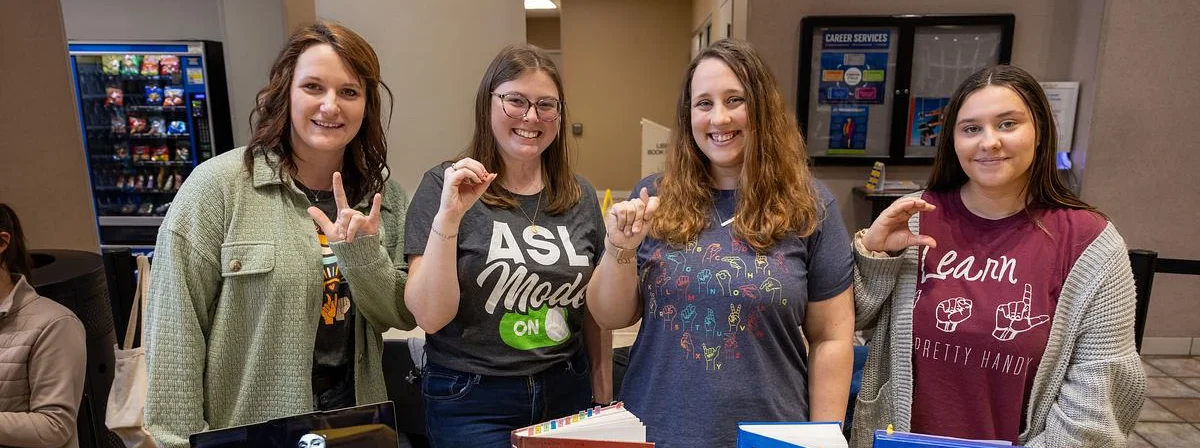
Build Your Skills At a Glance
Small class sizes allow you to build strong relationships with your instructors and classmates.
ASL skills are useful for communicating in any career.
Build new skills while earning elective requirements.
Break Communication Barriers in Your Workplace
Break communication barriers and open doors in your career. Missouri recognizes American Sign Language as a foreign language. Earning an ASL certificate is valuable on its own, and can also create a foundation for further study in fields like:
-
Sign language interpreting
-
Audiology
-
Speech pathology
-
Psychology
-
Counseling
-
Social work
-
Deaf education
Even if you don’t plan to work in these fields, ASL can still be for you! Courses can count toward your general or humanities electives, while also giving you tools to support accessibility and inclusion in any career.
Program Information
Explore our accreditation information, find program contacts and learn more about how to apply to Ozarks Tech.
General Admissions to Ozarks Tech
Admission to Ozarks Technical Community College is open to all individuals who can benefit from its educational programs. A focus of the college mission is on the academic, career and personal goals of the student. OTC may admit you as a First-Time student just completing their high school, GED or HiSET requirements or as a Transfer student coming from another institution finishing up a certificate or degree. For more information, visit OTC Admissions.
Wondering how you’re going to pay for college? At OTC, we believe that cost shouldn’t be a barrier to earning a degree. Our staff will work with you to make a financial plan. To browse the resources available to you, see paying for college.
At Ozarks Tech, we want your transfer process to be easy. We accomplish this goal through articulation agreements. These agreements are an official partnership to match coursework between schools. This gives you a more seamless transition from Ozarks Tech to a four-year institution.
We have established an agreement for this program. This will simplify the transfer of your credits to partner schools. To understand how this degree will transfer, review the current articulation agreements. Be sure to consult with your transfer school to ensure you’re on the right path toward completing your four-year degree.
OTC is accredited by the Higher Learning Commission (hlcommission.org), an accreditation agency recognized by the U.S. Department of Education. Our current accreditation status with the HLC is displayed on the page linked below. Our next comprehensive evaluation will be in 2030-2031. View more on OTC Accreditation.
Program Outcomes
Dr. Kimberly Berry
Department Chair, Communications and World Languages Department Chair
417-447-8227
Find Your Community
Getting involved is a great way to build connections and find your community on campus. With a variety of clubs and organizations and campus events it’s easy to find your people.
Looking for something a little different?
Check out similar programs that might be the right fit for you.
Course Information
Discover overview information, course sequences and specific course descriptions. Or, view the full catalog to see all the details.
American Sign Language Certificate
Certificate: 30 Hours
The American Sign Language (ASL) Certificate Program provides students with a deeper understanding of ASL, fostering proficiency in both expressive and receptive skills. The program prepares students across disciplines with the knowledge and skills necessary to communicate with and interact professionally with users of the language. This program allows students to gain knowledge and skills to better prepare them for interactions in professional career settings and provide vital language skills for evolving work environments.
Students will learn the fundamentals of ASL, receptive and expressive skills, societal competence, conversational skills, and technical vocabulary necessary for working with and interacting with users of the language. Career fields served by this program include early childhood, special education, mental health, gerontology, behavioral health support, business, fine arts, deaf studies, and allied health.
American Sign Language Requirements – 24 credit Hours
American Sign Language Requirements – 24 credit Hours
- ASL 100: History of Deafness
History of Deafness
The “History of Deafness” course seeks to explore the rich and multifaceted history of the Deaf community, tracing its evolution from ancient civilizations to the present day. By delving into the historical, cultural, social, and political dimensions of deafness, students will gain a comprehensive understanding of the challenges, triumphs, and contributions of the Deaf community throughout history.
- ASL 101: American Sign Language I
American Sign Language I
This course introduces students to the basic structural principles of American Sign Language and emphasizes visual reception and expression of signed concepts.
- ASL 102: American Sign Language II
American Sign Language II
This course continues development of the basic knowledge and understanding of conversational American Sign Language and expands on the cultural features of the language and the deaf community.
Prerequisite(s): ASL 101. - ASL 115: Fingerspelling and Numbers
Fingerspelling and Numbers
This course provides students the opportunity to develop increased fluency in their expressive and receptive abilities in fingerspelling through in-class practice and viewing of additional materials. Students also reinforce their abilities to utilize American Sign Language numbering systems for time, money, measurements, sports, and scientific numbering.
Prerequisite(s): Grade of "C" or better in ASL 102. - ASL 201: American Sign Language III
American Sign Language III
This course offers the American Sign Language student the opportunity to polish their expressive and receptive skills in classroom and conversational environments. Emphasis is on the transition from simply learning vocabulary to learning good conversational skills.
Prerequisite(s): Grade of "C" or better in ASL 102. - ASL 202: American Sign Language IV
American Sign Language IV
This course builds on what was learned in American Sign Language III. It offers the advanced American Sign Language student the opportunity to polish their expressive and receptive skills at an advanced level. Emphasis is on the use of classifiers, role shifting, listing, using space and communicating money issues, major decisions and health conditions in ASL discourse. The focus is on utilizing all American Sign Language skills simultaneously and fluently.
Prerequisite(s): Grade of "C" or better in ASL 201. - ASL 220: Conversational ASL
Conversational ASL
This course is designed to provide students with a foundation in ASL conversational skills, enabling them to engage in meaningful interactions within the Deaf community and beyond. Through interactive lessons, practice sessions, and cultural insights, students will develop proficiency in understanding and producing ASL signs, as well as gain a deeper appreciation for Deaf culture and communication norms.
Prerequisite(s): Grade of "C" or better in ASL 102 or prior knowledge demonstrated to the instructor. - ASL 221: Linguistics of ASL
Linguistics of ASL
American Sign Language (ASL) is a rich and dynamic visual-gestural language used by Deaf communities in the United States and parts of Canada. This course delves into the linguistic principles underlying ASL, exploring its structure, grammar, phonology, morphology, syntax, semantics, and pragmatics. Through a combination of theoretical discussions, practical exercises, and interactive activities, students will gain a deep understanding of ASL as a natural language and its place within the broader field of linguistics.
Prerequisite(s): Grade of "C" or better in ASL 101 and ASL 102.
General Education Requirements – 6 Credit Hours
General Education Requirements – 6 Credit Hours
Choose one COM course and one ENG course.
- COM 100: Introduction to Communication
Introduction to Communication
This course provides an introduction to the study of communication, including interpersonal communication, small group dynamics, and public speaking.
- COM 105: Public Speaking
Public Speaking
This is an introductory course in research, composition, delivery, and evaluation of speeches for a variety of purposes and occasions. Students develop skills in critical listening and analysis through small group and individual activities.
- COM 200: Interpersonal Communication
Interpersonal Communication
This course is designed as an introduction to the theory and practice of interpersonal communication. Students learn how to become both effective and appropriate communicators in a variety of contexts. Students also develop good listening and responding skills, conflict management strategies, sensitivity to language and an understanding of cultural and gender differences.
Prerequisite(s): Grade of "C" or better inENG 100 or ENG 101. - ENG 100: Composition I With Support
Composition I With Support
This course introduces students to college-level reading, thinking, and writing through a series of composition-rhetoric assignments and activities that culminate in a research-supported project. Specifically, students apply critical and creative thinking to evaluate problems, interpret evidence/data, and draw conclusions. As part of this process, students learn to evaluate sources and emerging digital tools for currency, feasibility, truthfulness, credibility, and accuracy. Ultimately, students learn to synthesize knowledge to solve problems. This writing process (thinking, researching, evaluating, and persuading) helps students to develop an essential skill set they can use in their future academic, civic, and professional lives. English 100 will be driven by the same course objectives as English 101 and satisfy the same requirement.
or - ENG 101: Composition I
Composition I
This course introduces students to college-level reading, thinking, and writing through a series of composition-rhetoric assignments and activities that culminate in a research-supported project. Specifically, students apply critical and creative thinking to evaluate problems, interpret evidence/data, and draw conclusions. As part of this process, students learn to evaluate sources and emerging digital tools for currency, feasibility, truthfulness, credibility, and accuracy. Ultimately, students learn to synthesize knowledge to solve problems. This writing process (thinking, researching, evaluating, and persuading) helps students to develop an essential skill set they can use in their future academic, civic, and professional lives.
- ENG 100: Composition I With Support
Locations Offered:
More Tools for Finding Your Path
Notices & Disclaimers
*Costs displayed are based on current tuition and fee rates for the program’s required credit hours, as approved by the OTC Board of Trustees, and are subject to change without notice. Estimates reflect both in-district and out-of-district residency rates. Actual costs, degree completion time, and credit requirements may vary based on residency, prior credits, elective courses, program updates, and enrollment factors. For additional information on attendance costs, visit Cost of Attendance, tuition and fees or contact us at 417-447-6900.
**Graduation rates vary by individual. For details on program enrollment, retention, exam/certification, and employment rates, visit Student Outcomes / Student Right-to-Know. Some careers on this list may require additional education and training. For program-specific accreditation visit OTC Accreditation.
General Admissions to Ozarks Tech
Admission to Ozarks Technical Community College is open to all individuals who can benefit from its educational programs. A focus of the college mission is on the academic, career and personal goals of the student. OTC may admit you as a First-Time student just completing their high school, GED or HiSET requirements or as a Transfer student coming from another institution finishing up a certificate or degree. For more information, visit OTC Admissions.
Wondering how you’re going to pay for college? At OTC, we believe that cost shouldn’t be a barrier to earning a degree. Our staff will work with you to make a financial plan. To browse the resources available to you, see paying for college.