Build Your Future at Ozarks Tech
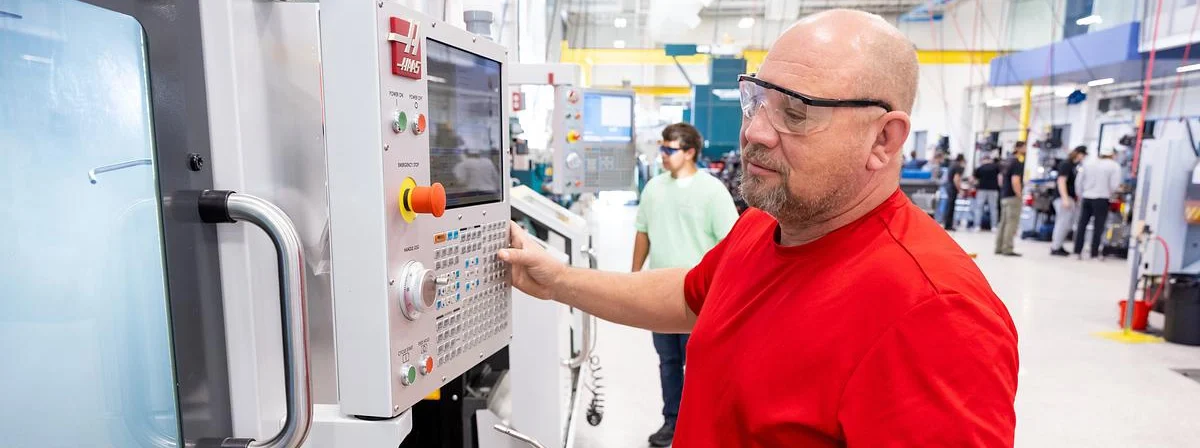
Ever wonder how everyday products are made with such detail and accuracy? Precision machining is the process that makes it happen. In our program, you’ll learn how to use special tools and machines to shape and build parts used in many industries.
As a student, you’ll:
- Set up and program CNC (Computer Numerical Control) machines.
- Use computer software to design and make parts (CAD/CAM).
- Measure parts with high-tech tools like Coordinate Measuring Machines (CMM).
These hands-on skills are in high demand. After finishing the program, you could work as a:
- CNC operator or programmer
- Quality control technician
- General machinist
With training in precision machining, you’ll be ready to succeed in a fast-paced and exciting career!
Program Information
View our accreditation information, find program contacts and learn more about how to apply for the program.
General Admissions to Ozarks Tech
Admission to Ozarks Technical Community College is open to all individuals who can benefit from its educational programs. A focus of the college mission is on the academic, career and personal goals of the student. OTC may admit you as a First-Time student just completing their high school, GED or HiSET requirements or as a Transfer student coming from another institution finishing up a certificate or degree. For more information, visit OTC Admissions.
Wondering how you’re going to pay for college? At OTC, we believe that cost shouldn’t be a barrier to earning a degree. Our staff will work with you to make a financial plan. To browse the resources available to you, see paying for college.
At Ozarks Tech, we want your transfer process to be easy. We accomplish this goal through articulation agreements. These agreements are an official partnership to match coursework between schools. This gives you a more seamless transition from Ozarks Tech to a four-year institution.
We have established an agreement for this program. This will simplify the transfer of your credits to partner schools. To understand how this degree will transfer, review the current articulation agreements. Be sure to consult with your transfer school to ensure you’re on the right path toward completing your four-year degree.
OTC is accredited by the Higher Learning Commission (hlcommission.org), an accreditation agency recognized by the U.S. Department of Education. Our current accreditation status with the HLC is displayed on the page linked below. Our next comprehensive evaluation will be in 2030-2031. View more on OTC Accreditation.
Program Outcomes
Industrial & Manufacturing Department Chair
417-447-6615
Find Your Community
Getting involved is a great way to build connections and find your community on campus. With a variety of clubs and organizations and campus events it’s easy to find your people.
Looking for something a little different?
Check out similar programs that may be the right fit for you.
Course Information
Discover overview information, course sequences and specific course descriptions. Or, view the full catalog to see all the details.
Precision Machining Technology (A.A.S.)
A.A.S. Degree: 62 Hours
Precision machining is a highly technical, advanced process that is essential to manufacture the products we use in our daily lives. The Precision Machining Technology program provides hands-on training with advanced machine tools and teaches the fundamental skills needed to precisely manufacture products and tooling. Students in the program learn technologies including Computer Numerical Control (CNC) setup and programming, Computer-Aided Design and Manufacturing (CAD/CAM), and advanced inspection equipment such as Coordinate Measuring Machines (CMM). The wide range of skills taught in this program provide many employment opportunities in manufacturing including CNC operator, general machinist, CNC setup technician, CNC programmer, quality control technician, and manufacturing engineering technician.
Precision Machining Technology Program Requirements – 46 Credit Hours
- DDT 110: Mechanical Dimensioning & Tolerancing
Mechanical Dimensioning & Tolerancing
- PMT 125: Machining Fundamentals I
Machining Fundamentals I
- PMT 135: CNC Programming – G & M Code
CNC Programming – G & M Code
- PMT 145: CAD/CAM Essentials
CAD/CAM Essentials
- PMT 150: Adv. Blueprint Reading & QC
Adv. Blueprint Reading & QC
- PMT 225: Machining Fundamentals II
Machining Fundamentals II
- PMT 235: CNC Setup and Operation
CNC Setup and Operation
- PMT 245: Advanced CAD/CAM
Advanced CAD/CAM
- PMT 250: Adv. Machining Processes I
Adv. Machining Processes I
- PMT 290: Co-operative Education/Internship
Co-operative Education/Internship
or - MFG 115: MFG Processes & Materials
MFG Processes & Materials
- PMT 290: Co-operative Education/Internship
- MFG 275: Manufacturing Capstone
Manufacturing Capstone
- TEC 285: Occupational Seminar
Occupational Seminar
Related Electives: May choose from the following program areas: CIS, CSC, CST, CYB, DDT, HRA, ITI, MEC, MFG, PMT, WLD.
General Education Requirements – 16 Credit Hours
The Missouri Department of Higher Education has identified a common set of general education courses that have been adopted statewide. These courses are called the “CORE 42.” CORE 42 courses are guaranteed to transfer to any Missouri public college or university to satisfy general education requirements.
Courses in knowledge areas below, designated with the CORE 42 logo indicates courses in that area have been evaluated and provided a MOTR number for transfer to all Missouri public institutions of higher education.
Courses that do not have this designation may still transfer to public and private colleges and universities in Missouri and elsewhere, but students are encouraged to check the transfer equivalency website of the institution to which they plan to transfer to confirm.
Please refer to the MDHE Core Transfer Curriculum for detailed information on CORE 42 courses.
Mathematical Sciences – 3 Credit Hours
- TEC 108: Applied Technical Mathematics
Applied Technical Mathematics
- MTH 110: Intermediate Algebra
Intermediate Algebra
- MTH 128: Contemporary Mathematics
Contemporary Mathematics
- MTH 128S: Cont Mathematics with Support
Cont Mathematics with Support
- MTH 129: Introductory Statistics
Introductory Statistics
- MTH 130: Algebra for Calculus
Algebra for Calculus
- MTH 130S: Algebra for Calculus With Support
Algebra for Calculus With Support
- MTH 131: Trigonometry
Trigonometry
- MTH 138: Pre-Calculus Mathematics
Pre-Calculus Mathematics
- MTH 140: Analytic Geometry and Calculus I
Analytic Geometry and Calculus I
- MTH 141: Analytic Geometry and Calculus II
Analytic Geometry and Calculus II
- MTH 210: Statistical Methods
Statistical Methods
- MTH 214: Discrete Mathematics
Discrete Mathematics
- MTH 215: Algebraic Structures
Algebraic Structures
- MTH 230: Linear Algebra
Linear Algebra
- MTH 240: Analytic Geometry and Calculus III
Analytic Geometry and Calculus III
- MTH 241: Differential Equations
Differential Equations
Written Communications – 3 Credit Hours
- ENG 101: Composition I
Composition I
or - ENG 100: Composition I With Support
Composition I With Support
- ENG 101: Composition I
Oral/Written Communications – 3 Credit Hours
- COM 100: Introduction to Communication
Introduction to Communication
- COM 105: Public Speaking
Public Speaking
- ENG 150: Technical Writing
Technical Writing
- COM 200: Interpersonal Communication
Interpersonal Communication
Natural Sciences – 4 Credit Hours
- TES 140: Technical Physics
Technical Physics
- BIO 100: Life Science
Life Science
- BIO 160: General Biology I
General Biology I
- CHM 101: Introductory Chemistry
Introductory Chemistry
- CHM 160: General Chemistry I
General Chemistry I
- PHY 105: Introduction to Physics
Introduction to Physics
- PHY 120: General Physics I
General Physics I
- PHY 220: Physics Engrs & Scientists I
Physics Engrs & Scientists I
Social and Behavioral Sciences – 3 Credit Hours
- PLS 101: American Government and Politics
American Government and Politics
- HST 120: U.S. History I: to 1865
U.S. History I: to 1865
- HST 130: U.S. History II: 1865-Present
U.S. History II: 1865-Present
Precision Machining Technology Certificate
Certificate: 32 Hours
Precision machining is a highly technical, advanced process that is essential to manufacture the products we use in our daily lives. The Precision Machining Technology program provides hands-on training with advanced machine tools and teaches the fundamental skills needed to precisely manufacture products and tooling. Students in the program learn technologies including Computer Numerical Control (CNC) setup and programming, Computer-Aided Design and Manufacturing (CAD/CAM), and advanced inspection equipment such as Coordinate Measuring Machines (CMM). The wide range of skills taught in this program provide many employment opportunities in manufacturing including CNC operator, general machinist, CNC setup technician, CNC programmer, quality control technician, and manufacturing engineering technician.
Precision Machining Technology Certificate Requirements
- PMT 125: Machining Fundamentals I
Machining Fundamentals I
- PMT 135: CNC Programming – G & M Code
CNC Programming – G & M Code
- PMT 145: CAD/CAM Essentials
CAD/CAM Essentials
- PMT 150: Adv. Blueprint Reading & QC
Adv. Blueprint Reading & QC
- PMT 225: Machining Fundamentals II
Machining Fundamentals II
- PMT 235: CNC Setup and Operation
CNC Setup and Operation
- PMT 245: Advanced CAD/CAM
Advanced CAD/CAM
- PMT 250: Adv. Machining Processes I
Adv. Machining Processes I
Precision Machining Technology Specialist Certificate
Certificate: 32 Hours
Precision machining is a highly technical, advanced process that is essential to manufacture the products we use in our daily lives. The Precision Machining Technology program provides hands-on training with advanced machine tools and teaches the fundamental skills needed to precisely manufacture products and tooling. Students in the program learn technologies including Computer Numerical Control (CNC) setup and programming, Computer-Aided Design and Manufacturing (CAD/CAM), and advanced inspection equipment such as Coordinate Measuring Machines (CMM). The wide range of skills taught in this program provide many employment opportunities in manufacturing including CNC operator, general machinist, CNC setup technician, CNC programmer, quality control technician, and manufacturing engineering technician.
Precision Machining Technology Specialist Requirements
Locations Offered:
More Tools for Finding Your Path
Notices & Disclaimers
*Costs displayed are based on current tuition and fee rates for the program’s required credit hours, as approved by the OTC Board of Trustees, and are subject to change without notice. Estimates reflect both in-district and out-of-district residency rates. Actual costs, degree completion time, and credit requirements may vary based on residency, prior credits, elective courses, program updates, and enrollment factors. For additional information on attendance costs, visit Cost of Attendance, tuition and fees or contact us at 417-447-6900.
**Graduation rates vary by individual. For details on program enrollment, retention, exam/certification, and employment rates, visit Student Outcomes / Student Right-to-Know. Some careers on this list may require additional education and training. For program-specific accreditation visit OTC Accreditation.
