
Aviation Program

Aviation Flight Technology

Prepare for a future in professional aviation.

See How You Can Afford It

2 Yrs. 65 Credit Hours
6 Semesters


$89,135 – $93,119*

Learn navigation systems and flight safety.

See How You Can Afford It

Aviation Flight Instructor Training

12 credit hours | 1 semester
$9,182 – $9,902*


Aviation Instrument Rating Flight Training

12 credit hours | 1 semester
$17,392 – $18,112*


Aviation Private Pilot Flight Training

10 credit hours | 1 semester
$17,596 – $18,196*

Prepare for a future in professional aviation.

See How You Can Afford It

2 Yrs. 65 Credit Hours
6 Semesters


$89,135 – $93,119*

Learn navigation systems and flight safety.

See How You Can Afford It

Aviation Flight Instructor Training

12 credit hours | 1 semester
$9,182 – $9,902*


Aviation Instrument Rating Flight Training

12 credit hours | 1 semester
$17,392 – $18,112*


Aviation Private Pilot Flight Training

10 credit hours | 1 semester
$17,596 – $18,196*

Take to the Skies at Ozarks Tech!

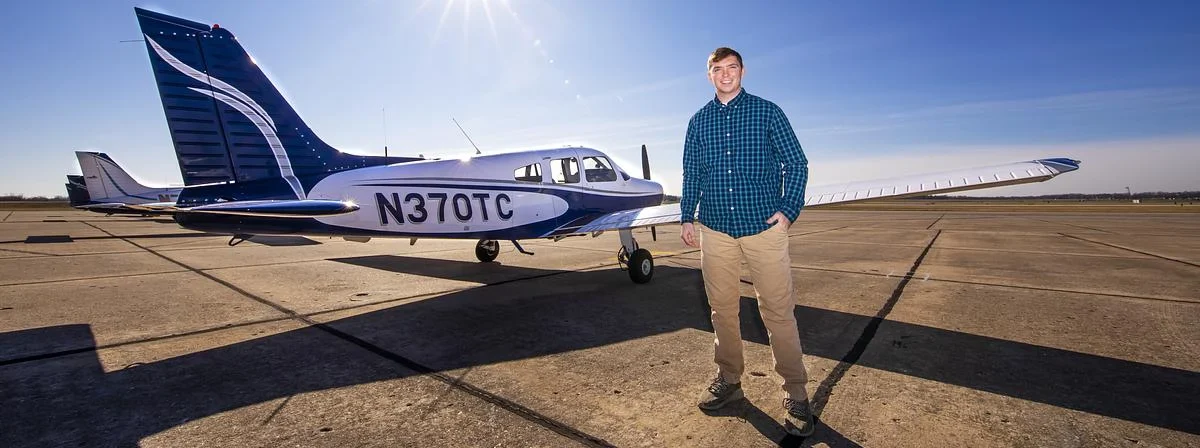
Do you dream of flying planes? At Ozarks Tech, our Aviation Flight Technology program teaches you how to make those dreams take off!

In this program, you’ll learn about:

  • Determining performance values
  • Flight systems and how they work
  • How pilots and crew work together
  • Air traffic procedures
  • Government regulations for pilots

You’ll train in our aviation facility near the Springfield-Branson National Airport. With help from our experienced instructors, you’ll get hands-on flight training that will prepare you to take the FAA exams for private, instrument and commercial flying.

Program Information

Explore our accreditation information, find program contacts and learn more about how to apply to Ozarks Tech.

The Aviation program is a selective-admission program.

View Admission Information

General Admissions to Ozarks Tech

Admission to Ozarks Technical Community College is open to all individuals who can benefit from its educational programs. A focus of the college mission is on the academic, career and personal goals of the student. OTC may admit you as a First-Time student just completing their high schoolGED or HiSET requirements or as a Transfer student coming from another institution finishing up a certificate or degree. For more information, visit OTC Admissions.

Wondering how you’re going to pay for college? At OTC, we believe that cost shouldn’t be a barrier to earning a degree. Our staff will work with you to make a financial plan. To browse the resources available to you, see paying for college.

At Ozarks Tech, we want your transfer process to be easy. We accomplish this goal through articulation agreements. These agreements are an official partnership to match coursework between schools. This gives you a more seamless transition from Ozarks Tech to a four-year institution.

We have established an agreement for this program. This will simplify the transfer of your credits to partner schools. To understand how this degree will transfer, review the current articulation agreements. Be sure to consult with your transfer school to ensure you’re on the right path toward completing your four-year degree.

Accreditation

OTC is accredited by the Higher Learning Commission (hlcommission.org), an accreditation agency recognized by the U.S. Department of Education. Our current accreditation status with the HLC is displayed on the page linked below. Our next comprehensive evaluation will be in 2030-2031. View more on OTC Accreditation.

Program Outcomes

View program outcomes

Kyle McKee
Aviation Department Chair
417-447-6655

Aviation Team

Looking for something a little different?

Check out similar programs that may be the right fit for you.

Aviation Airframe and Powerplant

Industrial & Engineering Programs

Find Your Community

Getting involved is a great way to build connections and find your community on campus. With a variety of clubs and organizations and campus events it’s easy to find your people.

Life at Ozarks Tech

Course Information

Discover overview information, course sequences and specific course descriptions. Or, view the full catalog to see all the details.

Aviation Flight Technology (A.A.S)

A.A.S. Degree: 65 Hours

The Aviation Flight Technology degree prepares individuals to apply technical knowledge and skills of students who plan a career in the flying and/or navigation of commercial passenger and cargo, agricultural, public service, corporate and rescue fixed-wing aircraft. Includes instruction in principles of aircraft design and performance, aircraft flight systems and controls, flight crew operations and procedures, radio communications, navigation procedures and systems, airways safety and traffic regulations, and governmental rules and regulations pertaining to piloting aircraft. In order to complete the program, students must successfully pass the Federal Aviation Administration [FAA] Private, Commercial, and Instrument computer examinations.  The program leads to FAA certification as a commercial pilot with an instrument rating.  Persons wishing to be airline pilots will need to transfer to a 4-year program to complete an Airline Transport Certificate [ATP].

This program is selective admission and complies with all Federal Aviation Administration (FAA) Regulations.  Prior to registration, students must provide a valid driver’s license AND official birth certificate with raised seal OR a US Passport for Transportation Security Administration verification purposes; FAA Flight Physical.  Non-US citizens will need to undergo Transportation Security Administration (TSA) processing.

A grade of “C” or better is required for all Aviation Program required courses. 

Aviation Flight Technology Program Requirements – 44 Credit Hours

Aviation Flight Technology Program Requirements – 44 Credit Hours

  • Credits: 3

    World of Aviation

    A broad overview of changes in aviation technology throughout history, with special emphasis on fixed-wing aircraft. The effect of the introduction and expansion of aviation will be analyzed as it relates to travel, trade, culture and combat.

  • Credits: 3

    Airline Operations

    A study of transportation systems and the aviation industry as they exist today. Applicable government organizations, controls, and regulations will be studied. Airline organization, operation, management, and marketing will be examined as well as career opportunities.

    Prerequisite(s): AVI 101 
  • Credits: 3

    Aviation Weather

    This course provides an analysis of aviation weather, which is appropriate for a professional commercial pilot. The student is expected to gain knowledge about basic weather concepts and acquire an understanding of weather theory. Weather hazards including thunderstorms, turbulence, wind shear, restrictions to visibility, icing, and hydroplaning will be discussed. Weather services will also be explained. The details of using coded weather reports, forecasts, weather charts and prognostic charts will be utilized in class for flight planning and in-flight decision-making. Extensive use of the Internet will be necessary.

    Prerequisite(s): AVI 101.
  • Credits: 3

    Private Pilot Ground

    Essentials to pass the Federal Aviation Administration Private Pilot Knowledge examination. Subjects include introduction to the airplane, airplane systems, airplane performance, weight and balance, airports, radio communications, air traffic control and airspace, navigation charts and flight computer, cross-country flight planning, flight publications, radio navigation weather theory and weather data, federal aviation regulations and National Transportation Safety Board, and medical factors of flight.

    Prerequisite(s): Active program of study must be AVI.  Instructor Consent required.
  • Credits: 2

    Private Flight Lab I

    This flight training course focuses on acquiring the aeronautical skills necessary for a private pilot license with an airplane category rating and single-engine land class rating.  Be advised, additional time is often needed to meet completion standards and proficiency. Fee required.

    Prerequisite(s): AVI 150 or concurrent enrollment.
  • Credits: 2

    Private Pilot Lab II

    This course is the continuation of flight training required to complete the private pilot program by acquiring aeronautical skills necessary to meet the requirements for a private pilot certificate.  Be advised, additional time is regularly needed to meet completion standards and proficiency. Fee required.

    Prerequisite(s): AVI 150, AVI 151.
  • Credits: 3

    Instrument Ground

    This ground training course focuses on acquiring the knowledge for both operating safely in the National Airspace System using Instrument Flight Rules (IFR) as well as preparing the student for the FAA Instrument Knowledge Exam for Airplanes (IRA).

    Prerequisite(s): AVI 101, AVI 150, AVI 151, AVI 152.
  • Credits: 1

    Instrument Flight Lab I

    This course is a continuation of flight training and the beginning of instrument flight training. Be advised, additional time is regularly needed to meet completion standards and proficiency. Fee required.

    Prerequisite(s): AVI 150, AVI 151, AVI 152; AVI 170 or concurrent enrollment.
  • Credits: 2

    Instrument Flight Lab II

    This course is a continuation of flight instrument training from AVI 171.  The student completes the cross-country requirements. Be advised, additional time is regularly needed to meet completion standards and proficiency. Fee required.

    Prerequisite(s): Grade of "C" or better in AVI 170 and AVI 171.
  • Credits: 3

    Aircraft & Engine Components

    This course is a study of aircraft structure, systems, and components for the pilot. Students will learn the basics of physics, important regulations related to maintenance, and study both airframe and engine systems.  

    Prerequisite(s): AVI 101. 
  • Credits: 3

    Air Transportation

    Study of the common carrier air transportation system and the structure of commercial air carriers. This course will have an emphasis on scheduled air carrier organizations and activities.

    Prerequisite(s): AVI 101.
  • Credits: 3

    Air Traffic Control System

    A study of the nation’s air traffic control system; focusing on basic air traffic control procedures and regulations, FAA control facilities, FSS services, radio communication, navigation principles, safety, and new developments

    Prerequisite(s): AVI 101.
  • Credits: 3

    Commercial Pilot Ground

    Basic knowledge to pass the Federal Aviation Administration commercial pilot knowledge test. Includes advanced multi-engine performance control, advanced meteorology, advanced multi-engine airplane systems, advanced radio navigation, commercial pilot FARs, physiology of flight, environmental systems, flight planning and commercial maneuvers.

    Prerequisite(s): AVI 170, AVI 171.
  • Credits: 4

    Commercial Pilot Flight Lab I

    This is the first course of flight training for acquiring aeronautical skills necessary to meet the requirements for a commercial pilot certificate. The course will follow the Flight Providers Training Course Outline. Be advised, additional time may be needed to meet completion standards and proficiency. Fee required.

    Prerequisite(s): AVI 170, AVI 171, AVI 172 
  • Credits: 3

    Commercial Pilot Flight II

    This is the second course of flight training for acquiring aeronautical skills necessary to meet the requirements for a commercial pilot certificate. The course will follow the Flight Provider’s Training Course Outline. Be advised, additional time may be needed to meet completion standards and proficiency. Fee required.

    Prerequisite(s): AVI 251 and AVI 250 or concurrent
  • Credits: 3

    Aviation Safety

    The purpose of this course is to expose the student to a variety of issues in Aviation Safety, including the nature of accident, the agencies involved in investigation, safety regulation, recommendations, and rule making, as well as safety management systems, tools, and methods used to promote and evaluate safety. A special emphasis will be placed on major aviation related accidents, the investigation, factors, causes, and the resulting effects of those. 

    Prerequisite(s): AVI 101.
  • Credits: 3

    CFI Ground

    The Certified Flight Instructor Ground course will instruct and train students for two FAA knowledge exams of Fundamentals of Instructing and Flight Instructor Airplane.  Topics covered will be fundamentals of instructing, aerodynamics and principles of flight, aircraft systems, aircraft performance, weather and weather services, reroute flight and navigation, procedures and airport operations, regulations, flight instruction and maneuvers, and flight physiology.

    Prerequisite(s): AVI 250, AVI 251;  AVI 252 or concurrent enrollment. 
General Education Requirements – 21 Credit Hours

General Education Requirements – 21 Credit Hours

The Missouri Department of Higher Education has identified a common set of general education courses that have been adopted statewide. These courses are called the “CORE 42.”  CORE 42 courses are guaranteed to transfer to any Missouri public college or university to satisfy general education requirements.

Courses in knowledge areas below, designated with the CORE 42 logo indicates courses in that area have been evaluated and provided a MOTR number for transfer to all Missouri public institutions of higher education.

Courses that do not have this designation may still transfer to public and private colleges and universities in Missouri and elsewhere, but students are encouraged to check the transfer equivalency website of the institution to which they plan to transfer to confirm.

Please refer to the MDHE Core Transfer Curriculum for detailed information on CORE 42 courses.

Mathematical Sciences – 3 Credit Hours

Mathematical Sciences – 3 Credit Hours

  • Credits: 3
    Algebra for Calculus

    This course is a standard course in college-level algebra necessary for further studies in mathematics. Topics include solving equations, systems of equations, and inequalities; properties of functions; polynomial, rational, exponential, logarithmic functions and their graphs.

  • Credits: 4
    Algebra for Calculus With Support

    This course is a standard course in college-level algebra necessary for further studies in mathematics. Topics include solving equations, systems of equations, and inequalities; properties of functions; polynomial, rational, exponential, logarithmic functions and their graphs. MTH 130S will be driven by the same objectives as MTH 130, and satisfy the same requirement. The course design will provide students with more time, support, and individualized instruction to accomplish those objectives.

  • Credits: 3
    Trigonometry

    This course is a study of trigonometric function and their graphs, identities, equations and applications. Topics include an introduction to polar coordinates, vectors, and solutions of right and oblique triangles.

    Prerequisite(s): Grade of "C" or better in MTH 130 or satisfactory score on the ACT.
  • Credits: 5
    Pre-Calculus Mathematics

    This course prepares students for calculus by integrating both college-level algebra and trigonometry. Topics include solving equations, systems of equations, and inequalities; properties of functions; polynomial, rational, radical, exponential, logarithmic, and trigonometric functions and their graphs; analytic trigonometry; and vectors. This course is designed for students with a prior background in algebra and trigonometry.

    Prerequisite(s): Grade of "B" or better in MTH 110 or satisfactory score on the ACT.
  • Credits: 5
    Analytic Geometry and Calculus I

    This is the first course in a three-semester sequence. Topics include an introduction to analytic geometry, limits and continuity, the derivative and differential, the definite integral and applications.

    Prerequisite(s): Grade of "C" or better in MTH 131 or MTH 138 or satisfactory score on the ACT.
  • Credits: 5
    Analytic Geometry and Calculus II

    This is the second course in a three-semester sequence. Topics include techniques of formal integration, applications of definite integration, infinite sequences and series, parametrized curves and polar coordinates.

    Prerequisite(s): Grade of "C" or better in MTH 140.
  • Credits: 3
    Statistical Methods

    Students study basic concepts of statistics and probability applicable to all disciplines. Topics include distributions, measures of central tendency and dispersion, elementary probability, sampling, estimation of parameters, hypothesis testing, regression and correlation.

    Prerequisite(s): Grade of "C" or better in MTH 128 or MTH 130 or satisfactory score on the ACT.
  • Credits: 3
    Algebraic Structures

    This course provides an introduction to techniques of mathematical reasoning and formal mathematical proof. Topics include logic, set theory, relations, functions, and number theory. 

    Prerequisite(s): Grade of "C" or better in MTH 140.
  • Credits: 3
    Linear Algebra

    This course is a study of vector spaces, matrices, linear transformations, determinants, quadratic forms, eigenvalues, eigenvectors, canonical forms and inner-product spaces. Emphasis is placed on rigorous proof and the development of mathematical maturity.

    Prerequisite(s): Grade of "C" or better in MTH 141.
  • Credits: 3
    Analytic Geometry and Calculus III

    This is the third course in a three-semester sequence. Topics include vector-valued functions, solid analytic geometry, partial differentiation, multiple integration and line and surface integrals in vector fields.

    Prerequisite(s): Grade of "C" or better in MTH 141.
  • Credits: 3
    Differential Equations

    This is an introduction to the techniques available for the solution of ordinary differential equations. Topics include first and second order equations, systems of differential equations, Laplace transforms, series solutions, numerical methods and applications.

    Prerequisite(s): Grade of "C" or better in MTH 141. 
Written Communications – 6 Credit Hours

Written Communications – 6 Credit Hours

    • Credits: 3
      Composition I

      This course introduces students to college-level reading, thinking, and writing through a series of composition-rhetoric assignments and activities that culminate in a research-supported project. Specifically, students apply critical and creative thinking to evaluate problems, interpret evidence/data, and draw conclusions. As part of this process, students learn to evaluate sources and emerging digital tools for currency, feasibility, truthfulness, credibility, and accuracy. Ultimately, students learn to synthesize knowledge to solve problems. This writing process (thinking, researching, evaluating, and persuading) helps students to develop an essential skill set they can use in their future academic, civic, and professional lives.

    • or
    • Credits: 5
      Composition I With Support

      This course introduces students to college-level reading, thinking, and writing through a series of composition-rhetoric assignments and activities that culminate in a research-supported project. Specifically, students apply critical and creative thinking to evaluate problems, interpret evidence/data, and draw conclusions. As part of this process, students learn to evaluate sources and emerging digital tools for currency, feasibility, truthfulness, credibility, and accuracy. Ultimately, students learn to synthesize knowledge to solve problems. This writing process (thinking, researching, evaluating, and persuading) helps students to develop an essential skill set they can use in their future academic, civic, and professional lives.  English 100 will be driven by the same course objectives as English 101 and satisfy the same requirement.

  • Credits: 3
    Composition II

    This course continues developing students’ abilities to use research and writing to make informed and ethical arguments; effectively communicating these arguments to professional and expert audiences in a research-supported project. Moreover, the course further develops students’ skills in critical and creative thinking to evaluate problems, interpret evidence/data, and draw conclusions.

    Emphasis is placed on honing skills of audience analysis, analytical reading, problem solving, research methods—including both primary and secondary research—and persuasive writing. Also, this course will acquaint students with patterns and conventions of multiple disciplinary communities. This writing process (thinking, researching, evaluating, and applying rhetorical strategy) prepares students for their academic and professional futures.

    Prerequisite(s): ENG 100 or ENG 101.
  • Credits: 3
    Technical Writing

    This course emphasizes developing the student’s ability to write clearly, concisely and accurately. Students practice collecting, analyzing, interpreting and presenting information in a variety of technical documents used in professional settings while using proper research and documentation techniques, sound visual design principles and effective writing styles suitable for a specific communicative context. Throughout, emphasis will be placed on honing skills in audience analysis, analytical reading, critical thinking, research methods and clear writing.

    Prerequisite(s): ENG 100 or ENG 101.
Oral Communications – 3 Credit Hours

Oral Communications – 3 Credit Hours

  • Credits: 3
    Introduction to Communication

    This course provides an introduction to the study of communication, including interpersonal communication, small group dynamics, and public speaking.

  • Credits: 3
    Public Speaking

    This is an introductory course in research, composition, delivery, and evaluation of speeches for a variety of purposes and occasions. Students develop skills in critical listening and analysis through small group and individual activities.

  • Credits: 3
    Interpersonal Communication

    This course is designed as an introduction to the theory and practice of interpersonal communication. Students learn how to become both effective and appropriate communicators in a variety of contexts. Students also develop good listening and responding skills, conflict management strategies, sensitivity to language and an understanding of cultural and gender differences.

    Prerequisite(s): Grade of "C" or better inENG 100 or ENG 101. 
Social and Behavioral Sciences – 3 Credit Hours

Social and Behavioral Sciences – 3 Credit Hours

PLS-101 is preferred.

  • Credits: 3
    U.S. History I: to 1865

    This course is a survey of the history of the United States from pre-Columbian societies through the Civil War, including formative political, social, economic and cultural developments. It also introduces students to history as an academic discipline and requires analysis, synthesis and evaluation of primary and secondary materials in reading, discussion and writing. HST 120 will satisfy the Missouri state law requiring instruction in the United States and Missouri Constitutions.

  • Credits: 3
    U.S. History II: 1865-Present

    This course is a survey of the history of the United States from Reconstruction to the present, covering the political, economic, social and cultural developments that have shaped modern America. It introduces students to history as an academic discipline and requires analysis, synthesis and evaluation of primary and secondary materials in reading, discussion and writing.  HST 130 will satisfy the Missouri state law requiring instruction in the United States and Missouri Constitutions.

  • Credits: 3
    American Government and Politics

    This introductory course familiarizes students with American and Missouri government constitutions, institutions, policies and processes. Students develop an understanding of the foundations, environment, and principles of democracy with key concepts about voting, political parties, campaigns, and interactions between the branches of government. The course emphasis is on the values, rights, and responsiblities that shape public decision making of active and informed citizens in the American political system. This course meets instruction requirements (Missouri Revised Statute 170.011.1) in the Constitution of the United States and the state of Missouri.

Institutional Electives – 6 Credit Hours

Institutional Electives – 6 Credit Hours

  • Credits: 3

    Technology & Digital Literacy

    This course provides an overview of digital literacy topics such as computer hardware, software, programming, security, safety, and information systems. This is a “hands-on” class learning to use the most common computer software programs and information resources facilities. This course provides a look at the structure and components of computers, their operating systems, and an introduction to various applications with emphasis on word processing, spreadsheet applications, presentation software, and Internet usage.

    Prerequisite(s): Keyboarding skill of 25 WPM or BUS 101 or CIS 100 recommended.
  • Elective Credits: 3

    (Any course numbered 100 and above)

Aviation Flight Instructor Training Certificate of Specialization

Certificate of Specialization – 12 Hours

The certificate of specialization for flight instructor training is designed for individuals who wish to pursue the knowledge and skills necessary to earn a FAA Flight Certificate (CFI license). This training includes both the conceptual theory and the hands-on experience to pass both the FAA written examinations for flight instructors (Fundamentals of Instructions and Flight Instructor – Airplane) and the FAA practical examination to earn an initial flight instructor certification for airplanes (CFI). With a CFI Certificate, one can teach others the knowledge and skills to fly airplanes.   

A grade of “C” (70%) or better is required for all required courses and students must pass the FAA Written Examinations (FOI and FIA) for this certificate. 

Flight Instructor Training Requirements – 6 Credit Hours

Flight Instructor Training Requirements – 6 Credit Hours

  • Credits: 3

    CFI Ground

    The Certified Flight Instructor Ground course will instruct and train students for two FAA knowledge exams of Fundamentals of Instructing and Flight Instructor Airplane.  Topics covered will be fundamentals of instructing, aerodynamics and principles of flight, aircraft systems, aircraft performance, weather and weather services, reroute flight and navigation, procedures and airport operations, regulations, flight instruction and maneuvers, and flight physiology.

    Prerequisite(s): AVI 250, AVI 251;  AVI 252 or concurrent enrollment. 
  • Credits: 3

    CFI Airplane Lab

    During this course, the student will learn the analysis and performance of all the maneuvers required for private and commercial pilot certification from the right seat of the training aircraft. In addition, the student will acquire the instructional knowledge of the elements of each of the maneuvers and procedures including the recognition, analysis, and correction of common student errors.

    Prerequisite(s): AVI 250, AVI 251, AVI 252, AVI 270.
Flight Instructor Training Electives – 6 Credit Hours

Flight Instructor Training Electives – 6 Credit Hours

Choose two (2) of the following

  • Credits: 3

    Aviation Weather

    This course provides an analysis of aviation weather, which is appropriate for a professional commercial pilot. The student is expected to gain knowledge about basic weather concepts and acquire an understanding of weather theory. Weather hazards including thunderstorms, turbulence, wind shear, restrictions to visibility, icing, and hydroplaning will be discussed. Weather services will also be explained. The details of using coded weather reports, forecasts, weather charts and prognostic charts will be utilized in class for flight planning and in-flight decision-making. Extensive use of the Internet will be necessary.

    Prerequisite(s): AVI 101.
  • Credits: 3

    Aircraft & Engine Components

    This course is a study of aircraft structure, systems, and components for the pilot. Students will learn the basics of physics, important regulations related to maintenance, and study both airframe and engine systems.  

    Prerequisite(s): AVI 101. 
  • Credits: 3

    Air Traffic Control System

    A study of the nation’s air traffic control system; focusing on basic air traffic control procedures and regulations, FAA control facilities, FSS services, radio communication, navigation principles, safety, and new developments

    Prerequisite(s): AVI 101.
  • Credits: 3

    Aviation Safety

    The purpose of this course is to expose the student to a variety of issues in Aviation Safety, including the nature of accident, the agencies involved in investigation, safety regulation, recommendations, and rule making, as well as safety management systems, tools, and methods used to promote and evaluate safety. A special emphasis will be placed on major aviation related accidents, the investigation, factors, causes, and the resulting effects of those. 

    Prerequisite(s): AVI 101.

Aviation Instrument Rating Flight Training Certificate of Specialization

Certificate of Specialization: 12 Hours

The certificate of instrument rating flight training is designed for individuals who wish to pursue the knowledge and skills necessary to earn a FAA Instrument Rating on an already approved pilot certificate. This training includes both the conceptual theory and the hands-on experience to pass both the FAA written examination for Instrument Rating Airplane and the FAA practical examination to earn an Instrument Rating to an estabilished pilot certificate. With this rating one can fly safely and efficiently in instrument meteorological condistion (IMC) in the national airspace system.   

A grade of “C” (70%) or better is required for all  required courses and students must pass the FAA Instrument Pilot – Airplane (IRA) Written Examination for this Certificate of Achievement. 

Instrument Rating Flight Training Requirements – 9 Credit Hours

Instrument Rating Flight Training Requirements – 9 Credit Hours

  • Credits: 3

    Aviation Weather

    This course provides an analysis of aviation weather, which is appropriate for a professional commercial pilot. The student is expected to gain knowledge about basic weather concepts and acquire an understanding of weather theory. Weather hazards including thunderstorms, turbulence, wind shear, restrictions to visibility, icing, and hydroplaning will be discussed. Weather services will also be explained. The details of using coded weather reports, forecasts, weather charts and prognostic charts will be utilized in class for flight planning and in-flight decision-making. Extensive use of the Internet will be necessary.

    Prerequisite(s): AVI 101.
  • Credits: 3

    Instrument Ground

    This ground training course focuses on acquiring the knowledge for both operating safely in the National Airspace System using Instrument Flight Rules (IFR) as well as preparing the student for the FAA Instrument Knowledge Exam for Airplanes (IRA).

    Prerequisite(s): AVI 101, AVI 150, AVI 151, AVI 152.
  • Credits: 1

    Instrument Flight Lab I

    This course is a continuation of flight training and the beginning of instrument flight training. Be advised, additional time is regularly needed to meet completion standards and proficiency. Fee required.

    Prerequisite(s): AVI 150, AVI 151, AVI 152; AVI 170 or concurrent enrollment.
  • Credits: 2

    Instrument Flight Lab II

    This course is a continuation of flight instrument training from AVI 171.  The student completes the cross-country requirements. Be advised, additional time is regularly needed to meet completion standards and proficiency. Fee required.

    Prerequisite(s): Grade of "C" or better in AVI 170 and AVI 171.
Instrument Rating Flight Training Elective – 3 Credit Hours

Instrument Rating Flight Training Elective – 3 Credit Hours

Select one of the following:

  • Credits: 3

    Aircraft & Engine Components

    This course is a study of aircraft structure, systems, and components for the pilot. Students will learn the basics of physics, important regulations related to maintenance, and study both airframe and engine systems.  

    Prerequisite(s): AVI 101. 
  • Credits: 3

    Air Traffic Control System

    A study of the nation’s air traffic control system; focusing on basic air traffic control procedures and regulations, FAA control facilities, FSS services, radio communication, navigation principles, safety, and new developments

    Prerequisite(s): AVI 101.

Aviation Private Pilot Flight Training Certificate of Specialization

Certificate of Specialization: 10 Hours

The certificate of private pilot flight training is designed for individuals who wish to pursue the knowledge and skills necessary to earn a FAA Private Pilot Certificate (license). This training includes both the conceptual theory and the hands-on experience to pass both the FAA written examination for Private Pilot and the FAA practical examination to earn Private Pilot certification. With a Private Pilot’s Certificate one can fly safely and efficiently for personal pleasure as well as transport non-paying passengers. 

A grade of “C” (70%) or better is required for all required courses and students must pass the FAA Private Pilot Written Examination for this certificate.

Private Pilot Flight Training Requirements – 10 Credit Hours

Private Pilot Flight Training Requirements – 10 Credit Hours

  • Credits: 3

    Aviation Weather

    This course provides an analysis of aviation weather, which is appropriate for a professional commercial pilot. The student is expected to gain knowledge about basic weather concepts and acquire an understanding of weather theory. Weather hazards including thunderstorms, turbulence, wind shear, restrictions to visibility, icing, and hydroplaning will be discussed. Weather services will also be explained. The details of using coded weather reports, forecasts, weather charts and prognostic charts will be utilized in class for flight planning and in-flight decision-making. Extensive use of the Internet will be necessary.

    Prerequisite(s): AVI 101.
  • Credits: 3

    Private Pilot Ground

    Essentials to pass the Federal Aviation Administration Private Pilot Knowledge examination. Subjects include introduction to the airplane, airplane systems, airplane performance, weight and balance, airports, radio communications, air traffic control and airspace, navigation charts and flight computer, cross-country flight planning, flight publications, radio navigation weather theory and weather data, federal aviation regulations and National Transportation Safety Board, and medical factors of flight.

    Prerequisite(s): Active program of study must be AVI.  Instructor Consent required.
  • Credits: 2

    Private Flight Lab I

    This flight training course focuses on acquiring the aeronautical skills necessary for a private pilot license with an airplane category rating and single-engine land class rating.  Be advised, additional time is often needed to meet completion standards and proficiency. Fee required.

    Prerequisite(s): AVI 150 or concurrent enrollment.
  • Credits: 2

    Private Pilot Lab II

    This course is the continuation of flight training required to complete the private pilot program by acquiring aeronautical skills necessary to meet the requirements for a private pilot certificate.  Be advised, additional time is regularly needed to meet completion standards and proficiency. Fee required.

    Prerequisite(s): AVI 150, AVI 151.

Locations Offered:

Notices & Disclaimers

*Costs displayed are based on current tuition and fee rates for the program’s required credit hours, as approved by the OTC Board of Trustees, and are subject to change without notice. Estimates reflect both in-district and out-of-district residency rates. Actual costs, degree completion time, and credit requirements may vary based on residency, prior credits, elective courses, program updates, and enrollment factors. For additional information on attendance costs, visit Cost of Attendancetuition and fees or contact us at 417-447-6900.

**Graduation rates vary by individual. For details on program enrollment, retention, exam/certification, and employment rates, visit Student Outcomes / Student Right-to-Know. Some careers on this list may require additional education and training. For program-specific accreditation visit OTC Accreditation.