
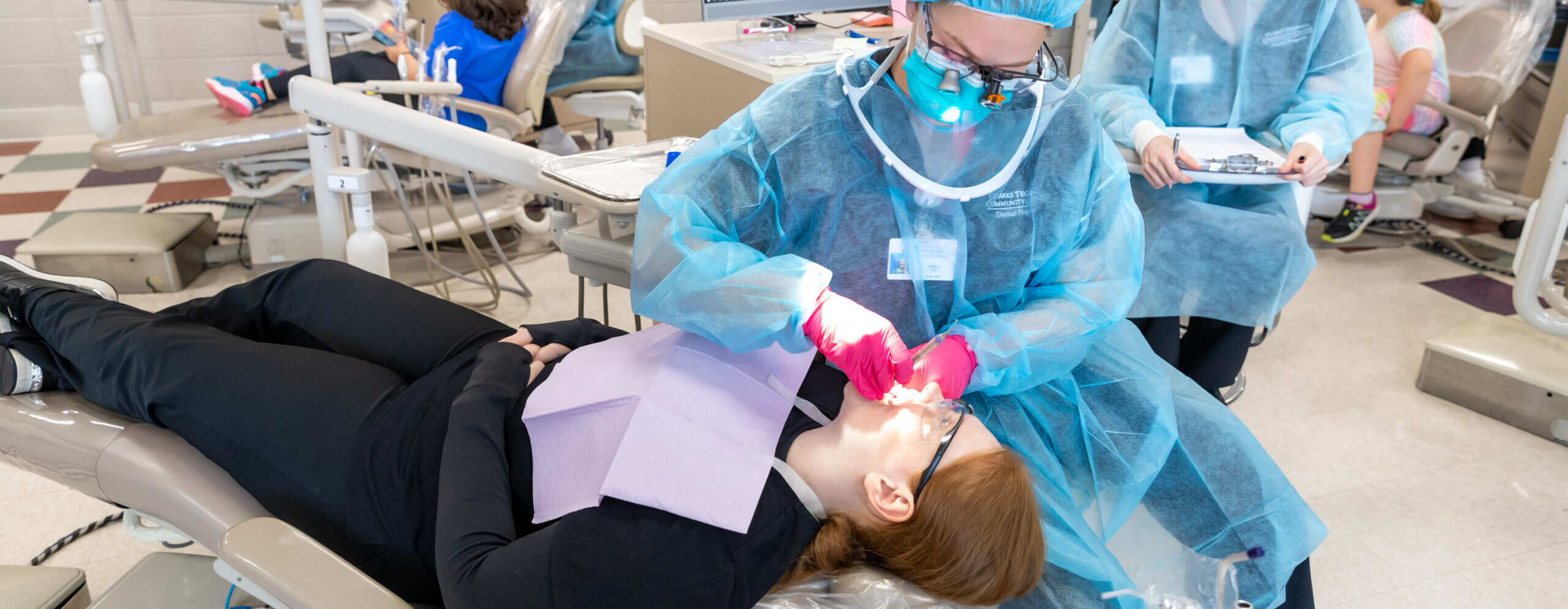
Provide Care to Promote Healthy Smiles
Prepare for a high-demand career as a dental hygienist. Your courses blend coursework with hands-on clinical experience to equip you with the confidence to provide comprehensive care.
-
Provide dental cleanings and periodontal therapy.
-
Complete oral health assessments and identify risk factors.
-
Capture diagnostic dental images.
-
Administer local anesthesia and nitrous oxide.
Gain real experience during your education. You’ll practice your skills in a state-of-the-art lab with real equipment. Then, gain experience with patients in the onsite dental clinic. Your courses and hands-on experience prepare you to test for licensure at the regional, state and national levels.
The Dental Hygiene Program is accredited by the Commission on Dental Accreditation (CODA) of the American Dental Association.
Program Information
Explore our accreditation information and learn more about how to apply for the program
The Dental Hygiene Program is a selective admission program and admission is determined by a points-based system. Points are awarded based on grades earned in preadmission courses; completion of clinical observation hours, or CDA, or CDA experience equivalent to 3 years; preadmission testing and cumulative GPA.
Application Requirements and Information
General Admissions to Ozarks Tech
Admission to Ozarks Technical Community College is open to all individuals who can benefit from its educational programs. A focus of the college mission is on the academic, career and personal goals of the student. OTC may admit you as a First-Time student just completing their high school, GED or HiSET requirements or as a Transfer student coming from another institution finishing up a certificate or degree. For more information, visit OTC Admissions.
Wondering how you’re going to pay for college? At OTC, we believe that cost shouldn’t be a barrier to earning a degree. Our staff will work with you to make a financial plan. To browse the resources available to you, see paying for college.
At Ozarks Tech, we want your transfer process to be easy. We accomplish this goal through articulation agreements. These agreements are an official partnership to match coursework between schools. This gives you a more seamless transition from Ozarks Tech to a four-year institution.
We have established an agreement for this program. This will simplify the transfer of your credits to partner schools. To understand how this degree will transfer, review the current articulation agreements. Be sure to consult with your transfer school to ensure you’re on the right path toward completing your four-year degree.
The program is accredited by the Commission on Dental Accreditation (CODA) 211 East Chicago Avenue; Chicago, IL 60611 800.232.6108 www.coda.ada.org
OTC is accredited by the Higher Learning Commission (hlcommission.org), an accreditation agency recognized by the U.S. Department of Education. Our current accreditation status with the HLC is displayed on the page linked below. Our next comprehensive evaluation will be in 2030-2031. View more on OTC Accreditation.
Program Outcomes
Rebecca Caceres
Dental Hygiene Program Director
417-447-6693

A dentist in his home country, OTC grad hopes to practice in the U.S.
Course Information
Discover overview information, course sequences and specific course descriptions. Or, view the full catalog to see all the details.
Dental Hygiene (A.A.S.)
A.A.S. Degree: 92 Hours
The Dental Hygiene profession offers a variety of career opportunities: clinical practice in general and specialty dental offices; federal, state, and county health clinics; hospital-based treatment; long-term care facilities; industrial clinics; armed services; pharmaceutical sales; research institutions; and educational settings.
Contemporary dental hygiene practice requires that dental hygienists possess a breadth of knowledge and skills in a variety of areas. Dental hygiene practice includes: oral prophylaxis (cleaning); patient education; exposing, processing, and mounting radiographs; collecting and evaluating patient medical history information; performing head and neck examinations; periodontal assessment and non-surgical therapy; applying preventive agents; application of desensitizing and antimicrobial agents; and administering local anesthesia and nitrous oxide analgesia.
The dental hygiene program is a selective admission program. A separate application process is required for acceptance into the program; the application deadline is May 31st. Upon acceptance, the student may take the “program specific courses”. A grade of “C” or better is required for all program required courses. The dental hygiene program is a five-semester program which prepares the student for their national, regional, and state licensure examinations. Contact the Health Sciences Office for an application packet.
The dental hygiene program is accredited by the Commission on Dental Accreditation (CODA) of the American Dental Association (ADA), 211 E. Chicago, Suite 1900, Chicago, IL 60611, (312) 621-8099. 800.232.6108 https://coda.ada.org/
Pre-Admission Requirements – 19 Credit Hours
Pre-Admission Requirements – 19 Credit Hours
- BCS 165: Human Anatomy *
Human Anatomy
Microscopic and macroscopic examination of the human body structures and systems are the focus of this course. Students evaluate the integration of the various systems within the entire body. The laboratory provides an opportunity for identification and evaluation of representative human models and slides and dissection of comparable mammalian organ systems.
- BCS 200: Microbiology
Microbiology
This course entails a study of the structure, growth, control, classification and identification of microorganisms. In the laboratory students learn basic aseptic techniques and become familiar with common laboratory procedures.
Prerequisite(s): Grade of "C" or better in BCS 165. - BCS 205: Human Physiology *
Human Physiology
This course examines the organization and function of the human body as a whole and the interrelationships of the various systems. The laboratory teaches the fundamental techniques necessary for the study of life processes. Laboratory activities give the students an opportunity to illustrate principles presented in lecture.
Prerequisite(s): Grade of "C" or better in BCS 165. - CHM 101: Introductory Chemistry (or higher)
Introductory Chemistry
This is an introductory course designed to study basic chemical principles. Topics include atomic structure, measurement, bonding, properties of gases, acids and bases, solutions, organic nomenclature, functional groups, carbohydrates, lipids, proteins, and nucleic acids. Laboratory activities give students the opportunity to demonstrate chemical principles presented in lecture.
- MTH 128: Contemporary Mathematics (or higher) *
Contemporary Mathematics
This course provides students with a basic survey of mathematics. Topics include problem solving, modeling, counting methods, probability, statistics and geometry.
Dental Hygiene Program Requirements – 55 Credit Hours
Dental Hygiene Program Requirements – 55 Credit Hours
- DHY 100: Foundations of Dental Hygiene
Foundations of Dental Hygiene
This course is designed to prepare the dental hygiene student with the foundational knowledge, theory, and technical skills necessary to perform in subsequent clinical dental hygiene courses. Basic principles of patient assessements, periodontal examinations, dental indices, instrument design, function, and usage are taught to render safe and effective clinical dental hygiene treatment.
- DHY 101: Dental Hygiene Preclinical Lab I
Dental Hygiene Preclinical Lab I
This preclinical laboratory course introduces the student to foundational principles, theory, and technical skills for dental hygiene care. Preclinical labs will include demonstration, application on typodonts, manikins, and lab partners.
Prerequisite(s): Admission to the Dental Hygiene program. - DHY 105: Orofacial Anatomy
Orofacial Anatomy
This course is a detailed study of the morphology and functions of deciduous and permanent teeth, including the study of muscular and skeletal functions, blood supply, and nervous system in relationship to the oral cavity and general dentistry.
Prerequisite(s): Admission to the Dental Hygiene program. - DHY 110: Oral Histology & Embryology
Oral Histology & Embryology
This course will provide an understanding of how cells and tissues comprising the anatomical parts of the oral cavity develop and function. The course will also focus on the embryonic development of related facial and oral structures. Prerequisite(s): Admission to the Dental Hygiene program.
- DHY 150: Dental Hygiene I
Dental Hygiene I
This course is designed to further the knowledge of foundational dental hygiene care to include skill development, ethics, jurisprudence, professionalism, and risk management.
Prerequisite(s): Grade of "C" or better in DHY-100, DHY-101, DHY-105 and DHY-110 - DHY 152: Dental Hygiene I Preclinic
Dental Hygiene I Preclinic
This course is designed to apply the foundations of dental hygiene care with comprehensive patient care in a pre-clinical setting. Pre-clinic labs will include demonstrations, applications, and evaluations involving manikins and lab partners.
Prerequisite(s): Grade of "C" or better in DHY-100, DHY-101, DHY-105 and DHY-110 - DHY 153: Dental Hygiene I Clinic
Dental Hygiene I Clinic
This course is designed to apply the concepts of comprehensive patient care in a clinical setting.
Prerequisite(s): Grade of "C" or better in DHY-100, DHY-101, DHY-105 and DHY-110, DHY-150, DHY-152 - DHY 155: Pharmacology Dental Hygiene
Pharmacology Dental Hygiene
This course will provide general principles of pharmacology and use of pharmaceuticals with specific emphasis on those used in dentistry, including their physical and chemical properties, dosage and therapeutic effects.
Prerequisite(s): Grade of "C" or better in DHY 100, DHY 101, DHY 105, DHY 110. - DHY 160: Intro to Periodontology
Intro to Periodontology
The study of periodontal disease, etiologies, recognition of normal periodontium and deviations of normal, clinical assessment, treatment and prevention of disease progression.
Prerequisite(s): Grade of "C" or better in DHY-100, DHY-101, DHY-105 and DHY-110 - DHY 200: Dental Hygiene II – Pain Mgt
Dental Hygiene II – Pain Mgt
This course is designed to further the student’s knowledge of dental hygiene comprehensive patient care to include block/local anesthesia, nitrous oxide, pain management, and advanced techniques in nonsurgical periodontal therapy.
Prerequisite(s): Grade of "C" or better in DHY 150, DHY 152, DHY 153, DHY 155, DHY 160. - DHY 201: Dental Hygiene II – Clinic
Dental Hygiene II – Clinic
This course is designed to apply the concepts of comprehensive patient care in a clinical setting with emphasis on administration of local anesthesia, pain management, and advanced techniques in nonsurgical periodontal therapy.
Prerequisite(s): Grade of "C" or better in DHY 150, DHY 152, DHY 153, DHY 155, DHY 160. - DHY 205: Dental Hygiene III
Dental Hygiene III
This course is designed to provide instruction in treatment planning, risk factors, and care of medically compromised patients in the dental hygiene process of care.
Prerequisite(s): Grade of "C" or better in DHY 200, DHY 201 - DHY 206: Dental Hygiene III – Clinic
Dental Hygiene III – Clinic
This course is designed to apply the concepts of comprehensive patient care in the clinical setting using advanced instrumentation and fulcruming. Emphasis will be placed on clinical treatment of medically compromised patients and the dental hygiene process of care.
Prerequisite(s): Grade of "C" or better in DHY 200, DHY 201. - DHY 210: Oral Pathology
Oral Pathology
The course will include circulatory disturbances, inflammation and tumors. Also, the course will emphasize diseases affecting the oral cavity, dental caries, periodontal diseases, oral neoplasia and similar problems.
Prerequisite(s): Grade of "C" or better in DHY 200, DHY 201. - DHY 215: Community Dental Health
Community Dental Health
This course provides a study of the principles and methods used in assessing, diagnosing, planning, implementing and evaluating community dental health programs. Attitudes and behaviors necessary to promote dental disease prevention through organized community-based programs will also be discussed. Upon completing this course, students should be able to assess, diagnose, plan, implement, and evaluate a community dental health program.
Prerequisite(s): Grade of "C" or better in DHY 200, DHY 201. - DHY 230: Community Dental Health II
Community Dental Health II
This course will allow the student to apply dental hygiene knowledge in developing, implementing, and evaluating a community-based oral health program.
- DHY 250: Dental Hygiene IV
Dental Hygiene IV
This course is designed to enable the student to apply all previously acquired dental hygiene knowledge towards analyzing patient case studies, the business of dentistry, and career planning.
Prerequisite(s): Grade of "C" or better in DHY 205, DHY 206, DHY 210, DHY 215. - DHY 251: Dental Hygiene IV – Clinic
Dental Hygiene IV – Clinic
This course is designed for the application of knowledge of the comprehensive patient care process into a clinical setting.
Prerequisite(s): Grade of "C" or better in DHY 205, DHY 206, DHY 210, DHY 215. - DAS 102: Infection Prevention *
Infection Prevention
Lecture and laboratory course designed to introduce dental assisting and dental hygiene students to infection prevention including procedures of instrument processing and sterilization, surface disinfection, use of protective barriers, waste management, hazardous materials management, regulatory agencies, and CDC guidelines.
Prerequisite(s): Admission to the Dental Assisting or Dental Hygiene program. - DAS 120: Dental Materials I *
Dental Materials I
The objective of this course is to educate dental assisting and dental hygiene students about the fundamental mechanical, physical, and chemical properties of dental materials. Through clinical and laboratory procedures, students will have the opportunity to apply their knowledge practically.
Prerequisite(s): Admission to the Dental Assisting or Dental Hygiene program. - DAS 130: Dental Radiology I *
Dental Radiology I
In this fundamental course, students will receive instruction on employing safe radiographic techniques and theories to produce accurate diagnostic radiographs.
Prerequisite(s): Admission to the Dental Assisting or Dental Hygiene program. - DAS 132: Dental Radiology II *
Dental Radiology II
Building upon the concepts introduced in Dental Radiology I, this course offers continued instruction and clinical experience with radiographic procedures.
Prerequisite(s): Admission to the Dental Assisting or Dental Hygiene program.
General Education Requirements – 18 Credit Hours
General Education Requirements – 18 Credit Hours
The Missouri Department of Higher Education has identified a common set of general education courses that have been adopted statewide. These courses are called the “CORE 42.” CORE 42 courses are guaranteed to transfer to any Missouri public college or university to satisfy general education requirements.
Courses in knowledge areas below, designated with the CORE 42 logo indicates courses in that area have been evaluated and provided a MOTR number for transfer to all Missouri public institutions of higher education.
Courses that do not have this designation may still transfer to public and private colleges and universities in Missouri and elsewhere, but students are encouraged to check the transfer equivalency website of the institution to which they plan to transfer to confirm.
Please refer to the MDHE Core Transfer Curriculum for detailed information on CORE 42 courses.
Written Communications – 3 Credit Hours
Written Communications – 3 Credit Hours
- ENG 101: Composition I
Composition I
This course introduces students to college-level reading, thinking, and writing through a series of composition-rhetoric assignments and activities that culminate in a research-supported project. Specifically, students apply critical and creative thinking to evaluate problems, interpret evidence/data, and draw conclusions. As part of this process, students learn to evaluate sources and emerging digital tools for currency, feasibility, truthfulness, credibility, and accuracy. Ultimately, students learn to synthesize knowledge to solve problems. This writing process (thinking, researching, evaluating, and persuading) helps students to develop an essential skill set they can use in their future academic, civic, and professional lives.
- ENG 100: Composition I With Support
Composition I With Support
This course introduces students to college-level reading, thinking, and writing through a series of composition-rhetoric assignments and activities that culminate in a research-supported project. Specifically, students apply critical and creative thinking to evaluate problems, interpret evidence/data, and draw conclusions. As part of this process, students learn to evaluate sources and emerging digital tools for currency, feasibility, truthfulness, credibility, and accuracy. Ultimately, students learn to synthesize knowledge to solve problems. This writing process (thinking, researching, evaluating, and persuading) helps students to develop an essential skill set they can use in their future academic, civic, and professional lives. English 100 will be driven by the same course objectives as English 101 and satisfy the same requirement.
- ENG 102: Composition II
Composition II
This course continues developing students’ abilities to use research and writing to make informed and ethical arguments; effectively communicating these arguments to professional and expert audiences in a research-supported project. Moreover, the course further develops students’ skills in critical and creative thinking to evaluate problems, interpret evidence/data, and draw conclusions.
Emphasis is placed on honing skills of audience analysis, analytical reading, problem solving, research methods—including both primary and secondary research—and persuasive writing. Also, this course will acquaint students with patterns and conventions of multiple disciplinary communities. This writing process (thinking, researching, evaluating, and applying rhetorical strategy) prepares students for their academic and professional futures.
Prerequisite(s): ENG 100 or ENG 101.
Oral Communications – 3 Credit Hours
Oral Communications – 3 Credit Hours
- COM 100: Introduction to Communication
Introduction to Communication
This course provides an introduction to the study of communication, including interpersonal communication, small group dynamics, and public speaking.
- COM 105: Public Speaking
Public Speaking
This is an introductory course in research, composition, delivery, and evaluation of speeches for a variety of purposes and occasions. Students develop skills in critical listening and analysis through small group and individual activities.
Natural Sciences – 3 Credit Hours
Natural Sciences – 3 Credit Hours
- BCS 132: Health Sciences Nutrition
Health Sciences Nutrition
This course is a survey of human nutrition for Pre-Health Sciences students. Students will study the different nutrients found in food, food grouping systems, the human digestive system, body weight maintenances, immunity and disease prevention, nutrition through lifespan, and food processing technology. Students will also study the different dietary requirements for disease treatment.
Social and Behavioral Sciences – 9 Credit Hours (must include PLS 101 or HST 120 or HST 130)
Social and Behavioral Sciences – 9 Credit Hours (must include PLS 101 or HST 120 or HST 130)
- HST 120: U.S. History I: to 1865
U.S. History I: to 1865
This course is a survey of the history of the United States from pre-Columbian societies through the Civil War, including formative political, social, economic and cultural developments. It also introduces students to history as an academic discipline and requires analysis, synthesis and evaluation of primary and secondary materials in reading, discussion and writing. HST 120 will satisfy the Missouri state law requiring instruction in the United States and Missouri Constitutions.
or - HST 130: U.S. History II: 1865-Present
U.S. History II: 1865-Present
This course is a survey of the history of the United States from Reconstruction to the present, covering the political, economic, social and cultural developments that have shaped modern America. It introduces students to history as an academic discipline and requires analysis, synthesis and evaluation of primary and secondary materials in reading, discussion and writing. HST 130 will satisfy the Missouri state law requiring instruction in the United States and Missouri Constitutions.
or - PLS 101: American Government and Politics
American Government and Politics
This introductory course familiarizes students with American and Missouri government constitutions, institutions, policies and processes. Students develop an understanding of the foundations, environment, and principles of democracy with key concepts about voting, political parties, campaigns, and interactions between the branches of government. The course emphasis is on the values, rights, and responsiblities that shape public decision making of active and informed citizens in the American political system. This course meets instruction requirements (Missouri Revised Statute 170.011.1) in the Constitution of the United States and the state of Missouri.
- HST 120: U.S. History I: to 1865
- SOC 101: Introduction to Sociology
Introduction to Sociology
This course is an inquiry into the nature of society, the foundation of group life, institutions, structure of society and the role of the individual as a group member. Emphasis on implications for social change is encouraged.
- PSY 110: Introduction to Psychology
Introduction to Psychology
This course provides an introduction to psychology including history and systems, physiology, human growth and development, sensation and perception, learning, memory, emotion, motivation, personality, adjustment, psychopathology, industrial and social psychology.
or - PSY 130: Life Span Development Psychology
Life Span Development Psychology
This course examines human development’s physical, cognitive, social, and emotional changes. The stages of development are discussed in the class, including the challenges individuals face along the developmental journey. The curriculum also studies the optimal conditions for humans to grow and flourish. The scientific principles introduced in the class are applied in a case study format.
- PSY 110: Introduction to Psychology
Interested in learning more?
Join us in person or online during our next informational session to ask questions and learn more about the program.
In person session will meet on the Springfield Campus in Lincoln Hall 217.
Get Involved
The Pre-Dental Club is a great place to meet other students pursuing a career in dentistry. Find educational resources, professional development opportunities and meet others with a similar interest in dental careers.
Frequently Asked Questions
Learn more about our admission, acceptance and schedules.
The dental hygiene program accepts up to 20 students per cohort. A new cohort of students begins each fall semester.
Admission is competitive, with the top applicants being chosen based on their candidate selection form scores. If you are not accepted into the program, you may reapply. Directions will be outlined in your regret letter.
No. No experience is required to apply for the dental hygiene program. However, you will be expected to complete prerequisites courses prior to application.
- Test scores can be applied to both the dental hygiene and dental assisting program applications.
- You can take the preadmission tests once per year.
- Study guides are available through the Ozarks Tech Library, including ebooks and print materials for the Wonderlic and Bennett exams.
Yes. However, you must complete a separate application for each program.
You may complete observation hours at one office or several.
It is preferable to visit multiple offices to view different job expectations. It is encouraged to spend time with the different team members to learn about their job responsibilities.
Ozarks Tech does not provide a list of dental offices. You will need to arrange your own observation. Our program has an outstanding relationship with the dental community, and many offices will work with students from our programs. Let the office know you are applying to Ozarks Tech and you want to learn more about dental by observing in their office.
If you are applying to both dental assisting and dental hygiene programs, you can use the 24 hours of observation for both program applications.
The dental hygiene program is delivered in a hybrid format. Students meet on campus, two to three days per week depending on the semester.
In general, the recommendation is that students should anticipate studying 2-3 hours per credit hour. This does not include the time spent in labs or clinical.
You will begin your clinical experience in the last half of the second semester through the completion of the program. Plan to be in a clinical course 2 days per week.
Locations Offered:

More Tools for Finding Your Path
Notices & Disclaimers
*Costs displayed are based on current tuition and fee rates for the program’s required credit hours, as approved by the OTC Board of Trustees, and are subject to change without notice. Estimates reflect both in-district and out-of-district residency rates. Actual costs, degree completion time, and credit requirements may vary based on residency, prior credits, elective courses, program updates, and enrollment factors. For additional information on attendance costs, visit Cost of Attendance, tuition and fees or contact us at 417-447-6900.
**Graduation rates vary by individual. For details on program enrollment, retention, exam/certification, and employment rates, visit Student Outcomes / Student Right-to-Know. Some careers on this list may require additional education and training. For program-specific accreditation visit OTC Accreditation.